
Organizations that rely on high-volume information processing frequently use the terms interchangeably, yet the difference between data capture and data entry is both operationally and technologically significant. While both processes deal with collecting and recording information, they differ in scope, methodology, and level of automation. Understanding this distinction is essential for businesses aiming to improve accuracy, reduce processing time, and integrate intelligent technologies into their workflows.
Today, AI data entry services with advanced data capture capabilities streamline healthcare workflows by automating patient record entry, reducing manual errors, and ensuring accurate documentation for coding and compliance. As digital transformation accelerates across industries, companies must evaluate how these two functions contribute to broader information management strategies and where modern solutions can deliver measurable improvements.
Understanding Data Entry in Operational Context
Data entry refers to the process of manually inputting information into a system, typically from physical or digital sources. This process involves human operators who interpret source documents and input structured information into databases, spreadsheets, or enterprise platforms.
Organizations depend on this function in scenarios where:
- Source materials require human interpretation
- Systems lack automated ingestion capabilities
- Accuracy depends on contextual judgment
For example, administrative teams may input handwritten forms, update customer records, or digitize paper-based invoices. While this process ensures human oversight, it introduces risks associated with manual effort, including typographical errors, inconsistencies, and delays.
Manual input processes introduce measurable error rates, particularly under high workload conditions.
Despite these limitations, many organizations continue to rely on traditional data entry services because they provide flexibility in handling unstructured or complex inputs that automated systems may not easily interpret.
What Is Data Capture and How It Differs
Data capture refers to the process of collecting information from various sources and converting it into a machine-readable format. Unlike manual input processes, it focuses on extracting information directly from source materials using automated or semi-automated technologies.
Common methods include:
- Optical Character Recognition (OCR) for scanned documents
- Intelligent Character Recognition (ICR) for handwritten text
- Barcode and QR code scanning
- Digital form submissions
- Sensor-based input in connected systems
The key distinction lies in how information enters the system. Instead of relying on manual transcription, systems extract and structure information at the source.
Research from IBM indicates that poor information quality leads to significant financial losses, with many organizations reporting millions of dollars in annual impact due to inefficiencies and errors.
This highlights the importance of capturing information accurately at the earliest stage rather than correcting errors later.
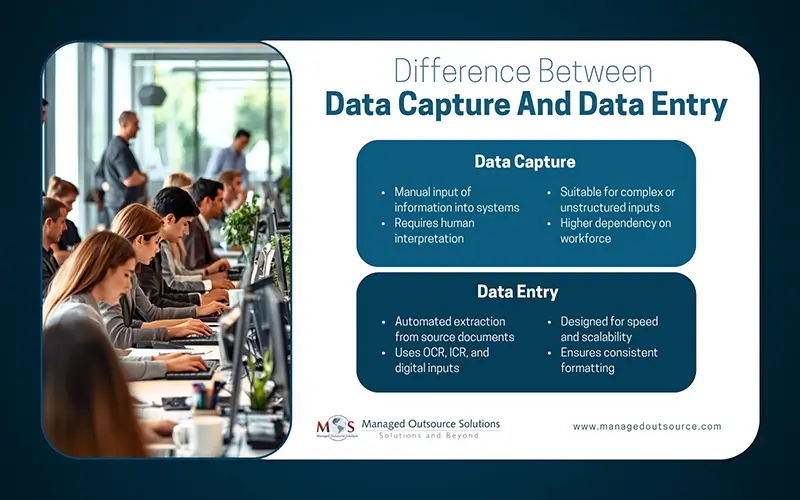
Difference Between Data Capture and Data Entry
The difference between data capture and data entry becomes clearer when examined across key operational dimensions.
- Method of Information Collection
- Entry processes rely on manual input performed by human operators
- Data capture uses automated tools to extract information directly from sources
- Speed and Scalability
- Manual processes scale linearly with workforce size
- Capture technologies process large volumes rapidly without proportional increases in labor
- Accuracy and Consistency
- Human input introduces variability and potential errors
- Automated extraction ensures consistency when systems are properly configured
- Cost Structure
- Manual input incurs ongoing labor costs
- Capture systems require initial investment but reduce long-term operational expenses
- Data Sources
- Data entry works well with complex, ambiguous, or handwritten content
- Data capture excels with structured or semi-structured formats
These differences demonstrate that the two processes serve distinct roles within an information workflow rather than acting as direct substitutes.
Why Organizations Still Use Both Approaches
Despite the advantages of automation, most enterprises use a hybrid approach that combines both methods. This is because real-world information environments include a mix of structured, semi-structured, and unstructured inputs.
For example:
- Automated systems extract information from standardized forms
- Human operators handle exceptions, unclear entries, or validation
Organizations that combine automation with human validation achieve measurable improvements in efficiency and accuracy compared to fully manual workflows.
This approach ensures that businesses maintain accuracy while benefiting from increased speed and scalability.
Common Use Cases Across Industries
Different industries apply these processes based on their operational requirements.
Healthcare
- Patient registration and medical records digitization
- Insurance claims processing
Finance and Banking
- Loan application processing
- Transaction documentation
Retail and E-commerce
- Product catalog updates
- Order processing and invoice management
Logistics
- Shipment tracking and documentation
- Inventory record management
In each of these sectors, organizations balance automation with manual oversight to maintain information integrity.
Challenges Associated with Manual Input Processes
Manual workflows introduce several operational challenges that directly affect performance and decision-making.
Error Propagation
Even minor inaccuracies can multiply across systems, leading to inconsistencies.
Time Constraints
High-volume environments create pressure that reduces accuracy.
Labor Dependency
Scaling operations requires proportional increases in workforce.
Data Silos
Manual processes may not integrate seamlessly with modern digital systems.
According to Experian’s Data Quality Report, 91% of organizations report negative impacts from poor information quality, including inefficiencies and revenue loss.
These challenges reinforce the need for more efficient and reliable approaches.
Challenges in Data Capture Systems
While automated capture offers advantages, it also presents specific limitations.
Quality of Source Documents
Low-resolution scans or poor handwriting reduce extraction accuracy.
Initial Setup Complexity
Systems require configuration, training, and validation.
Edge Case Handling
Unstructured or ambiguous data still requires human intervention.
Integration Requirements
Organizations must ensure compatibility with existing systems.
Despite these challenges, advances in machine learning continue to improve performance and adaptability.
The Role of AI in Transforming Information Processing
Artificial intelligence is reshaping how organizations handle both capture and input processes. Instead of treating them as separate functions, AI integrates extraction, validation, and processing into a unified workflow.
AI-Assisted Extraction
AI models identify and extract relevant fields from documents with higher accuracy than traditional OCR.
AI-Driven Validation
Systems cross-check information against existing databases to detect inconsistencies in real time.
Contextual Understanding
Machine learning models interpret meaning rather than just recognizing characters.
Continuous Improvement
AI systems learn from historical corrections and improve performance over time.
Research by McKinsey shows that organizations are increasingly adopting automation technologies to improve operational efficiency and performance across business processes.
This demonstrates how AI shifts the focus from manual correction to proactive accuracy.
AI Data Entry Services and Their Impact
Modern AI data entry services combine automation with human oversight to create efficient and reliable workflows. These solutions do not replace human involvement entirely; instead, they optimize how tasks are distributed between systems and operators.
Key capabilities include:
- Automated document processing
- Intelligent field recognition
- Real-time validation
- Exception handling workflows
These services reduce manual workload while maintaining high accuracy levels. Organizations that adopt AI-assisted solutions typically experience faster turnaround times and improved consistency across records.
When to Use Data Capture vs. Data Entry
Choosing the right approach depends on several factors.
Use Data Capture When:
- Information is structured or semi-structured
- High volumes require rapid processing
- Standardized formats are available
Use Data Entry When:
- Inputs are handwritten or ambiguous
- Contextual interpretation is required
- Data requires validation before system entry
Most organizations benefit from combining both methods to address diverse input types effectively.
Integration with Modern Enterprise Systems
Modern businesses operate within interconnected digital ecosystems. Information must flow seamlessly between systems such as CRM platforms, ERP solutions, and analytics tools.
Automated capture solutions integrate directly with these systems, ensuring:
- Faster data availability
- Reduced duplication
- Improved consistency across platforms
Manual processes, while valuable, may require additional steps to achieve the same level of integration.
Data Quality as a Strategic Priority
Accurate information serves as the foundation for decision-making, analytics, and regulatory compliance. Organizations that invest in improving input processes gain a competitive advantage.
Key benefits include:
- Reliable reporting and analytics
- Improved customer experience
- Reduced operational costs
- Enhanced compliance with regulations
Gartner estimates that poor data quality costs organizations an average of $12.9 million annually.
This underscores the importance of addressing accuracy at the earliest stage of information processing.
Future Trends in Data Processing
The evolution of technology continues to reshape how organizations manage information.
Increased AI Adoption
More organizations are implementing AI-driven systems to improve efficiency.
Real-Time Processing
Businesses are moving toward immediate validation and processing.
Advanced Document Understanding
Systems are becoming capable of interpreting complex, unstructured documents.
Greater Automation Integration
End-to-end automation is reducing reliance on manual intervention.
These trends indicate a shift toward intelligent, adaptive systems that combine the strengths of both approaches.
Strategic Insights on Data Capture and Data Entry
Understanding the difference between data capture and data entry is essential for organizations seeking to optimize their information workflows. While manual input provides flexibility and human judgment, automated capture delivers speed and consistency. Neither approach operates in isolation; instead, they complement each other within modern processing environments.
AI-driven technologies are redefining how organizations manage these functions by integrating extraction, validation, and processing into cohesive systems. Businesses that adopt these advancements position themselves to improve accuracy, reduce costs, and enhance operational efficiency.
Ultimately, the goal is not to replace one method with another but to implement a balanced strategy that leverages the strengths of both. Organizations that achieve this balance will maintain higher data quality, support better decision-making, and remain competitive in increasingly data-driven markets.
Improve processing accuracy and streamline information flow with AI-driven data capture and data entry solutions.