Organizations today generate large volumes of digital records from websites, transactions, customer interactions, and apps. However, raw information alone does not create business value. Companies must analyze it carefully to discover patterns, trends, and meaningful insights. This is where data mining services play a crucial role.
Businesses across industries rely on advanced analytics to extract actionable intelligence from large information sets. The advantages of using data mining services extend far beyond simple analysis. These services help companies identify customer behavior patterns, boost operational efficiency, enhance marketing strategies, and support strategic planning.
Modern organizations increasingly depend on professional service providers that combine analytics tools, artificial intelligence, and domain expertise to interpret voluminous records. By transforming scattered information into strategic insights, businesses can make informed decisions and remain competitive in today’s economy.
Ready for smarter business insights?
Connect with our data mining specialists now.
Call: (800) 670-2809
Advantages of Using Data Mining Services
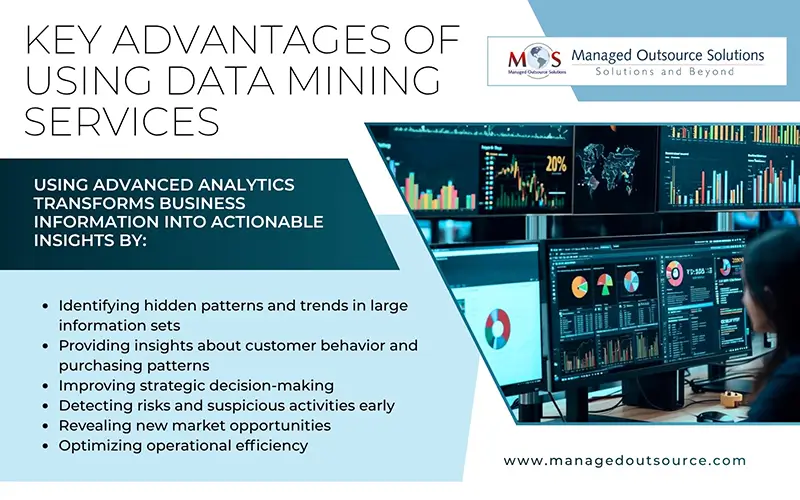
Analytical techniques help uncover hidden relationships, patterns, and correlations within extensive records. Firms seeking maximum value from their records should understand how data mining services can improve their operational efficiency:
Improved Decision-Making
Strategic decision-making ranks among data mining services’ top benefits. By examining historical records and real-time information, teams can identify trends that guide planning and business strategy.
For example:
- Companies can forecast demand using predictive models
- Marketing teams can identify high-value customer segments
- Financial institutions can detect suspicious transactions
These insights allow businesses to reduce uncertainty and base decisions on reliable evidence rather than assumptions. Organizations that embrace data-driven decision making achieve better results and performance.
Enhanced Customer Insights
Teams need to understand customer behavior through purchasing patterns, browsing habits, and demographics for sustainable growth. Analytics tools make this possible by enabling companies to:
- Identify customer preferences
- Segment audiences more accurately
- Create targeted marketing campaigns
- Improve customer engagement
By examining behavioral patterns, businesses can personalize products and services to match user needs, boosting customer satisfaction, retention, and brand loyalty.
Operational Efficiency
Many organizations struggle with inefficiencies in workflows and business processes. Analytical tools help evaluate operational records to identify bottlenecks, redundancies, and resource wastage.
Key improvements include:
- Streamlining supply chain operations
- Optimizing inventory management
- Reducing operational costs
- Improving resource allocation
Leveraging predictive analytics for business growth helps companies anticipate future trends and adjust their operations accordingly. This proactive approach boosts productivity and overall efficiency.
Risk Detection and Fraud Prevention
Risk management is a major concern for financial institutions, e-commerce platforms, and insurance providers. Analytical tools help identify unusual patterns or anomalies in voluminous records.
Examples include:
- Identifying fraudulent credit card transactions
- Detecting cybersecurity threats
- Monitoring unusual financial activities
- Preventing identity theft
Early detection of suspicious patterns enables organizations to take preventive measures before significant losses occur.
Identification of Market Opportunities
Businesses operate in constantly evolving markets. By analyzing customer behavior, competitor activities, and industry trends, firms can uncover new opportunities for growth. They can:
- Identify emerging customer demands
- Launch innovative products based on insights
- Enter untapped market segments
- Optimize pricing strategies
These insights provide companies with a strong competitive advantage in dynamic markets.
Key Business Benefits of Data Mining
Beyond basic advantages, data mining services deliver broader strategic benefits that support sustainable growth and innovation.
Better Marketing Strategies
Analytical techniques help businesses understand customer journeys across multiple online channels. By analyzing metrics such as website traffic, conversion rates, and audience demographics, businesses can:
- Understand customer behavior, preferences, and engagement patterns
- Identify what strategies are working and what needs improvement
- Refine targeting, personalize messaging, optimize budgets, and make data-driven decisions
Data-driven decision making ultimately leads to more effective and higher-performing marketing campaigns.
Accurate Sales Forecasting
Sales forecasting is essential for inventory planning, budgeting, and long-term strategy. Analytical tools examine historical records to predict future demand patterns. Benefits include:
- Reduced inventory shortages
- Improved demand planning
- Better production scheduling
- More accurate revenue projections
Organizations that implement predictive analytics for business growth gain valuable foresight that supports long-term planning and stability.
Competitive Advantage
Companies that effectively analyze their records gain insights that competitors may overlook. Data mining services allow companies to better understand market dynamics, customer expectations, and product performance. This knowledge helps businesses:
- Develop innovative strategies
- Improve product offerings
- Enhance customer experiences
- Respond quickly to market changes
The ability to convert complex information into meaningful insights becomes a key differentiator in competitive industries.
Applications of Data Mining Across Industries
The influence of analytical technologies extends across numerous sectors. Different industries use these techniques to solve specific challenges and uncover valuable insights.
Retail and E-commerce
Retail businesses rely on analytics to understand consumer behavior and optimize sales strategies. Common applications include:
- Product recommendation systems
- Customer segmentation
- Price optimization
- Demand forecasting
These insights help retailers increase revenue while delivering personalized shopping experiences.
Healthcare
Healthcare organizations analyze patient records, treatment outcomes, and medical histories to improve clinical decisions. Applications include:
- Predicting disease outbreaks
- Identifying high-risk patients
- Supporting medical research
- Improving hospital resource planning
These insights help healthcare providers enhance patient care and operational efficiency.
Finance and Banking
Financial institutions examine transaction records to detect fraud, assess credit risk, and manage investments. Examples include:
- Fraud detection systems
- Credit risk assessment
- Customer profitability analysis
- Investment trend forecasting
Marketing and Advertising
Marketing professionals rely heavily on data mining to understand audience sentiment and engagement patterns by:
- Evaluating interactions on social platforms
- Identifying trending topics and consumer interests
- Measuring campaign effectiveness
Similarly, LinkedIn data mining allows teams to gather insights about professional networks, recruitment trends, and B2B marketing opportunities.
Types of Data Mining
Organizations apply different analytical techniques depending on the nature of the information being examined and the insights required.
Text Mining
Text mining extracts insights from unstructured content sources such as customer reviews, emails, and documents.
It helps organizations:
- Analyze customer feedback
- Monitor brand reputation
- Identify product improvement opportunities
Image Data Mining
Analyzing visual content can extract meaningful insights. Image data mining uses advanced algorithms to interpret images and detect patterns.
Applications include:
- Medical image analysis
- Facial recognition technology
- Retail product recognition
- Security monitoring systems
Spreadsheet-Based Analysis
Many businesses rely on spreadsheet to manage and analyze structured information. Firms use Excel data mining to perform statistical analysis, pattern identification, and predictive modeling in spreadsheets.
Companies combine spreadsheet-based techniques with advanced analytics tools to extract deeper insights from their business records.
Why Businesses Outsource Data Mining
Although many organizations see analytics’ value, they struggle to implement advanced analytical solutions internally. Businesses outsource data mining services to professionals for several reasons.
Access to Expertise
Analytical processes require expertise in statistics, machine learning, and information management. Outsourcing allows organizations to access experienced professionals without building large internal teams. Specialists bring cross-industry experience, allowing them to apply proven analytical techniques to different business challenges. Their exposure to diverse projects also helps them identify patterns and opportunities that internal teams may overlook. This level of expertise helps organizations implement analytical initiatives more efficiently and with greater confidence.
Advanced Technology
Professional service providers use sophisticated analytics platforms and automation tools that enable faster and more accurate analysis of records. These organizations typically invest heavily in modern analytical software and infrastructure to stay competitive. As a result, businesses can benefit from advanced capabilities without purchasing expensive tools themselves. Access to cutting-edge technology also enables faster processing and more reliable insights.
Cost Efficiency
Building an internal analytics infrastructure requires significant investment in technology and skilled personnel. Outsourcing helps organizations reduce operational costs while benefiting from high-quality analytical solutions. Instead of maintaining full-time specialists and expensive systems, companies can allocate resources more strategically. This approach allows organizations to focus their budgets on core business activities while still benefiting from professional analytical support.
Scalability
As business information grows rapidly, organizations need scalable solutions to manage and analyze large volumes efficiently. Outsourced service providers offer flexible capabilities that adapt to changing business requirements. Companies can increase or reduce analytical support depending on project size or seasonal demand. This flexibility allows organizations to respond quickly to new opportunities and evolving market conditions without major internal restructuring.
Future Trends
The field of analytics continues to evolve as emerging technologies reshape how organizations extract insights from information.
- Artificial Intelligence Integration
- Big Data Analytics
- Cloud-Based Analytics
- Real-Time Insights
- Turning Insights into Business Growth
Artificial intelligence and machine learning algorithms are improving the accuracy and speed of modern analytics processes. Automated systems can identify patterns and correlations much faster than traditional methods.
Organizations now process information from multiple sources, including IoT devices, social platforms, and digital applications. Advanced analytics platforms help companies interpret these complex records efficiently.
Cloud computing platforms provide scalable infrastructure for storing and analyzing massive information sets. This allows organizations to access powerful analytical tools without heavy infrastructure investments.
Modern analytics solutions allow companies to analyze streaming information instantly. This capability enables faster decision-making and more responsive business strategies.
Modern analytical techniques help companies to evaluate information from a wide range of digital sources such as social platforms, professional networks, visual content, and structured business records. By examining these diverse information streams together, organizations gain a more comprehensive understanding of customer behavior, market dynamics, and operational performance.
As technology continues to evolve, analytics will play an even greater role in shaping business strategy. Organizations that adopt insight-driven decision processes respond faster to market changes and spot new opportunities. Likewise, businesses that integrate advanced forecasting and analytical capabilities into their strategies create innovative strategies and achieve sustainable growth in an increasingly information-driven economy.