
In today’s rapidly evolving financial landscape, organizations face constant pressure to improve efficiency, maintain compliance, and reduce operational costs. Finance and accounting teams handle massive volumes of documents—from invoices and purchase orders to bank statements, tax forms, and audit records.
This is where intelligent document processing in finance is transforming operations.
By combining artificial intelligence (AI), machine learning (ML), optical character recognition (OCR), and advanced data analytics, Intelligent Document Processing (IDP) enables businesses to automate document-heavy workflows with speed and precision. It plays a central role in workflow automation and drives measurable improvements in financial performance.
What Is Intelligent Document Processing in Finance?
Intelligent Document Processing (IDP) uses AI, ML, and OCR to extract, validate, and process data from financial documents — reducing manual effort, improving accuracy, and accelerating workflows.
Understanding Intelligent Document Processing
Back office automation for accounting teams has historically lagged behind other departments. However, IDP is changing that.
IDP uses AI, ML, and OCR to process structured, semi-structured, and unstructured documents—extracting relevant data and sending it to downstream systems for further processing. These systems don’t just read documents—they understand context, identify key data points, and convert them into actionable information.
For finance and accounting teams, this enables:
- Automated invoice processing
- Real-time data extraction from receipts and statements
- Accurate reconciliation of financial records
- Faster month-end closing
- Improved compliance documentation
With increasing document complexity and regulatory requirements, AI-powered document automation is no longer optional – it is a strategic necessity.
Benefits of Intelligent Document Processing in Accounting
Organizations adopting IDP experience measurable operational and financial gains:
- Increased Efficiency: Reduces manual document handling time by up to 70–80%
- Cost Reduction: Minimizes labor costs, errors, and rework
- Improved Compliance: Maintains audit trails for traceability and security
- Enhanced Data Accuracy: Ensures consistent, validated data capture
- Faster Decision-making: Provides real-time access to financial data
- Scalability: Handles growing document volumes without added staffing
- Better Productivity: Frees teams for high-value tasks like financial analysis
Top Ways Intelligent Document Processing Improves Finance and Accounting Operations
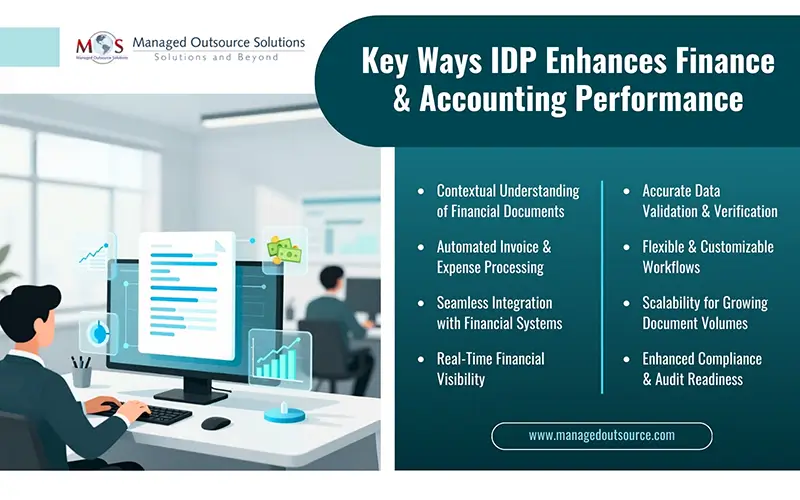
Here are the top ways intelligent document processing improves finance and accounting operations:
- Contextual Understanding of Accounting Documents: Unlike traditional systems, IDP interprets document context—not just text.
- Accurate Data Validation and Verification: IDP reduces financial risk through built-in validation mechanisms.
- Flexible and Customizable Document Workflows: Accounting workflows vary across document types and organizations.
- Smooth Integration with Accounting and Business Systems: Modern IDP platforms integrate seamlessly with ERP, CRM, and financial reporting systems.
- Scalability to Handle Growing Document Volumes: As document volumes increase, manual processes become unsustainable.
- Real-time Data Extraction and Financial Visibility: Timely access to financial data is critical.
- Enhanced Analytics and Decision Support: Beyond automation, IDP provides actionable insights.
It identifies document types, extracts meaningful fields, and distinguishes between similar data points (e.g. due date vs. issue date). This eliminates manual sorting and enables accurate classification of structured and unstructured documents.
It cross-checks extracted data against ERP systems, purchase orders, vendor contracts, and payment terms—ensuring accuracy before processing continues. This minimizes errors that could impact payments or compliance.
IDP systems adapt easily to different formats and requirements, enabling teams to automate diverse processes without heavy customization or development effort.
API-based integrations ensure validated data flows directly into downstream systems, eliminating duplication and improving workflow efficiency while maintaining real-time synchronization.
IDP platforms scale effortlessly, processing thousands of documents consistently without fatigue. This enables organizations to grow without proportionally increasing operational costs.
IDP enables real-time extraction of key data, supporting budgeting, cash flow analysis, and performance tracking with up-to-date insights.
Structured data enables advanced analytics, helping teams identify trends, detect anomalies, and monitor vendor performance—without manual aggregation.
Common Use Cases of IDP in Finance
Intelligent document processing is widely used across financial operations:
- Invoice processing and accounts payable automation
- Expense and receipt management
- Bank statement reconciliation
- Tax document processing
- Audit and compliance documentation
The Future of Intelligent Document Processing in Finance
As AI continues to evolve, IDP is becoming more intelligent and adaptive:
- AI models with deeper contextual understanding
- Integration of predictive analytics for financial forecasting
- Seamless connectivity across financial ecosystems
- Continuous learning systems that improve accuracy over time
Organizations adopting IDP today are building future-ready finance functions.
IDP Redefines Document-intensive Workflow Management
Intelligent document processing in finance is redefining how organizations manage document-intensive workflows. Through workflow automation, AI-powered document automation, and accounting process automation, businesses achieve:
- Higher accuracy
- Faster processing
- Reduced costs
- Improved compliance
More importantly, IDP enables finance teams to move beyond administrative tasks and become strategic contributors to business growth.
As document volumes rise and compliance requirements grow more complex, adopting intelligent document processing is no longer just a competitive advantage—it is essential for long-term transformation.
Transform your finance department with AI-powered document automation.