
Supply chain organizations face ever-increasing volumes of documents — from invoices and purchase orders to bills of lading and customs forms. Traditionally, managing this influx has relied heavily on manual work, a bottleneck that slows down operations, increases costs, and introduces errors. However, with the use of intelligent document processing in supply chain environments, companies now have a powerful tool to transform document handling, streamline processes, and unlock new levels of operational efficiency.
At its core, intelligent document processing (IDP) refers to a category of automation technology that combines artificial intelligence (AI), machine learning (ML), optical character recognition (OCR), and natural language processing (NLP) to extract, validate, and integrate data from documents without requiring manual input. When applied to supply chain operations, IDP revolutionizes how information flows — enhancing accuracy, accelerating decision-making, and supporting seamless workflow automation across systems.
Transform your supply chain performance with our AI-powered document automation.
The Rise of AI-powered Document Processing in Modern Supply Chains
Supply chains are inherently document-intensive. Every link in the chain — from procurement and order fulfillment to shipping and finance — generates and relies on paperwork. If unmanaged, this paper trail can lead to delays, miscommunication, and costly errors. Traditional systems depend on rule-based automation or manual entry, which struggle with unstructured or semi-structured documents and can’t scale as supply chains grow in complexity. This is where AI-powered document processing and supply chain document automation step in.
Unlike legacy approaches, an IDP system doesn’t just convert a scanned image into text. It understands context, recognizes patterns, categorizes information, and routes data to the right systems in real time. By applying AI and machine learning, modern IDP platforms can process diverse document types — even those with varying layouts — without requiring custom templates for each. These capabilities make IDP not just a data-entry tool, but a strategic enabler of workflow automation, helping organizations achieve faster processing cycles, improved accuracy, and true end-to-end supply chain document automation.
Key Benefits of IDP for Supply Chain Efficiency
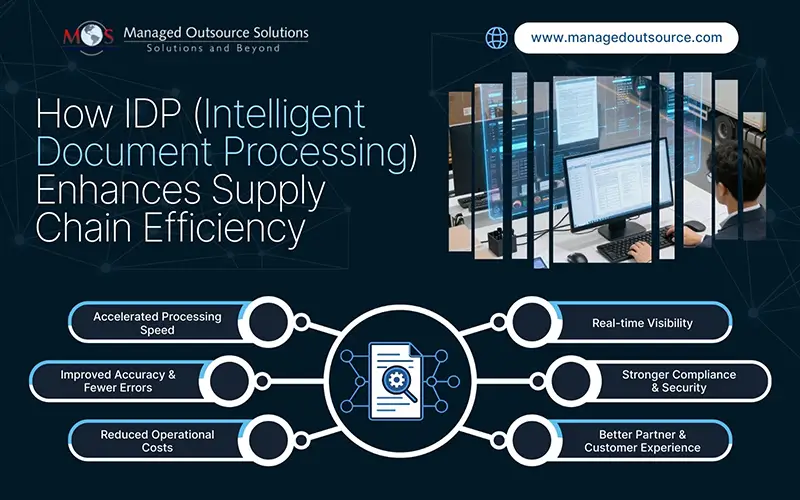
Here are the most impactful benefits of IDP for supply chain efficiency:
- Speed and Time Savings: Manual document review is slow and repetitive. IDP platforms accelerate document processing times by automating every step — from ingestion and classification to data extraction and validation. Instead of spending hours entering invoice data or checking shipping manifests, teams can have structured, accurate data in minutes.
- Improved Accuracy and Fewer Errors: AI-driven extraction and validation significantly reduce errors that may arise from manual data entry. This means fewer disputes with suppliers, more accurate financial records, and smoother fulfillment cycles. With built-in quality checks, IDP catches anomalies and inconsistencies before they enter core systems like ERPs.
- Cost Reduction: By reducing manual labor and increasing processing speeds, companies can cut operational costs. Less time spent on low-value tasks means staff can focus on strategic efforts like planning and optimization, which further boosts supply chain agility.
- Real-time Visibility: One of the most transformative aspects of IDP is that it turns static documents into real-time data streams. Leaders can gain instant insights into inventory levels, shipment statuses, and bottlenecks — enabling quicker decision-making and improved responsiveness across global operations.
- Seamless Compliance and Security: Supply chains must adhere to regulatory standards and maintain accurate records for audits. AI-powered systems automatically store document metadata, maintain audit trails, and ensure sensitive information is protected — all while supporting compliance frameworks.
- Enhanced Partner and Customer Experience: For companies with external stakeholders, delayed or inaccurate documentation can strain relationships. With automated workflows and quicker turnaround times, organizations can deliver faster order fulfillment and more reliable partner communications, improving overall experience and trust.
Practical Applications: Where IDP Makes a Difference
The real power of intelligent document processing in supply chain operations lies in how it touches everyday processes:
- Invoice Management: Invoices are one of the most cumbersome documents to process manually. IDP automatically captures key fields like invoice numbers, dates, line-item details and totals, and routes data into finance systems for approval and payment processing.
- Purchase Orders and Order Management: Purchase orders vary in format across vendors and regions. IDP can interpret and standardize this information to synchronize order data with inventory and fulfillment systems without human intervention.
- Shipping and Logistics Documentation: Complex logistics paperwork — such as bills of lading, packing lists, and customs forms — can delay international shipments if not processed correctly. IDP captures and validates this data, helping ensure timely customs clearance and delivery.
- Analytics and Continuous Improvement: Beyond basic extraction, IDP analytics tools enable companies to monitor processing performance, identify recurring bottlenecks, and refine automation rules — helping supply chains become truly adaptive and data-driven.
Leveraging IDP for Supply Chain: A Roadmap for Success
If your organization is ready to take advantage of IDP’s potential, here are strategic steps to ensure success:
- Assess Document Workflows: Begin by identifying where document-heavy processes slow down operations, such as invoices, purchase orders, or shipping documents. Mapping these workflows helps pinpoint automation opportunities that will deliver the highest impact.
- Invest in AI-ready Platforms: Choose an intelligent document processing solution that uses machine learning and adapts to multiple document formats. A scalable, AI-powered document processing platform ensures long-term efficiency without constant manual rule updates.
- Integrate with Core Systems: Ensure your IDP solution integrates seamlessly with ERP, WMS, TMS, or accounting systems. This enables smooth workflow automation and real-time data transfer across your supply chain ecosystem.
- Monitor and Optimize: Track key performance indicators such as processing time, error rates, and cost savings. Continuous monitoring helps refine automation strategies and maximize the benefits of IDP for supply chain efficiency.
- Train and Empower Teams: Provide training so employees can manage exceptions and interpret automated insights effectively. Empowered teams can leverage IDP for your supply chain strategically rather than relying solely on automation.
The modern supply chain cannot afford to be slowed down by traditional document bottlenecks. By combining AI-powered document processing, workflow automation, and real-time data integration, IDP in supply chain operations dramatically improves efficiency, accuracy, and responsiveness. IDP reduces manual work, minimizes errors, and unlocks actionable insights, and thereby enhances operational performance as well as competitive advantage in a fast-evolving global market.