
Insurance underwriting depends heavily on accurate, timely, and well-structured information. Yet many organizations still struggle with fragmented intake processes, inconsistent record handling, and manual intervention that slows decision cycles. These inefficiencies become more pronounced as submission volumes increase and regulatory expectations tighten. In this context, how to minimize data entry hassles in insurance underwriting is a major consideration. As a result, AI data entry is increasingly being evaluated as a structured approach to reduce manual dependency and improve processing consistency.
Modern underwriting teams must evaluate not only how information is collected but also how it is validated, standardized, and integrated into decision systems. As digital transformation accelerates, traditional manual-heavy workflows are being reassessed in favor of more structured, technology-enabled approaches that reduce friction and improve consistency across the lifecycle of policy evaluation.
Operational Burden of Manual Intake in Underwriting Workflows
Underwriting operations traditionally depend on manual review and transcription of policy applications, supporting documents, and risk disclosures. While this approach provides human judgment at the point of entry, it introduces several operational constraints that directly affect performance.
Manual intake processes typically involve:
- Interpretation of unstructured forms submitted in varied formats
- Re-entry of information into core systems
- Validation against external or internal reference sources
- Reconciliation of inconsistencies across documents
These steps increase turnaround time and introduce variability in output quality. Research from IBM indicates that poor-quality information costs organizations in the United States an estimated $5 million annually, largely due to inefficiencies in correction and reprocessing workflows.
For underwriting teams, this translates into slower policy issuance cycles, higher operational overhead, and increased reliance on rework. Addressing these inefficiencies is essential for organizations aiming to minimize data entry hassles in insurance underwriting while maintaining compliance and accuracy standards.
Key Sources of Inefficiency in Information Handling
The complexity of underwriting environments introduces multiple points where inefficiencies emerge. These are not limited to manual typing but extend to broader structural issues in how information flows through systems.
Common inefficiency drivers include:
- Fragmented submission channels: Applications arriving via email, portals, and physical documents create inconsistent formatting.
- Unstandardized documentation: Variations in application forms increase interpretation time.
- Duplicate record handling: Multiple entries of the same applicant data across systems.
- Limited validation at intake stage: Errors detected late in the process require rework.
- Dependency on legacy systems: Older platforms lack seamless integration with modern ingestion tools.
Each of these factors contributes to extended cycle times and reduces operational predictability. Over time, these inefficiencies accumulate, impacting both customer experience and internal resource allocation.
Role of Structured Workflow Design in Reducing Processing Friction
A systematic approach to workflow design plays a central role in reducing friction across underwriting operations. Instead of treating intake as a standalone activity, high-performing organizations integrate it into a continuous information pipeline.
Key elements of structured workflow design include:
- Standardized intake templates across all submission channels
- Automated validation rules at entry points
- Centralized repositories for unified record access
- Clear separation between verification and decision-making stages
- Defined exception handling protocols
This structure reduces dependency on repetitive manual intervention and improves consistency in downstream decision processes. It also enables underwriting teams to focus more on risk evaluation rather than administrative correction tasks.
AI-driven Transformation of Intake and Processing Systems
Artificial intelligence has introduced a significant shift in how underwriting-related information is processed. Instead of relying solely on manual transcription or static rule-based systems, organizations are adopting intelligent models that interpret, classify, and validate information in real time.
An AI-assisted approach improves intake efficiency through several mechanisms:
- Extraction of structured fields from unstructured documents
- Recognition of contextual relationships between data points
- Automated flagging of inconsistencies or missing fields
- Continuous learning from correction patterns
A practical example is the adoption of intelligent document processing systems, which combine machine learning with optical recognition technologies to reduce manual intervention.
In enterprise environments, AI data entry is increasingly being used to automate repetitive transcription tasks while maintaining human oversight for exception handling. This hybrid approach reduces operational burden while preserving accuracy in complex scenarios.
McKinsey research highlights that automation technologies can reduce processing time in back-office operations by up to 60% in certain workflows.
These advancements demonstrate how AI is reshaping intake systems from reactive correction models to proactive validation frameworks.
Reducing Dependency through External Processing Models
Organizations seeking to improve operational efficiency also evaluate external support models to manage high-volume intake workloads. One such approach is data entry outsourcing, where specialized providers handle structured information processing under defined quality frameworks.
This model is typically adopted when organizations face:
- Seasonal spikes in application volume
- Resource constraints in internal teams
- Requirements for rapid scaling without infrastructure expansion
Outsourced processing functions are generally governed by strict accuracy benchmarks, audit trails, and service-level agreements. While not a replacement for internal governance, this approach supports workload distribution and helps stabilize processing timelines during peak demand periods.
Hybrid Intelligence: Combining Automation and Human Review
No single system fully replaces the need for human oversight in underwriting environments. Instead, organizations are moving toward hybrid intelligence models where automation and human review operate in complementary roles.
In this model:
- Automated systems handle extraction and initial classification
- Human reviewers focus on exception handling and contextual validation
- Systems continuously learn from corrections to improve future accuracy
This structure improves both scalability and reliability. It also ensures that complex or ambiguous cases receive appropriate attention without slowing down routine processing.
The balance between automation and human judgment is particularly important in regulated environments where compliance and auditability remain critical.
Impact on Decision Speed and Operational Efficiency
Reducing friction in intake processes has a direct effect on underwriting performance metrics. Faster and more accurate information handling contributes to:
- Shorter policy issuance cycles
- Reduced backlog in submission queues
- Improved risk assessment consistency
- Lower operational cost per application
Organizations that modernize intake systems typically report improved throughput without proportional increases in staffing. This shift is especially relevant in competitive markets where speed of response influences customer acquisition and retention.
Strategic Considerations for System Modernization
Modernizing intake and processing systems requires more than technology adoption. It demands a structured evaluation of workflows, integration points, and governance models.
Key considerations include:
- Compatibility with existing underwriting platforms
- Scalability across multiple product lines
- Data governance and audit requirements
- Change management for operational teams
- Long-term maintenance and model retraining needs
Organizations that approach modernization strategically achieve more sustainable improvements compared to those implementing isolated tools without process alignment.
Future Direction of Underwriting Information Management
The future of underwriting information processing is moving toward fully integrated, adaptive ecosystems. These systems combine automation, AI-driven interpretation, and real-time validation to minimize manual intervention while maintaining high accuracy standards.
Emerging trends include:
- Greater use of predictive models for risk pre-assessment
- Real-time document validation at the point of submission
- Expansion of end-to-end digital intake pipelines
- Continuous optimization through machine learning feedback loops
These developments indicate a long-term shift away from fragmented intake processes toward unified, intelligence-driven systems.
Strengthening Governance and Compliance in Automated Intake Systems
As underwriting operations transition toward automation and AI-supported frameworks, governance becomes a central requirement rather than a secondary consideration. While speed and efficiency improve significantly through digital systems, regulatory accountability and audit readiness remain non-negotiable in financial risk assessment environments.
Modern intake systems must therefore incorporate governance controls directly into their design rather than treating compliance as a post-processing function. This shift ensures that every stage of information handling remains traceable, verifiable, and aligned with regulatory expectations.
Key governance elements in automated intake environments include:
- Audit trails for every transaction
Each modification, extraction, or correction must be recorded with timestamps and user or system identifiers. This ensures transparency during internal or external audits.
- Rule-based validation frameworks
Structured validation rules help enforce consistency across incoming submissions, reducing discrepancies before they enter underwriting evaluation stages.
- Role-based access controls
Limiting system access based on defined roles reduces the risk of unauthorized modifications and strengthens internal accountability.
- Version control for submitted documents
Maintaining structured version histories ensures that underwriters and auditors can track changes across submission cycles.
- Compliance mapping within workflows
Regulatory requirements should be embedded directly into intake and verification processes rather than managed externally.
According to a Deloitte report on digital transformation in financial services, organizations that embed compliance into automated workflows reduce audit preparation time by nearly 30%, improving both efficiency and regulatory responsiveness.
When governance is integrated into system architecture, automation does not compromise oversight. Instead, it strengthens operational discipline while maintaining scalability.
This layer of structured control becomes essential as organizations scale intake automation across multiple product lines and jurisdictions. It ensures that efficiency gains do not introduce regulatory exposure or inconsistencies in risk evaluation processes.
Building Efficient, Scalable Underwriting Operations
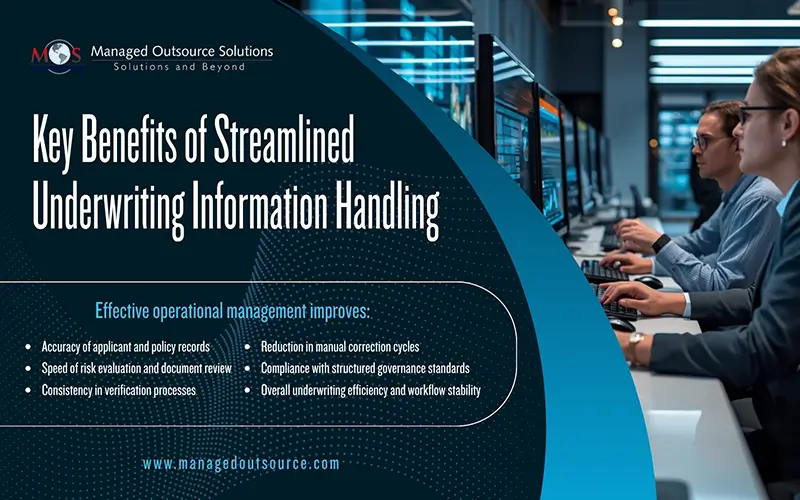
The challenge to minimize data entry hassles in insurance underwriting is fundamentally about improving how information flows, is validated, and is transformed into actionable insight. Manual-heavy approaches continue to create delays and inconsistencies, while modern systems emphasize structured intake, intelligent automation, and hybrid processing models.
AI-enabled technologies, structured workflow design, and selective external support mechanisms such as data entry outsourcing collectively reshape operational efficiency. Organizations that align these elements create faster, more reliable underwriting environments that support both scalability and accuracy.
Discover how intelligent automation in underwriting workflows can reduce manual effort, improve accuracy, and strengthen decision-making speed.
Contact us!