
Managing information has become a critical part of modern real estate operations. Property firms, brokers, and investors now manage massive volumes of data ranging from listing details and client records to transaction documents and market analytics. This growing volume of information now creates a major operational challenge. As a result, many organizations increasingly rely on outsourcing partners to maintain accurate and organized property records.
Technological innovation, automation, and advanced analytics are shaping the future of real estate data entry outsourcing. Companies are no longer outsourcing solely for cost savings. Instead, they seek strategic partnerships that provide scalable expertise, improved information accuracy, and access to new technologies such as AI data entry tools and cloud-based platforms. These developments reshape how a data entry company delivers value to real estate firms.
Streamline Real Estate Data Entry.
Partner with outsourcing experts for accuracy and speed.
Call: (800) 670-2809
Future of Real Estate Data Entry Outsourcing: Key Industry Trends
The growth of outsourced real estate data entry solutions depends on how service providers integrate emerging technologies with skilled human expertise. Experts expect data entry companies to play a key role in helping property dealers manage business information, maintain structured, easily accessible records, and streamline workflows.
Several trends influence how real estate data entry services operate and deliver value.
Growing Volume of Property Information
Real estate businesses now generate large volumes of information every day. Listings, asset descriptions, transaction documents, rental records, and customer interactions all produce records that teams must process and store. At the same time, digital transformation across the property sector has increased the complexity of information management. Companies must maintain structured databases, integrate third-party platforms, and ensure accuracy across multiple channels.
Key sources of information include:
- Property listing platforms
- Customer relationship management systems
- Online property portals
- Property valuation reports
- Market analytics and demographic insights
Managing such extensive information internally takes significant time and resources. Outsourcing allows companies to process these records efficiently while maintaining high standards of accuracy.
Increasing Adoption of Artificial Intelligence
Artificial intelligence drives major transformation in the property sector. Most companies now use AI-powered tools to analyze market trends, automate administrative tasks, and improve operational efficiency. Studies show that around 80% of property agents use AI tools in their daily operations, and many firms are developing AI strategies to improve productivity.
The global AI market in real estate is expanding rapidly, with analysts projecting it to reach $41 billion by 2033. This growth highlights automation’s rising role in property management and analytics.
Within outsourcing services, AI data entry technologies help automate repetitive tasks such as:
- Extracting property information from documents
- Updating listing databases
- Processing transaction records
- Categorizing property images and descriptions
- Verifying structured datasets
However, human expertise remains essential for validating complex information and ensuring quality. As a result, many outsourcing providers combine AI tools with trained professionals to deliver reliable information processing services.
Rising Demand for Property Data Management Services
Another significant trend shaping the outsourcing landscape is the increasing need for property data management services. Property firms rely on accurate and well-structured information to make investment decisions, manage portfolios, and track market conditions.
Organizations now analyze multiple types of insights, including:
- Property price trends
- Rental yield statistics
- Demographic indicators
- Local infrastructure developments
- Market demand patterns
Digital transformation has intensified this demand. For example, many large firms are upgrading their information infrastructure to support real-time analytics and advanced reporting capabilities.
Outsourcing partners help manage these large datasets by:
- Structuring property databases
- Standardizing listing information
- Maintaining updated records
- Supporting information migration and integration
These services allow businesses to focus on strategic activities such as investment planning and customer engagement.
Growth of Automation and Robotic Process Automation
Automation technologies boost operational efficiency in real estate. Robotic Process Automation (RPA) tools can handle repetitive administrative tasks that previously required manual effort. Examples of automated workflows include:
- Lease documentation processing
- Tenant record updates
- Property listing uploads
- Rental payment record management
- Property inspection reporting
Automation can eliminate up to 60% of manual work in some property management processes, significantly reducing time and operational costs. When combined with outsourcing, automation creates highly efficient workflows. A professional data entry company can integrate automated systems with skilled operators to ensure accuracy and consistency across large information sets.
Expansion of PropTech Ecosystems
Property technology, commonly known as PropTech, drives powerful change in reshaping the real estate sector. PropTech platforms use digital tools, analytics, and automation to improve property transactions and management. Investment in PropTech startups continues to grow, reflecting strong demand for technology-driven solutions. Key technologies influencing property information management include:
- AI-powered valuation tools
- Virtual property tours
- Predictive analytics platforms
- Smart building monitoring systems
- Blockchain-based property records
These platforms generate large volumes of structured and unstructured information. Outsourcing services help firms manage these records effectively, ensuring that property databases remain accurate and up to date.
Increasing Importance of Real Estate Back Office Support
Administrative operations play a major role in asset management and brokerage activities. Tasks such as updating listings, maintaining client records, and processing documents require careful attention to detail. However, property managers spend a significant portion of their time handling administrative responsibilities instead of focusing on business growth.
Outsourcing providers now offer specialized real estate back office support, which includes:
- Listing entry and updates
- Document digitization
- Property database management
- CRM record maintenance
- Lease and transaction processing
By delegating these tasks to external specialists, property firms can improve operational efficiency and focus on customer relationships and strategic planning.
Increased Focus on Accuracy and Compliance
Property transactions, financial reporting, and regulatory compliance all require accuracy. Errors in listing information or transaction records can lead to serious operational and legal issues. Many organizations also face challenges related to information quality. In fact, accuracy remains one of the biggest obstacles for companies adopting analytics in the property sector.
Outsourcing providers address these challenges through structured processes such as:
- Multi-level validation
- Standardized entry formats
- Automated quality checks
- Regular database audits
These measures help ensure that property records remain reliable and compliant with regulatory requirements.
Growing Adoption of Cloud-Based Platforms
Cloud technology is transforming how companies manage information. Cloud platforms enable organizations to store, access, and share records from any location.
Cloud-based systems offer several advantages:
- Centralized property databases
- Real-time access to information
- Improved collaboration across teams
- Scalable storage capacity
- Enhanced security and backup capabilities
For outsourcing providers, cloud platforms enable seamless collaboration with clients. Entry teams can update property records in real time while maintaining strict security standards.
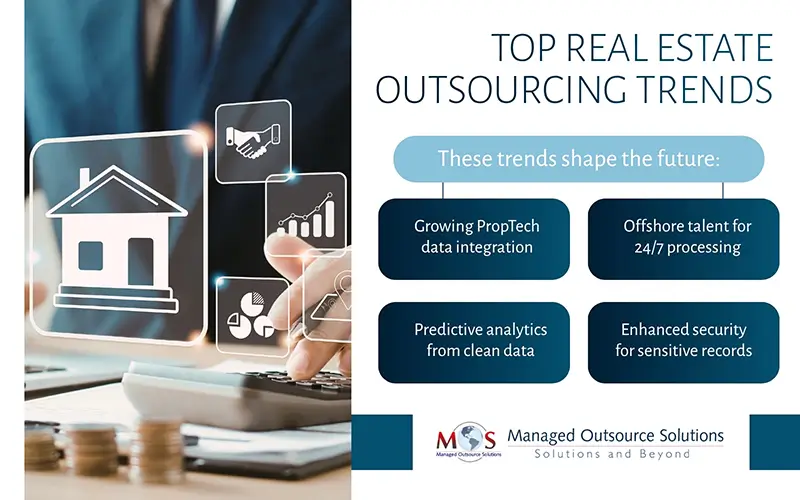
Offshore Outsourcing and Global Talent Access
Global outsourcing has become an important strategy for companies seeking specialized skills and cost-efficient operations. Offshore teams provide access to trained professionals who can handle large volumes of information efficiently.
Outsourcing models offer several advantages:
- Reduced operational costs
- Access to skilled professionals
- Round-the-clock processing capabilities
- Faster turnaround times
Industry reports indicate that offshore staffing can reduce back-office costs by 30% to 50% while improving workflow efficiency. As property businesses expand globally, outsourcing providers play a crucial role in maintaining standardized information processes across multiple markets.
Integration of Predictive Analytics
Predictive analytics is another trend shaping outsourced real estate data entry operations. By analyzing historical records and market trends, analytics tools can help investors and developers identify profitable opportunities.
Artificial intelligence algorithms can analyze factors such as:
- Property price fluctuations
- Neighborhood development trends
- Rental demand patterns
- Economic indicators
These insights enable companies to make more informed investment decisions and reduce financial risks.
Predictive analytics platforms rely heavily on structured information. Accurate databases created through real estate data entry services ensure that analytical models produce reliable results.
Security and Privacy Considerations
As property firms digitize their operations, information security has become a major concern. Property records contain sensitive financial information, personal details, and transaction documents.
Outsourcing providers must therefore implement strong security measures, including:
- Encrypted information transfer systems
- Secure cloud storage environments
- Access control protocols
- Compliance with privacy regulations
These measures help protect client records while maintaining trust in outsourced services.
How Outsourcing Providers Are Evolving
To remain competitive, outsourcing providers are expanding their capabilities beyond traditional entry services. Modern companies offer comprehensive information management solutions that integrate technology and human expertise.
Advanced outsourcing solutions may include:
- AI-assisted processing
- Intelligent document recognition
- Property analytics support
- Integration with property CRM platforms
- Customized reporting and dashboards
These capabilities demonstrate how outsourcing companies support property firms seeking scalable solutions for managing large volumes of data in real estate operations. As technology continues to evolve, such support will play a key role in helping organizations adapt to digital transformation.
The Strategic Value of Outsourcing Real Estate Data Entry
Outsourcing real estate data entry is becoming an increasingly valuable strategy for property firms by ensuring accurate, well-structured information to support decision-making, investment planning, and customer engagement. Outsourcing provides the expertise, technology, and scalability needed to manage these growing information demands.
From AI data entry tools to advanced analytics and cloud-based platforms, outsourcing companies are evolving into strategic partners for organizations. By leveraging specialized real estate data entry services, businesses can streamline operations, maintain accurate databases, and remain competitive as the industry continues to adopt new digital technologies.