Enterprises are adapting operations to bigger data, stricter rules, and faster decision needs. These pressures explain why companies are turning to BPOs as part of a broader shift toward intelligent automation-driven operating models rather than purely cost-driven outsourcing decisions. Modern enterprises no longer treat outsourcing as an external support function; instead, they integrate intelligent automation frameworks that execute workflows with structured logic, validation layers, and continuous feedback mechanisms.
Within this transformation, AI platforms such as DeepKnit AI serve as the operational backbone that powers AI-driven BPO ecosystems. These ecosystems combine algorithmic processing, contextual data extraction, and organized workflow routing to maintain accuracy, predictability, and operational resilience across distributed enterprise environments.
Streamline Workflows with AI-driven BPO solutions.
Why Companies Are Turning to BPOs in AI-Native Enterprise Environments
The decision to collaborate with business process outsourcing companies has evolved from workforce expansion to technology integration. Enterprise operations leaders now evaluate outsourcing capabilities based on computational efficiency, automation maturity, and process intelligence rather than labor availability alone.
Organizations evaluating modern outsourcing strategies increasingly focus on how outsourcing partners execute workflows through AI-assisted pipelines rather than manual task sequences. Instead of assigning repetitive functions to human operators, AI-enabled environments convert operational logic into executable digital workflows that maintain consistency across high-volume data ecosystems.
In intelligent automation-driven environments, outsourcing workflows typically progress through structured stages:
- Input normalization: The system standardizes incoming records into standardized formats.
- Contextual recognition: Machine learning classifiers identify document types, data fields, and contextual relationships.
- Rule-based validation: The system verifies extracted values against business rules and regulatory logic.
- Exception routing: AI flags invalid records for human review.
- Output synchronization: Verified data feeds into ERP and analytics systems.
This workflow-centric approach represents the practical foundation of AI in business process outsourcing, where automation pipelines maintain continuity across distributed operational environments.
AI-driven BPO Ecosystems: Redefining Enterprise Operations
The concept of AI-driven BPO ecosystems introduces an organized model in which outsourcing workflows operate as interconnected digital systems rather than isolated service tasks. These ecosystems rely on predictive logic, workflow synchronization, and adaptive learning models to ensure sustained operational stability.
Within these ecosystems, intelligent process automation functions as the execution layer that coordinates workflow sequences and delivers consistent results. Automation engines execute tasks such as indexing, classification, reconciliation, and organized output generation with minimal latency.
Operational leaders now assess outsourcing models using key performance metrics, including:
- Processing throughput stability
- Exception frequency reduction
- Reliable decision accuracy
- Workflow latency minimization
Beyond these metrics, digital workflow orchestration strengthens enterprises by synchronizing execution across departments. Rather than relying on isolated processing units, orchestration frameworks align workflow dependencies across finance, customer operations, compliance, and reporting systems.
The resulting infrastructure shows how AI-driven outsourcing improves enterprise workflow resilience, ensuring continuity during demand fluctuations, regulatory changes, or infrastructure disruptions.
The Role of DeepKnit AI as a Core Enabling Engine
At the center of intelligent outsourcing environments, DeepKnit AI functions as a platform designed to operationalize enterprise workflows through contextual automation.
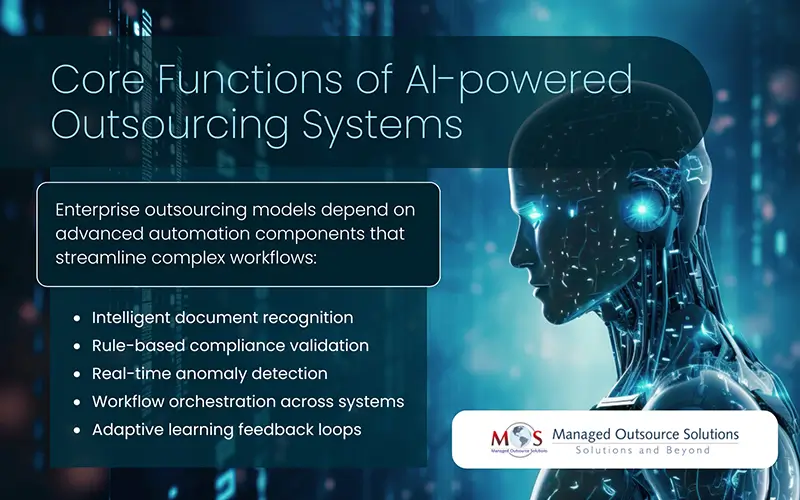
The platform operates through a layered execution architecture that integrates multiple automation capabilities into unified processing pipelines. Instead of treating automation tools as isolated modules, DeepKnit AI synchronizes document ingestion, semantic interpretation, and workflow routing into continuous execution cycles.
Key functional components within the platform include:
- Intelligent document processing engines: These systems capture structured and unstructured data from digital or scanned records using OCR and contextual parsing techniques.
- Natural language processing modules: Semantic interpretation mechanisms identify contextual meaning across complex text structures.
- Validation frameworks: Rule-driven logic reconciles extracted values with enterprise policy definitions.
- Adaptive learning loops: Feedback improves classification models through iterative cycles.
- Workflow execution engines: Automated routing logic transfers the validated outputs to downstream enterprise systems.
Through these capabilities, the platform supports enterprise-scale intelligent document processing automation, ensuring predictable execution across large-volume operational environments.
Intelligent Workflow Execution and Process Intelligence
Modern enterprise workflows rely on defined execution pipelines that maintain logical consistency across operational events. The integration of AI data entry services illustrates how automated extraction pipelines replace manual data transcription workflows.
Within intelligent workflow models, incoming datasets undergo sequential transformation phases:
- Document ingestion: Automated systems capture files through intake channels.
- Data segmentation: Systems identify structured zones using pattern recognition.
- Context verification: The system evaluates extracted values against domain logic.
- Output generation: Verified data fields populate enterprise databases.
- Continuous monitoring: Systems track workflow metrics to spot optimization opportunities.
These workflows contribute to intelligent process automation capabilities that maintain accuracy across large-scale data environments. In parallel, digital workflow orchestration ensures that interdependent systems maintain synchronized execution states.
Industry Workflow Model: Healthcare Operations
Healthcare organizations operate under stringent documentation requirements that demand precise data handling and secure information management. AI-enabled outsourcing models restructure patient record processing into organized digital workflows.
In healthcare environments, document conversion services support the transformation of paper-based clinical records into standardized digital formats. The digitization process integrates classification engines that identify patient identifiers, procedural codes, and treatment records.
Typical healthcare workflow execution stages include:
- Medical document ingestion
- Record classification by specialty type
- Systems extract organized data from clinical notes
- Compliance verification against healthcare policies
- Output synchronization with electronic health record systems
The implementation of such workflows strengthens information accuracy, supports regulatory readiness, and enhances audit traceability across clinical environments.
Industry Workflow Model: Insurance Operations
Insurance environments depend on precise document validation and structured claim processing logic. AI-driven outsourcing frameworks restructure claim handling processes into repeatable execution models that minimize operational inconsistency.
Insurance workflow pipelines typically include:
- Claim intake and indexing
- Policy verification against stored datasets
- Fraud risk identification through anomaly detection models
- Structured settlement calculation workflows
- Decision routing based on validation results
These structured workflows support the integration of AI data entry services, ensuring consistent claim lifecycle management across distributed insurance environments.
Human-in-the-Loop Intelligence in Enterprise Automation
Despite the sophistication of automation frameworks, human oversight remains critical in workflows involving regulatory judgment or contextual interpretation. Human-in-the-loop frameworks introduce controlled intervention points that maintain decision accountability without disrupting automation continuity.
Human review mechanisms operate under defined conditions such as:
- Validation threshold failure
- Regulatory exception detection
- Contextual ambiguity identification
- Cross-system inconsistency detection
By embedding structured oversight into automation pipelines, enterprises preserve governance integrity while maintaining computational efficiency.
Governance, Compliance, and Operational Risk Intelligence
Enterprise outsourcing environments operate under strict regulatory requirements that demand structured governance frameworks. Intelligent outsourcing models incorporate policy-driven logic that enforces compliance protocols across workflow execution layers.
Governance intelligence mechanisms typically include:
- Role-based workflow authorization: Access permissions block unauthorized data changes.
- Audit trail generation: Workflows generate traceable logs for compliance verification.
- Policy validation engines: Business rules enforce procedural consistency across operational workflows.
- Data lineage mapping: Transaction histories record origin points and transformation stages.
These mechanisms strengthen organizational transparency while reducing exposure to operational risk events.
Emerging Trends in AI-Native Outsourcing Architectures
Automation-centric outsourcing environments continue to evolve in response to emerging technology innovations. Organizations adopting AI in business process outsourcing frameworks increasingly incorporate predictive intelligence into workflow execution pipelines.
Key technological trends shaping enterprise outsourcing include:
- Predictive analytics integration: Forecasting models anticipate workflow demand patterns.
- Distributed processing architectures: Cloud-based execution environments enhance scalability.
- Autonomous workflow refinement: Adaptive algorithms optimize processing pathways based on historical outcomes.
- Real-time performance analytics: Continuous monitoring improves operational transparency.
These developments reinforce enterprise readiness for future operational complexity.
Strategic Direction for Enterprise Operations Leaders
Enterprise leaders evaluating outsourcing strategies must consider how technology integration influences operational reliability. Strategic planning now prioritizes workflow sustainability rather than isolated performance improvements. Organizations collaborating with advanced business process outsourcing companies deploy automation frameworks that align processing logic with business objectives. Organized workflows keep operations running smoothly and support business growth.
AI-powered document conversion services enhance record lifecycle management by improving searchability and data accessibility across enterprise environments. Ultimately, enterprises adopting intelligent outsourcing architectures strengthen operational resilience, maintain compliance readiness, and position themselves to respond effectively to evolving industry requirements.