Geographic Information Systems play a major role in industries such as construction, transportation, utilities, telecommunications, urban planning, and environmental management. Organizations use these solutions to analyze spatial information, improve planning, and support better decision-making. However, one of the biggest operational hurdles businesses encounter is GIS data conversion. Converting geospatial information between different formats, coordinate systems, and platforms can be complex. Challenges such as incompatible file types, outdated legacy platforms, inconsistent records, and projection mismatches affect accuracy and workflow efficiency. Understanding the key challenges in GIS data conversion is essential for maintaining reliable spatial information and ensuring smoother implementation.
What Is GIS Data Conversion?
GIS data conversion refers to the process of transforming geographic or spatial information from one format, structure, or coordinate system into another so it can function seamlessly across various mapping platforms and applications.
Examples include:
- Converting CAD drawings into compatible mapping formats
- Transforming raster images into vector layers
- Migrating legacy spatial databases into modern environments
- Reprojecting files into different coordinate systems
- Combining location-based information from multiple sources
The primary objective is to ensure the converted information remains accurate, usable, and compatible with the target environment.
Looking to overcome GIS data conversion challenges?
Connect with our experts to streamline integration, improve data quality, and ensure seamless spatial data management.
How to Overcome GIS Data Conversion Challenges
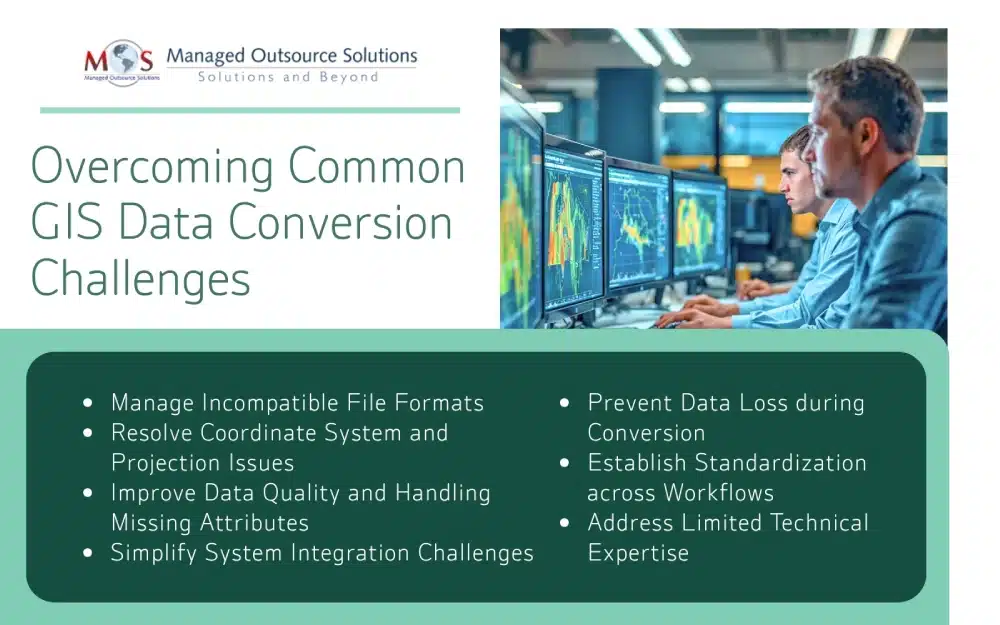
With the global geospatial technology market valued at $10.24 billion in 2022 and projected to reach $23.37 billion by 2029, organizations across industries are rapidly adopting location-based technologies to improve analysis, planning, and operational efficiency. As reliance on geospatial intelligence continues to increase, the need for accurate and efficient GIS Data Conversion is becoming more important than ever. However, despite its advantages, implementation and conversion projects involve technical and operational difficulties. Since these systems require specialized expertise and careful information management, businesses must address these issues effectively to maintain accuracy and long-term efficiency.
Inconsistent Data Formats: One of the most common problems in GIS data conversion is handling multiple file formats.
Different platforms support different structures, including:
- Shapefiles
- GeoJSON
- KML/KMZ
- DWG/DXF
- GDB files
- Raster imagery
- LiDAR datasets
When files originate from multiple departments or third-party vendors, compatibility becomes a serious concern. Some formats may lose attributes during migration, while others may not support advanced spatial features.
How to Overcome It
Using professional conversion tools and middleware solutions can help minimize compatibility issues. Strong GIS data integration strategies also ensure information from different sources works together efficiently. Choosing interoperable formats and validating outputs after conversion further reduces operational risks.
Coordinate System and Projection Errors: Spatial accuracy depends heavily on correct coordinate systems and map projections. During conversion, layers may become misaligned if different reference systems are used. For example:
- One layer may use WGS84
- Another may use UTM
- A third may rely on a local projection system
If these references are not transformed correctly, maps may display incorrect locations, overlapping features, or distorted spatial relationships.
How to Overcome It
Before starting the conversion process, teams should identify:
- Existing coordinate systems
- Projection requirements
- Datum transformation needs
Automated reprojection tools within mapping software can reduce manual errors. Post-conversion validation is also essential for verifying alignment accuracy. Maintaining detailed metadata records throughout the workflow further improves consistency.
Poor Quality and Missing Attributes: Inconsistent attributes, duplicate entries, incomplete metadata, and outdated records are major concerns during conversion projects. Poor-quality information results from:
- Manual collection methods
- Outdated standards in legacy platforms
- Different entry methods across teams
- Poorly maintained historical records
These issues can reduce the effectiveness of mapping and spatial analysis.
How to Overcome It
This is where GIS data cleansing becomes extremely important. The process involves:
- Removing duplicate records
- Standardizing naming conventions
- Correcting attribute inconsistencies
- Filling missing fields
- Validating spatial accuracy
Organizations should also implement automated quality-control checks before and after conversion. Establishing governance policies helps maintain consistency and long-term reliability.
Integration Challenges between Systems: Modern mapping platforms need to connect with:
- ERP platforms
- Asset management systems
- CAD software
- Utility management tools
- CRM applications
- Cloud environments
Unfortunately, integration is difficult because many businesses still rely on legacy systems that were not designed for modern geospatial workflows. This creates significant GIS data integration challenges.
How to Overcome It
Organizations can simplify integration by:
- Using API-based platforms
- Adopting low-code or no-code integration tools
- Choosing interoperable solutions
- Standardizing schemas and workflows
These approaches help improve connectivity while reducing operational complexity.
Data Loss during Conversion: Another major issue during conversion is the accidental loss of spatial or attribute information. For example:
- Polygon boundaries may become distorted
- Labels may disappear
- Attribute tables may lose fields
- Raster resolution may decrease
This problem occurs when incompatible formats are used or settings are configured incorrectly. In sectors such as engineering, utilities, transportation, and infrastructure management, these errors can directly affect operations.
How to Overcome It
Organizations should:
- Maintain backup copies of original files
- Perform pilot conversions before large-scale migration
- Validate converted outputs against source files
- Use automated QA/QC workflows
Testing small samples before full migration also helps identify issues early and reduces large-scale risks.
Lack of Standardization: Different departments use different naming conventions, symbols, attribute structures, and classification methods. Without consistency, conversion becomes more complicated and error-prone. For example:
- One team may label roads as “Street”
- Another may use “Rd”
- A third may use “Road Name”
How to Overcome It
Organizations should establish standardized policies that define:
- File naming conventions
- Attribute schemas
- Projection standards
- Metadata requirements
- Update procedures
Enterprise-wide governance policies improve consistency across departments and projects.
Limited Technical Expertise: Geospatial technologies require trained professionals for accurate implementation and conversion. Many organizations struggle with limited in-house expertise, which can lead to:
- Incorrect conversion settings
- Mismanaged coordinate systems
- Overlooked quality issues
- Integration bottlenecks
How to Overcome It
Businesses can address this challenge by:
- Investing in training programs
- Hiring experienced specialists
- Partnering with professional service providers
- Automating repetitive workflows where possible
Modern AI-powered mapping tools and automation platforms also help simplify conversion processes and reduce manual workloads.
As organizations continue adopting geospatial technologies, the importance of reliable GIS data conversion will continue to grow. While the process offers significant operational value, it also presents several technical and workflow-related hurdles. From projection mismatches and integration issues to poor-quality records and lack of standardization, the challenges in GIS data conversion can affect the accuracy and efficiency of entire systems. Fortunately, these obstacles can be addressed through proper planning, standardized workflows, effective GIS data cleansing, and strong GIS data integration strategies. By understanding common GIS data conversion errors and solutions, organizations can minimize inaccuracies, improve spatial reliability, and build a more efficient geospatial infrastructure.
Improve the accuracy and efficiency of your geospatial workflows with reliable GIS data conversion solutions tailored to your business needs.