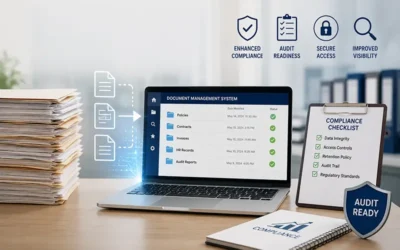
Organizations manage massive volumes of documents in multiple languages every day. From contracts in Spanish and invoices in German to legal files in French and medical records in Arabic, handling multilingual documents manually can be slow, complex, and error-prone. Traditional document processing methods often struggle with language barriers, inconsistent formats, and compliance requirements. Manual review not only consumes valuable time but also increases the risk of costly errors and delays. This is where AI document processing for multilingual documents is transforming the game. By combining advanced technologies like OCR, Natural Language Processing (NLP), and machine learning, AI document processing helps businesses to automate document extraction, translation, classification, and workflow management with greater speed and precision.
What Is AI Document Processing
AI document processing refers to the use of artificial intelligence to capture, interpret, and process information from documents automatically. Unlike traditional systems that simply scan and store files, AI-driven systems can:
- Recognize text across multiple languages
- Understand context and intent
- Extract relevant data points
- Translate content accurately
- Categorize and organize files automatically
This makes multilingual document processing faster, smarter, and more scalable for global businesses.
Why Multilingual Document Processing Matters
As businesses expand globally, they face increasing challenges in managing multilingual documentation. Some common examples include:
- Healthcare providers processing patient records in different languages
- Law firms reviewing contracts and agreements across regions
- eCommerce businesses managing invoices and shipping documents from international vendors
- Financial institutions handling multilingual KYC and compliance documents
Without automation, these tasks can lead to inefficiencies, inconsistencies, and compliance risks. With AI-powered document automation, organizations can centralize and streamline these workflows while improving operational efficiency.
How AI Processes Multilingual Documents Efficiently
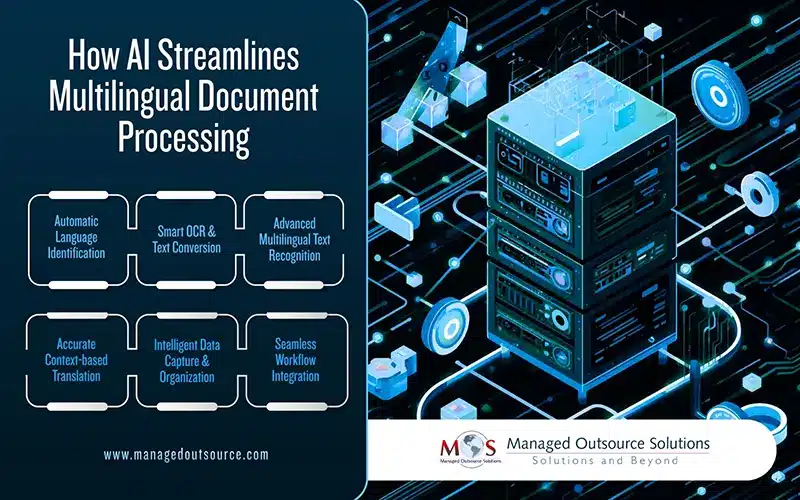
It is interesting to note how AI processes multilingual documents efficiently. We find a combination of intelligent technologies working together.
- Language Detection: AI automatically detects the language of a document, whether it’s English, Spanish, Arabic, or any other language. This eliminates the need for manual sorting and speeds up processing.
- OCR and Text Extraction: Optical Character Recognition (OCR) scans printed or handwritten text and converts it into machine-readable digital content. Modern OCR tools can process scanned documents, PDFs, and forms with high accuracy.
- AI-based Multilingual Text Recognition System: An AI-based multilingual text recognition system can understand various scripts, fonts, and layouts. This is especially useful for processing:
- Invoices
- Contracts
- Medical forms
- Legal documents
- Structured and unstructured PDFs
- Context-aware Translation: AI-driven translation tools go beyond word-for-word conversion. Using neural machine translation, AI understands context, tone, and industry-specific terminology to deliver more accurate translations.
- Intelligent Data Extraction and Classification: AI can automatically extract key details such as:
- Names
- Dates
- Invoice numbers
- Addresses
- Legal clauses
- Payment details
- Workflow Automation: The final step is integrating the extracted information into business systems. Documents are automatically sent to departments such as finance, legal, HR, or compliance for further action.
Once extracted, documents are automatically classified and routed to the correct workflow.
Benefits of AI-powered Document Automation
Organizations implementing AI-powered document automation gain measurable advantages.
- Reduced Costs: Automation minimizes manual labor and lowers operational expenses.
- Faster Processing: Tasks that once took hours or even days can now be completed in minutes.
- Improved Accuracy: AI reduces errors in data entry, translation, and classification.
- Better Scalability: Businesses can process thousands of multilingual documents without increasing workforce requirements.
- Enhanced Compliance: AI can flag missing information, identify anomalies, and support regulatory compliance.
This marks a shift from simple process efficiency to decision intelligence.
Real-world Use Cases of AI Document Processing
- Healthcare Industry: Hospitals and clinics use AI document processing to manage multilingual patient records, prescriptions, and insurance claims.
- Outcome: Faster access to patient information and reduced administrative burden.
- Legal Industry: Law firms use AI to analyze multilingual contracts, agreements, and case documents.
- Outcome: Improved document review speed and reduced legal risks.
- Finance Industry: Banks and financial institutions automate multilingual KYC verification, invoices, and compliance documentation.
- Outcome: Faster onboarding and improved regulatory compliance.
- Logistics and Supply Chain: Companies process shipping manifests, customs forms, and supplier invoices in multiple languages.
- Outcome: Faster global operations and fewer documentation errors.
Challenges and Considerations
While AI document processing for multilingual documents offers significant advantages, businesses should consider:
- Implementation Complexity: Integrating AI tools into existing workflows may require time and expertise.
- Compliance and Data Security: Sensitive documents must be processed securely and in compliance with regulations.
- Human Validation: In industries like healthcare and legal, human review may still be necessary for critical decisions.
The Future of Multilingual Document Processing
The future of multilingual document processing is becoming even more advanced with innovations such as:
- Large Language Models (LLMs)
- Context-aware AI translation
- Predictive analytics
- Human-in-the-loop verification
- Industry-specific automation solutions
As technology evolves, businesses will move beyond simple automation toward intelligent systems that can understand, analyze, and act on multilingual information in real time.
Streamline your workflows with AI document processing for multilingual documents
AI document processing for multilingual documents empowers organizations to unlock valuable information hidden in documents across different languages and formats. By combining AI document processing, multilingual document processing, and AI-powered document automation, businesses can improve speed, reduce costs, and enhance accuracy. Now is the ideal time to invest in an AI-based multilingual text recognition system and discover how AI processes multilingual documents efficiently. The future of document management is not just digital; it is intelligent, automated, and multilingual.