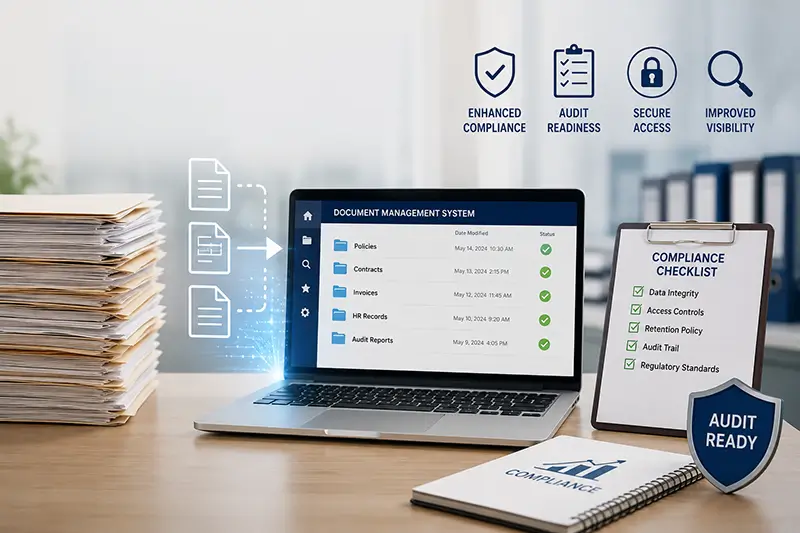
Regulatory demands and compliance pressures are rising rapidly across industries, driven by cybersecurity concerns, consumer protection initiatives, data transparency requirements, and stricter financial regulations. However, maintaining compliance remains a major challenge. In PwC’s Global Compliance Survey, 77% of companies reported being negatively impacted by growing compliance complexity. Most CCOs also expect compliance demands to increase amid rising regulatory scrutiny, customer expectations, and evolving social and public pressures, according to a 2024 KPMG report. As organizations manage growing volumes of records and documentation, tech-assisted document digitization services are becoming essential for improving compliance management and audit readiness.
Managing paper-based records during audits can be time-consuming. Physical documents are difficult to retrieve, increasing the risk of missing or outdated records. Manual filing also makes it harder to track versions, maintain audit trails, and enforce retention policies. In addition, paper records are vulnerable to damage, unauthorized access, and data loss, which can complicate compliance efforts and delay audits.
By converting paper records into secure, searchable digital files, businesses can implement electronic document management. This simplifies document retrieval, strengthens data security, helps maintain accurate audit trails, and supports regulatory compliance more efficiently.
What Is Document Digitization?
Document digitization involves scanning, converting, storing, and managing documents using advanced software and digital technologies. By reducing manual paperwork, saving time, and lowering operational costs, it plays a key role in modernizing workflows and enhancing compliance management. Documents digitized for compliance management include financial records, HR files, medical records, legal documents, contracts, and invoices.
Digital document management for regulatory compliance combines OCR (Optical Character Recognition), indexing, and metadata tagging to transform unstructured, physical documents into searchable, auditable electronic assets. For example, by digitizing patient records and using OCR and metadata tagging, healthcare providers can quickly retrieve treatment histories, consent forms, and billing documents during HIPAA compliance audits. Likewise, businesses handling customer data can use searchable digital records and audit trails to help meet GDPR compliance and data access requirements.
Why Compliance and Audit Readiness Matter
Efficient compliance and audit readiness are essential for organizations to meet regulatory demands, safeguard data privacy, and avoid costly risks associated with poor document management.
- Increasing regulatory requirements: Organizations face growing oversight from governments and industry bodies, making compliance a non‑negotiable priority.
- Industry retention mandates: Specific rules dictate how long records must be kept and in what format, requiring disciplined document management.
- Data privacy and security obligations: Protecting sensitive information is both a legal requirement and essential for maintaining customer trust. Secure document digitization for regulated industries ensures compliance, efficiency, and protection of sensitive information.
Poor document management poses several risks:
- Missing records: Incomplete or missing documentation can negatively impact compliance efforts and damage credibility.
- Delayed audits: When records cannot be retrieved easily, it slows down audit processes, increasing costs and stress.
- Security breaches: Weak document controls expose organizations to cyberattacks and unauthorized access.
- Compliance penalties: Failure to meet regulatory standards can result in fines, sanctions, or reputational harm.
With the average data breach costing $4.44 million in 2025, compliance failures directly translate into financial losses and reputational damage.
Beyond regulatory best practices, secure and compliant document digitization services are a critical safeguard against multimillion-dollar breaches, fines, and reputational harm.
How Document Digitization Improves Compliance
Digitized documents are easier to store and retrieve than voluminous paper records. They can be organized within a centralized system, reducing the risk of duplication and misfiling while improving compliance management. Other benefits include:
Better Data Security and Access Control
A secure digitization process ensures that documents are encrypted, properly categorized, and stored in compliance with data protection laws such as HIPAA, GDPR, and other industry-specific regulations. It also includes clear role-based access controls, audit trails, and regular system updates to reduce security risks over time.
Improved Records Retention Management
Secure document digitization directly supports compliance by automating retention and disposal processes, reducing human error and ensuring consistency. Digital records management automates record classification and enables enforcement of retention timelines based on regulatory requirements.
Enhanced Version Control
Manually filed documents are challenging to track and update. Digitization allows for intelligent document management facilitates record updates and automated tracking. Enhanced version control prevents the use of outdated information.
Stronger Audit Trails
Digital record management systems log the entire lifecycle of a document, recording exactly who made a change, when, and what they changed. Organizations can maintain an audit trail and protect confidential data with granular access control. Tracking document access and modifications supports transparency and accountability.
How Digitization Enhances Audit Readiness
Electronic document management supports audit readiness in several ways:
Improves Record Retrieval
Document digitization reduces manual searching and supports audit readiness by facilitating quick and smooth file retrieval during audits. OCR turns text into machine-readable format which makes it easy to locate specific documents with a quick keyword search.
Enhances File Sharing with Auditors
Companies can share digital documents easily and securely with auditors, speeding up response times. Better organization of records improves accuracy and reduces risks of missing or incomplete documentation
Supports Real-time Document Monitoring
Digital document management systems support real-time monitoring and reporting through compliance dashboards and automated reporting tools. Compliance dashboards provide visibility into document status, access activity, retention schedules, and regulatory requirements, helping organizations identify potential compliance gaps quickly.
Improves Data Accuracy and Transparency
Automated reporting tools simplify audit preparation by generating accurate reports on document access, updates, retention history, and compliance activities, reducing manual effort and improving transparency.
However, while electronic document management for compliance tracking and audit readiness is essential, implementing it involves several challenges. Common hurdles include data migration issues, security concerns, legacy file compatibility, and employee adoption.
Fortunately, advanced technologies are helping companies implement compliance-focused digitization.
How Technology Supports Document Digitization for Compliance and Audits
Advanced AI-powered document processing systems support compliance and audit readiness by automating document processing, improving data accessibility, and strengthening audit trails across large volumes of records. Let’s explore the capabilities of the intelligent DeepKnit AI agent in this context.
DeepKnit combines OCR, Intelligent Character Recognition (ICR), document classification, and data extraction capabilities to convert unstructured paper or digital files into searchable, organized records. It can help organizations:
- centralize compliance-related documents
- automate categorization for faster data retrieval during audits
- supports secure document handling through encrypted storage and controlled data access
- help organizations meet industry-specific compliance requirements
- deliver organized digital records that improve transparency, traceability, and audit preparedness
In sectors such as healthcare, legal, and finance, this platform can generate customized reports that support compliance monitoring and audit documentation. DeepKnit AI’s workflow automation and AI-assisted quality checks help reduce errors, improve consistency, and speed audit response times.
Partner with an Expert for Successful Document Digitization
Document digitization plays a critical role in strengthening compliance management and improving audit readiness across industries. By converting paper records into secure, searchable digital files, organizations can simplify document retrieval, maintain accurate audit trails, support regulatory requirements, and reduce the risks associated with manual recordkeeping. Best practices include:
Partnering with a document conversion company that provides digital records management support and AI-driven compliance monitoring can enhance audit readiness. Digital document management also improves operational efficiency, strengthens data security, and ensures long-term accessibility of critical records. Features such as centralized storage, automated reporting, access controls, and retention management help organizations respond to audits more quickly and maintain better compliance control.
Convert paper records into secure, searchable digital documents for better compliance management.