
The insurance sector is undergoing rapid transformation as companies adapt to increasing data volumes, evolving customer expectations, and complex regulatory requirements. Managing administrative operations efficiently has become essential for maintaining service quality and operational stability. In this context, insurance back office outsourcing offers a structured way to handle non-core processes while improving accuracy, scalability, and increasingly, decision-making through AI-enabled insights.
Insurance providers deal with high volumes of transactions across claims, underwriting, and customer records. These tasks require precision, consistency, and speed. However, managing them internally not only increases operational strain and costs but can also limit the organization’s ability to leverage data for informed decision-making. By partnering with experienced service providers that incorporate AI technologies, insurers can streamline workflows, enhance efficiency, maintain compliance, and gain actionable insights. This shift mirrors a broader industry trend of optimizing resources while transforming outsourcing from a cost-saving model into a decision-enhancing ecosystem focused on strategic growth initiatives.
Scale Operations Seamlessly.
for AI-powered insurance back office outsourcing solutions
Call: (800) 670-2809
Understanding Insurance Back Office Outsourcing
Insurance back office outsourcing refers to delegating administrative and operational functions to a specialized external provider. These functions support core business activities but do not directly generate revenue. Common outsourced processes include:
- Claims processing and adjudication
- Policy issuance and renewals
- Data entry and policy administration services
- Underwriting support
- Billing and accounting
- Compliance and reporting
- Document digitization and indexing
- Customer communication support
Policy administration services play a crucial role in maintaining compliance and ensuring smooth management across the policy lifecycle.
An experienced outsourcing company brings domain expertise, structured workflows, and process consistency to manage these functions effectively. Outsourcing helps insurers improve internal efficiency while ensuring that routine tasks are handled with precision.
Key Benefits of Insurance Back Office Outsourcing
- Cost Reduction and Financial Efficiency
Cost management remains a key concern for insurers operating in competitive markets. Maintaining in-house teams involves continuous investments in recruitment, infrastructure, and training. By adopting back office outsourcing, organizations can optimize resource allocation and manage expenses more effectively.
Outsourcing supports the alignment of operational costs with actual workload requirements. Instead of maintaining large teams during low-demand periods, insurers can scale services based on need. This flexibility contributes to better financial planning and long-term sustainability. It also reflects how insurance companies reduce costs through outsourcing services by cutting overhead and improving cost predictability.
- Improved Operational Efficiency
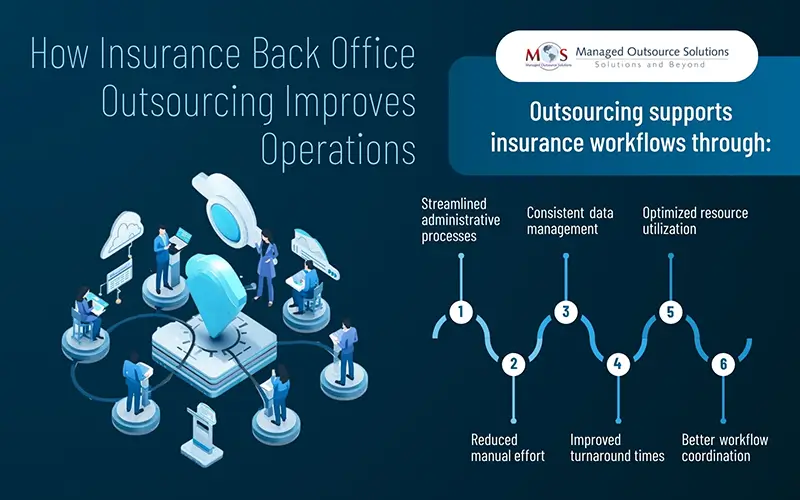
Efficiency plays a crucial role in ensuring timely service delivery and maintaining customer satisfaction. Outsourcing providers bring structured workflows and clearly defined processes that help streamline administrative tasks.
These providers rely on standardized procedures, enabling faster execution of repetitive functions. This reduces delays, minimizes bottlenecks, and ensures smoother operations across departments. Over time, insurers benefit from improved turnaround times and better coordination between teams.
- Access to Skilled Talent
The insurance industry requires specialized expertise in areas such as underwriting support, claims management, and compliance. Hiring and training such talent internally can be time-consuming and resource-intensive.
Partnering with an outsourcing company provides access to trained professionals who are already familiar with industry practices. These experts can manage complex tasks efficiently while maintaining high standards of quality. This approach helps insurers bridge skill gaps and maintain consistent performance across operations.
- Scalability and Flexibility
Insurance operations experience fluctuations in workload due to seasonal trends or unexpected events. Outsourcing enables organizations to adapt to these changes without investing in additional infrastructure.
Service providers can quickly scale resources up or down based on demand. This flexibility ensures that insurers can handle increased workloads without compromising service quality. It also promotes agility and responsiveness in a dynamic business environment.
- Enhanced Accuracy and Quality
Accuracy is essential in insurance processes, where even minor errors can lead to costly rework, compliance issues, or customer dissatisfaction. Outsourcing providers follow structured quality control measures to ensure consistency across operations.
Standardized workflows, combined with continuous monitoring, help reduce errors and maintain data integrity. This improves the reliability of administrative processes and supports better decision-making within the organization.
- Focus on Core Business Functions
Outsourcing administrative tasks helps insurers focus on strategic initiatives such as customer engagement, product innovation, and market expansion.
By reducing the burden of routine tasks, organizations can allocate more time and resources to activities that directly contribute to growth. This shift highlights the benefits of outsourcing insurance back office operations that help insurers strengthen their competitive position.
Role of Technology in Outsourcing
Technology has become an integral part of modern back office outsourcing, contributing to consistent and reliable service delivery. Advanced tools automate routine tasks, shifting team focus toward more complex activities.
Insurers increasingly use artificial intelligence and machine learning to enhance decision-making and improve process efficiency. Cloud-based platforms enable secure data storage and real-time access to information, ensuring better collaboration between insurers and service providers. By embedding AI-driven analytics into outsourced operations, insurers can not only streamline workflows but also gain actionable insights that inform strategic choices. Here outsourcing becomes a valuable tool for smarter decision-making rather than just a cost reduction strategy.
Insurance process automation services help standardize workflows and reduce reliance on manual processes. As organizations continue to invest in digital transformation, these services play a growing role in improving operational consistency and scalability. These technology-driven enhancements demonstrate how outsourcing, empowered by AI, evolves from a traditional efficiency model into a dynamic ecosystem that actively supports informed business decisions.
Real-world Case Studies in Insurance Outsourcing
Case Study 1: Accuracy and Quality Improvement
A U.S.-based brokerage and insurance firm partnered with an outsourcing provider to manage back office operations. The results included:
- Accuracy exceeding 99.95%
- Over 78% reduction in defective processing
- Improved turnaround time and service quality
These results highlight how a structured outsourcing approach can significantly enhance data accuracy and operational reliability. The partnership also demonstrates the value of consistent quality control in high-volume insurance processes.
Case Study 2: Operational Efficiency Enhancement
A UK-based insurance company adopted outsourcing to improve efficiency and customer service. The initiative delivered:
- 65% improvement in claims turnaround time
- Accuracy rates exceeding 98%
- Faster response times within 24 hours
These outcomes show how process optimization through outsourcing boosts both speed and service quality. They also reveal the direct impact of streamlined workflows on customer experience.
Case Study 3: Automation-driven Transformation
A leading U.S. insurer implemented AI-driven outsourcing solutions to handle mid-term adjustments. The project achieved:
- 99% data accuracy
- 57% faster processing time
- Significant reduction in manual workload
This project shows how technology-enabled outsourcing transforms complex insurance processes. It also highlights automation’s value in building consistency and cutting manual work.
Case Study 4: Productivity and Business Growth
A global insurance provider improved underwriting efficiency through outsourcing support:
- Increased productivity from 40% to 80%
- Reduced turnaround time from 15 days to 5 days
- Achieved a 25% increase in new business
These gains prove how outsourcing drives business growth by freeing internal teams for core work. They also connect operational efficiency to stronger revenue.
Case Study 5: Claims Processing Optimization
A European insurance company improved claims operations through outsourcing:
- 60% faster claims processing
- 95% improvement in accuracy
- Improved customer satisfaction
Together, these results underline outsourcing’s role in claims efficiency and accuracy. Faster processing, in turn, builds customer satisfaction and trust.
Challenges and Considerations
While back office outsourcing offers several advantages, insurers must address potential challenges. These challenges arise during the transition phase as well as in ongoing operations, especially when multiple systems and stakeholders are involved. A clear understanding of these risks helps organizations plan more effectively and avoid disruptions.
- Data security and privacy concerns
- Vendor selection and management
- Integration with internal systems
- Compliance with regulatory requirements
Addressing these challenges requires careful planning, clear communication, and strong governance frameworks.
Best Practices for Successful Implementation
To achieve optimal outcomes, insurers should adopt a structured approach. A well-defined implementation strategy helps ensure a smooth transition and reduces the risk of operational disruptions. Clear planning and consistent oversight also improve coordination between internal teams and service providers.
- Define clear objectives and measurable goals
- Select providers with industry expertise
- Implement robust data protection measures
- Maintain continuous performance monitoring
- Start with phased implementation
These practices help ensure long-term success and minimize operational risks.
Future Trends in Insurance Outsourcing
The future of back office outsourcing in insurance is shaped by ongoing digital transformation and evolving customer expectations. Organizations are increasingly adopting advanced technologies to enhance efficiency and improve service delivery.
Key developments include greater use of automation, integration of cloud-based systems, and increased reliance on data analytics. These trends will further streamline operations and improve decision-making across the industry.
Another emerging trend is the increasing emphasis on customer-centric operations. Insurers are leveraging outsourced teams to support faster response times, improved communication, and more personalized service experiences. By aligning administrative processes with customer expectations, organizations can enhance satisfaction and build stronger relationships.
Outsourcing strategies now place data security and regulatory compliance at the center. As insurers handle sensitive customer information, outsourcing providers are investing in advanced security frameworks and compliance protocols. This ensures that data is managed securely while meeting regional and international regulatory standards.
Strengthening Insurance Operations through Outsourcing
The insurance industry must continuously adapt to remain competitive. Insurance back office outsourcing provides a structured approach to managing administrative functions while improving efficiency and operational consistency.
By leveraging external expertise, insurers can streamline processes, enhance accuracy, and focus on delivering value to customers. When AI-driven insights are integrated into these outsourced operations, organizations gain the ability to make faster, more informed decisions, transforming outsourcing into a strategic enabler rather than just a cost-saving tool.
As demonstrated by real-world case studies, outsourcing enables organizations to achieve measurable improvements in performance and service quality. This evolution highlights how combining human expertise with AI-enhanced outsourcing creates a decision-focused ecosystem that supports growth, resilience, and long-term strategic planning.