
Modern organizations depend on timely, accurate information to manage transactions, reporting, forecasting, and day-to-day decision-making. Yet many enterprises continue to struggle with delays, inconsistencies, and manual bottlenecks that reduce productivity and increase administrative burden. This is where financial and operational data entry becomes critically important. When information handling processes lack consistency or speed, organizations face downstream issues ranging from reporting delays to reconciliation errors. Many enterprises are also exploring AI data entry services to improve accuracy, reduce repetitive workloads, and streamline administrative workflows. Improving efficiency is no longer simply about reducing manual workload. It has become a strategic priority tied directly to accuracy, business continuity, and performance.
For finance and operations teams, inefficiencies rarely emerge from a single source. Manual inputs, disconnected systems, duplicate processing, inconsistent formats, and approval delays collectively slow execution. A delayed invoice entry can affect vendor relationships, while inconsistent inventory updates may create fulfillment challenges. High-performing organizations increasingly recognize that improving workflow efficiency requires systematic improvements rather than isolated process adjustments.
Why Inefficiency Creates Business Risk
Many organizations underestimate how inefficient information handling affects broader business performance.
Administrative delays can influence:
- Cash flow visibility
- Procurement timelines
- Payroll accuracy
- Inventory planning
- Vendor management
- Executive reporting
Even small delays create cumulative disruptions when multiplied across departments.
For example:
-
- Delayed invoice processing may affect payment cycles
- Incorrect transaction inputs can create reconciliation challenges
- Inconsistent inventory records may disrupt procurement planning
- Duplicate entries can distort forecasting and reporting
In fast-moving environments, slow workflows reduce organizational agility and weaken decision-making confidence.
According to a recent survey by Deloitte, finance leaders continue prioritizing process modernization and automation to improve efficiency, reduce administrative complexity, and strengthen reporting reliability.
Improve workflow efficiency and strengthen reporting accuracy with expert business process solutions!
Financial and Operational Data Entry: Building Efficient Workflows
Improving financial and operational data entry requires more than faster typing or larger teams. Organizations must redesign how information moves through systems, departments, and approval structures.
Efficiency improves when enterprises focus on:
- Standardized input formats
- Workflow automation
- Validation checkpoints
- System integration
- Reduced duplication
Rather than correcting mistakes after they occur, high-performing organizations establish controls that improve accuracy from the beginning.
For example, invoice management systems using standardized templates reduce inconsistencies and speed up approval timelines. Similarly, inventory updates linked directly to enterprise systems improve visibility across departments.
The objective is not merely faster processing but consistent, reliable information that supports better decisions.
Common Bottlenecks That Reduce Efficiency
Several recurring challenges affect finance and operations teams regardless of industry.
Manual Processes
Heavy dependence on manual input increases:
- Delays
- Human error
- Duplicate work
- Processing inconsistencies
As transaction volumes increase, manual systems become increasingly difficult to manage.
Disconnected Platforms
Many organizations rely on separate systems for accounting, procurement, inventory, and customer management.
Without integration:
- Information must be entered repeatedly
- Teams experience visibility gaps
- Reporting becomes slower
- Errors increase between systems
Disconnected workflows reduce consistency and efficiency.
Lack of Standardization
Different departments may follow different formatting practices.
Examples include:
- Inconsistent naming conventions
- Varying invoice structures
- Different reporting templates
- Non-standard transaction categories
Without standardization, review and reconciliation processes become more time-consuming.
Poor Exception Management
Not every workflow follows predictable patterns.
Missing invoices, incomplete purchase requests, and unusual transactions require additional review.
Without clear escalation processes, exceptions slow broader workflows.
Practical Strategies to Improve Workflow Efficiency
Organizations seeking measurable improvements typically focus on process redesign rather than isolated fixes.
Standardize Input Processes
Standardized workflows reduce inconsistencies and simplify review processes.
This may include:
- Uniform templates
- Defined formatting requirements
- Mandatory field verification
- Consistent categorization methods
When teams follow consistent standards, downstream corrections decrease significantly.
Reduce Duplicate Processing
Repeated information handling wastes time and increases error rates.
Organizations can improve efficiency by:
- Integrating systems
- Automating transfers between platforms
- Eliminating redundant approvals
- Reducing repetitive manual tasks
Simplified workflows support faster execution.
Improve Real-time Visibility
Delayed visibility creates decision-making gaps.
Finance and operations teams benefit from:
- Live reporting dashboards
- Integrated approval tracking
- Automated status updates
- Centralized information repositories
Better visibility improves responsiveness and planning accuracy.
Strengthen Quality Controls
Speed without accuracy creates additional risk.
Organizations should implement:
- Automated verification checks
- Exception monitoring
- Validation workflows
- Periodic quality reviews
This helps maintain consistency while reducing downstream corrections.
How AI Is Transforming Process Efficiency
Artificial intelligence is reshaping how organizations manage administrative workflows. Traditional processes depended heavily on repetitive manual input and human review. Today, AI-enabled systems improve speed, precision, and scalability.
AI-assisted Information Extraction
AI-assisted tools capture information from invoices, receipts, purchase orders, and forms automatically.
This reduces:
- Manual input effort
- Typographical errors
- Processing delays
- Administrative workload
Teams spend less time entering repetitive information and more time reviewing exceptions.
AI-enabled Validation
AI-enabled systems identify inconsistencies before they affect reporting or reconciliation.
These tools detect:
- Missing values
- Duplicate transactions
- Formatting discrepancies
- Unusual transaction patterns
This strengthens accuracy while reducing manual review time.
AI-driven Workflow Automation
AI-driven workflows improve prioritization and routing.
For example:
- Urgent invoices may receive faster escalation
- High-risk discrepancies may trigger additional review
- Routine approvals may process automatically
This improves workflow speed while maintaining oversight.
AI-powered Exception Handling
Exception management remains one of the largest efficiency challenges.
AI-powered systems help organizations:
- Identify irregularities faster
- Prioritize high-risk issues
- Reduce review bottlenecks
- Improve response times
As transaction volumes increase, intelligent automation becomes increasingly important.
According to McKinsey, organizations implementing AI in core business functions continue reporting measurable efficiency improvements, particularly in repetitive administrative and analytical workflows.
Industry-specific Efficiency Challenges
Although workflow challenges affect nearly every organization, priorities vary by industry.
Manufacturing and Supply Chain
Manufacturers process large volumes of procurement, inventory, and logistics information.
Efficient workflows improve:
- Inventory visibility
- Procurement coordination
- Vendor communication
- Production planning
Retail and E-Commerce
Retail environments depend on accurate transaction and inventory information.
Efficiency supports:
- Faster order fulfillment
- Inventory accuracy
- Better customer experiences
- Improved demand forecasting
Healthcare
Healthcare organizations process claims, billing records, supplier information, and administrative paperwork.
Better efficiency improves:
- Billing accuracy
- Claims management
- Vendor coordination
- Administrative productivity
Financial Services
Banks and financial institutions manage large transaction volumes under strict regulatory oversight.
Efficient workflows strengthen:
- Reconciliation speed
- Reporting accuracy
- Compliance readiness
- Risk management
The Role of Specialized Support Services
As organizations scale, maintaining efficient workflows internally becomes increasingly complex.
Many enterprises rely on professional data entry services to manage high-volume administrative workloads while maintaining consistency and speed.
Similarly, AI data entry services help organizations improve productivity through automation, intelligent extraction, validation workflows, and faster processing of repetitive tasks.
These partnerships help organizations reduce bottlenecks while strengthening reliability across finance and operations functions.
Keep Reading: Top Benefits of Implementing AI Data Entry Solutions
How High-performing Organizations Improve Efficiency
Leading organizations approach process improvement systematically rather than reactively.
Effective enterprises typically:
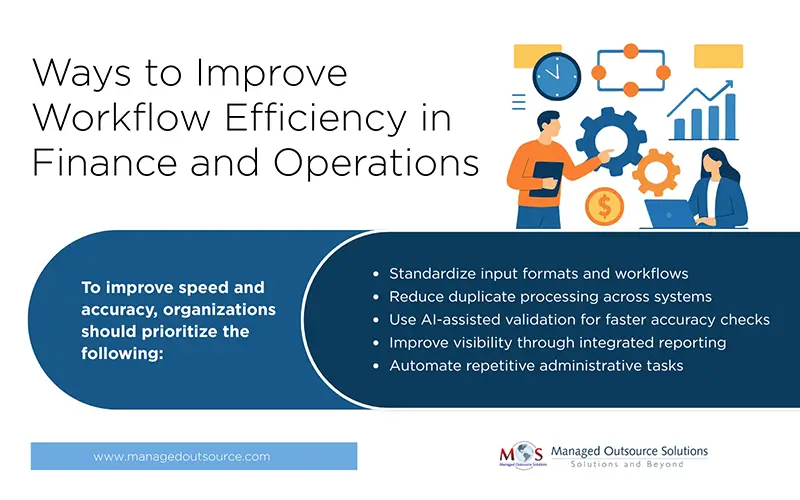
- Standardize workflows across departments
- Reduce unnecessary approvals
- Automate repetitive processes
- Monitor quality continuously
- Invest in AI-enabled systems for scalability
For example, organizations managing large invoice volumes may automate extraction and routing while reserving manual review only for exceptions. This reduces workload without compromising accuracy.
High-performing organizations recognize that efficient administrative workflows directly support profitability, responsiveness, and operational resilience.
Why Efficient Processes Create Competitive Advantage
Organizations that improve workflow efficiency strengthen far more than administrative productivity. Faster information handling improves reporting accuracy, procurement coordination, cash flow visibility, and decision-making responsiveness. Businesses that continue relying on fragmented and heavily manual systems risk delays, inconsistencies, and reduced visibility into critical processes. In contrast, organizations prioritizing financial and operational data entry create stronger foundations for accuracy, scalability, and long-term performance improvement. For enterprises managing high transaction volumes, partnering with providers offering data entry services can further improve consistency, efficiency, and process reliability across finance and operations workflows.
Frequently Asked Questions
Why is efficient financial and operational information handling important for businesses?
Efficient workflows improve reporting accuracy, transaction visibility, and decision-making across departments. They also reduce delays, administrative burden, and errors that may affect finance, procurement, inventory, and customer-facing operations.
What are the biggest causes of inefficiency in finance and operations workflows?
Manual processes, disconnected systems, duplicate inputs, inconsistent formats, and unclear approval structures commonly reduce efficiency. These issues create delays, increase errors, and slow reporting and reconciliation activities.
How does AI improve workflow efficiency?
AI-assisted systems improve speed by automating repetitive tasks such as information extraction, validation, and routing. AI-driven monitoring also helps organizations identify inconsistencies faster and reduce manual review workloads.
When should organizations consider outsourcing administrative workflows?
Organizations may consider external support when transaction volumes become difficult to manage internally or when delays begin affecting productivity and reporting. Specialized providers can improve consistency, scalability, and process efficiency.
How can organizations improve accuracy without slowing productivity?
Organizations can improve accuracy by standardizing workflows, automating repetitive tasks, integrating systems, and implementing validation checks. This helps reduce errors while maintaining efficiency across finance and operations processes.
Want to streamline finance and operations workflows?
Discover how smarter processes can improve speed, accuracy, and business performance.
Contact Us Today!