
Technology isn’t just changing the finance world, it’s completely reinventing it. In fact, financial technology efficiency has become the driving force behind how modern banking, investment management, and financial operations work today. Whether it’s streamlining workflows, speeding up decision-making, or enabling smarter data use, technology ensures financial firms can move faster and operate with greater accuracy. This shift reflects the broader wave of digital transformation in finance, which continues to reshape performance expectations across the sector.
With many institutions now relying on data conversion services to transform legacy information into usable digital formats, the shift toward tech-driven efficiency is only getting stronger. From automated processes to AI-driven insights, finance is evolving—and the transformation is more exciting than ever.
Financial Technology Efficiency and Digital Tools driving Smarter Operations
As consumers enjoy the many conveniences brought by digital innovation, financial businesses continue to push for improved customer experiences. Yet, behind the scenes, finance organizations struggle to keep up with increasing volumes of data, expanding client bases, and growing operational demands. This makes efficient document and data management more critical than ever for long-term stability and growth.
Today, AI-powered tools are giving financial institutions the power to turn raw data into meaningful insights that improve decisions and streamline processes. For banks, insurance companies, and investment firms, digital transformation translates into quicker transactions, more precise data analysis, and stronger security—while cutting down on manual work. With AI and data analytics driving this change, companies can automate decisions, detect fraud, and evaluate risks in real time. The result? Smarter, data-backed strategies and a significantly better customer experience through faster, safer, and more reliable financial services. This evolution highlights how AI improves efficiency in financial services, giving organizations a distinct competitive edge.
Key Digital Banking Statistics
According to insights shared by CoinLaw:
- Mobile and online banking continue to dominate, with 77% of U.S. adults now handling their bank accounts through apps or computers—clear evidence of the ongoing shift toward digital-first financial services.
- The global digital banking platform market is expected to climb to $12.94 billion by 2025, with a strong CAGR of 13.23% between 2024 and 2032, signaling rapid industry expansion.
- Millennials are leading the digital charge, 80% prefer banking digitally in 2025, and nearly half say they would switch to another bank if they don’t get a smooth digital experience.
- In the U.S. alone, 80% of all banking transactions in 2025 have occurred through digital channels.
- By 2025, three-quarters of banks with assets of $100 billion or more are expected to have fully implemented AI-driven strategies throughout their operations.
- The AI market within the banking sector is expected to soar to $34.58 billion by 2025, expanding at an impressive CAGR of 30.63% through 2034.
- 9 out of 10 financial institutions are already leveraging AI-driven solutions to enhance fraud detection, elevate customer service, and streamline their day-to-day operations.
Role of Technology in Financial Reporting
Technology is transforming financial reporting at an incredible pace. What once required hours of manual effort can now be completed faster and more accurately thanks to rapidly evolving digital tools. As companies continue to adopt digital-first strategies, innovations like artificial intelligence, blockchain, and cloud platforms are streamlining financial workflows and helping organizations produce reliable reports in record time. This shift is a clear example of technology-driven banking influencing broader financial functions.
- Artificial Intelligence and Machine Learning
AI has become a powerful force in reshaping how financial reports are created and analyzed. Instead of sifting through endless sheets of data, AI-driven systems can instantly process massive volumes of both structured and unstructured information. These tools uncover trends and anomalies that humans might easily miss. Meanwhile, machine learning models continue to learn and improve, delivering increasingly precise insights that elevate the quality of financial reporting over time.
- Blockchain Technology
Blockchain is introducing a new era of security and transparency to financial reporting. Its decentralized and tamper-proof nature allows transactions to be securely recorded without the need for intermediaries. This creates a more trustworthy accounting environment by minimizing the risk of manipulation or fraud. With clearer visibility into every transaction, stakeholders gain greater confidence in the integrity of an organization’s financial data.
- Cloud Computing
Cloud technology has redefined how financial information is stored, accessed, and shared. Businesses can now rely on scalable and cost-effective cloud platforms to manage large volumes of financial data. With real-time access from virtually anywhere, finance teams can collaborate more seamlessly and make quicker, better-informed decisions. Cloud solutions also simplify compliance by keeping important records secure, updated, and easy to retrieve.
- DeFi Revolution
Decentralized finance (DeFi) is emerging as one of the most groundbreaking innovations reshaping today’s financial landscape. Powered by blockchain technology, DeFi gives users access to traditional financial services—without relying on centralized institutions such as banks or brokers. Through the use of smart contracts, it automates transactions with enhanced security, transparency, and efficiency.
- Embedded Finance
Embedded finance is creating powerful new possibilities for businesses by integrating financial services directly into everyday customer experiences. Instead of navigating separate banking platforms, users can access options like installment payments seamlessly at the point of purchase—right within the online shopping journey. This smooth integration eliminates barriers, making financial transactions faster, more convenient, and effortless.
- Data Analytics and Visualization Tools
As financial data grows in scale and complexity, advanced analytics and visualization tools are becoming essential. These technologies help organizations make sense of large datasets, uncovering insights that might otherwise stay hidden. Interactive dashboards and intuitive visual charts allow decision-makers to grasp performance trends quickly and act on actionable intelligence that supports strategic planning.
In summary, technology is reshaping financial reporting in meaningful ways—automating repetitive work, improving transparency, and strengthening decision-making capabilities across the board. To stay competitive, finance leaders must remain aware of these advancements and understand how they influence modern reporting practices.
Key Trends Shaping the Future of Financial Reporting
With technological progress and regulatory expectations evolving rapidly, financial reporting is undergoing a major transformation. Below are the leading trends that will define the future of the field.
- Growing Adoption of Automation
Automation is quickly becoming the backbone of modern financial reporting. Tools powered by AI and platforms like IRIS CARBON are helping organizations streamline data gathering, validation, and report creation. By reducing manual work and minimizing errors, automation allows finance professionals to shift their attention to higher-level analysis and strategic decision-making. This aligns with the ongoing rise of automation in financial services, which is changing how financial teams operate.
- Real-Time Reporting Becomes the Standard
Access to real-time financial information is now essential for timely and accurate decision-making. Cloud-based systems make this possible by storing data securely online and providing instant access from any location. Real-time reporting benefits key stakeholders such as investors, executives, and regulators by offering up-to-date insights instead of waiting for traditional periodic reports.
- Demand for Greater Transparency
To strengthen investor trust and curb accounting misconduct, regulatory bodies worldwide are pushing for more transparency in financial disclosures. One major step in this direction is the widespread adoption of XBRL, which enhances data accuracy and streamlines analysis. At the same time, blockchain is also gaining attention for its potential to provide verifiable, tamper-proof records that further increase trust in financial statements.
- Advanced Analytics Unlocking Deeper Insight
Sophisticated analytics tools powered by predictive modeling, machine learning, and natural language processing are enabling finance teams to gain meaningful insights from extensive data sets. From forecasting trends to evaluating risk and personalizing financial services, advanced analytics are allowing companies to make smarter, data-driven decisions. In the banking sector specifically, these tools play a major role in optimizing credit risk assessment and elevating customer engagement. These innovations reflect the best technologies for modernizing finance departments, helping institutions operate with greater intelligence and efficiency.
As these trends accelerate, organizations must stay proactive to remain competitive. Understanding the impact of technological innovation on financial reporting is essential for navigating the evolving landscape and preparing for the future.
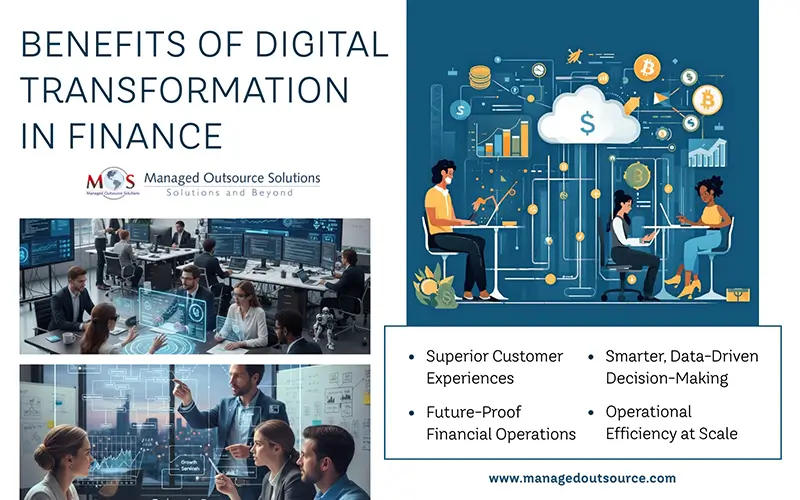
Benefits of Digital Transformation in Finance
Digital transformation is reshaping the financial world in powerful ways—but what does that really mean for financial institutions? Here’s a closer look at the major advantages this shift is delivering:
- Superior Customer Experiences: Gone are the days of navigating bulky websites or standing in long queues. With mobile apps, chatbots, and AI-powered recommendations, customers now enjoy round-the-clock banking access, faster transactions, and highly personalized support—all made possible through digital innovation.
- Operational Efficiency at Scale: From front-end services to back-office operations, digital transformation boosts efficiency across the board. Automation eliminates repetitive tasks, minimizes human error, and accelerates essential processes such as onboarding, approvals, and compliance checks—allowing teams to devote more time to strategic, high-value initiatives.
- Future-Proof Finance: By modernizing systems and adopting flexible tech solutions, financial institutions can better adapt to evolving customer expectations and industry shifts. This ensures they stay competitive, scalable, and prepared for whatever the future holds.
- Smarter, Data-Driven Decisions: With real-time access to accurate data, banks can apply advanced analytics to understand customer behavior and market trends. This reduces guesswork, strengthens risk management, and leads to more confident, well-informed decision-making.
Looking beyond Customer Experience
Most financial companies focused on digital transformation prioritize customer experience to effectively meet and exceed the increasing expectations of the present day digitally savvy customers. However, companies must understand the importance of prioritizing their core business processes as well. In a rapidly transforming business world, they must also think about delivering success to all parts of the organization network.
Back office automation, for example, is vital to an organization’s long-lasting success and must be given due importance. For true digital transformation to take place, the entire organization must be brought under the digital parasol. You may have to reinvent your business processes and overhaul them to ensure simplicity, agility, and innovation throughout the organization. Only in this way can you build the foundation for growth into new products/services and maybe new and unique business models.
Customer experience is of course important, but financial services organizations must look beyond that and make sure that their organization enjoys an overall digital transformation that will simplify processes and deliver value and quality. This is where data becomes important. The financial sector must focus more on becoming data-centric, which is the prime requirement when it comes to enhancing each and every aspect of the organization.
- Organizations must make sure that digital initiatives are not happening in isolation, and are well-connected with strategy. These initiatives must impact CEO-level metrics for the business.
- When driving digital strategy and capability building, adopt a customer-oriented approach. Ensure that you take a cross-functional view of the digitization process, and highlight the need for transformative change over time.
- Consumer financial firms often find they have to adapt their talent strategy and culture to attract superior, digital talent. It is important to acknowledge the culture divide – digital vs. traditional – but focus on establishing shared goals. Incentive structures can be designed to boost collaboration and shared Profit & Loss (P & L) responsibility. Also, a minimum bar of literacy can be established on business and technology at all levels via cross-training.
- To keep up with new technologies and fintechs, provide training for a baseline understanding of new technological approaches at all levels. Disseminating “test and learn” approaches to mainstream business applications can help. Develop strict criteria and a robust framework for assessing and partnering with fintech firms.
- Do not ignore the back office. Automate back office processes and ensure there is a person who is accountable for end-to-end digital capabilities.
- View data as an important asset and keep it ready for use at any desired time. Your data strategy must link critical strategy questions to analytical decision making. Find ways in which you can combine transaction data with customer data in real time.
From automation and analytics to advanced security tools, every new advancement contributes to improved accuracy, agility, and overall financial efficiency. As organizations integrate smarter systems, the ability to convert outdated records into accessible digital data remains equally important, making data conversion services a key partner in this digital evolution. Ultimately, technology empowers financial institutions to deliver better services, make quicker decisions, and stay competitive in a rapidly changing world.