
Drowning in spreadsheets, forms, and ever-growing databases? You’re not alone and that’s exactly why smart businesses are rethinking their data entry outsourcing strategies to work faster and more efficiently. As reliance on data entry services continues to grow across industries such as healthcare, finance, and eCommerce, outsourcing has become a strategic decision rather than a cost-cutting tactic.
According to Technavio, there is a steady expansion of the data entry outsourcing services market, showing a clear upward trend from previous years and projecting strong growth through 2029. The market is expected to increase by USD 206.8 million between 2024 and 2029, registering a compound annual growth rate (CAGR) of 6%, with a 5.7% year-over-year growth in 2025. This accelerating momentum underscores why businesses must adopt well-planned outsourcing approaches to stay competitive. In this guide, we provide ten practical tips for effective data entry outsourcing that align with market growth and evolving business needs.
Significance of Data Entry Outsourcing Strategies
Businesses generate enormous volumes of information every day—from customer orders and financial records to survey responses and inventory levels. Managing this data accurately and efficiently is essential for informed decision-making, compliance, and customer satisfaction. However, data entry can be time-consuming, resource-intensive, and prone to human error if managed internally without the right expertise. This is where thoughtful data entry outsourcing becomes indispensable.
Outsourcing data entry enables companies to access specialized skills and technologies while freeing internal teams to focus on core business goals. With the rise of outsourced data management and data processing outsourcing, businesses can streamline workflows, accelerate turnaround times, and maintain high data integrity across departments. Moreover, outsourcing providers incorporate advanced tools and security practices to ensure data quality and confidentiality. As organizations increasingly depend on precise and timely data, developing effective outsourcing strategies not only enhances operational performance but also contributes to scalability, innovation, and competitive advantage.
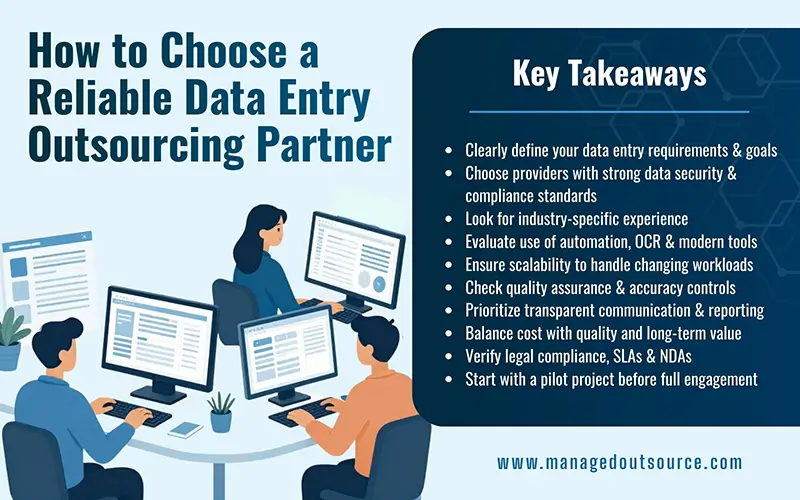
How to Choose a Reliable Data Entry Outsourcing Partner
Selecting the right strategy for outsourcing data entry begins with understanding how to choose the right outsourcing partner. The provider you select shapes the quality, efficiency, and security of your outsourced data processes. Below are 10 practical tips to help you streamline that choice and build a successful outsourcing framework:
- Define Your Requirements and Objectives
Before evaluating potential vendors, clearly outline your data entry goals, project scope, and expectations. Determine the type and volume of data you need handled, turnaround time requirements, quality standards, and any niche business rules. A well-defined brief ensures that prospective partners understand your needs from the outset and can tailor their approach accordingly.
Having clear requirements also makes it easier to compare proposals and evaluate whether a provider’s capabilities align with your objectives. This step sets the foundation for a transparent and productive outsourcing relationship.
- Prioritize Secure Data Entry Services
When outsourcing sensitive business or customer data entry, security should be non-negotiable. Choose a partner that follows strong data protection protocols, including encrypted data transmission, secure storage, access control mechanisms, and compliance with relevant privacy laws such as GDPR or HIPAA where applicable. These safeguards help protect intellectual property and maintain customer trust.
Reliable vendors will also offer policies for incident response, regular security audits, and confidentiality agreements. With secure data entry services, you can prevent unnecessary data breaches and avoid costly remediation efforts.
- Assess Industry Expertise and Experience
Not all data entry tasks are the same—healthcare records, financial statements, product catalogs, and survey responses have different requirements. Look for a partner with experience processing similar data types within your industry. This expertise often translates into faster onboarding, fewer errors, and better workflow optimization.
Ask for case studies, client testimonials, or references that demonstrate successful projects related to your business. Experienced vendors are more likely to anticipate challenges and suggest strategic solutions that enhance overall efficiency.
- Evaluate Technology and Tool Adoption
Modern data entry services must leverage technology to maintain speed and accuracy. Ask whether the outsourcing partner uses advanced systems such as Optical Character Recognition (OCR) for digitizing paper documents, intelligent validation systems, automated workflows, or collaboration platforms that support real-time visibility. State-of-the-art solutions help reduce manual effort, minimize errors, and improve quality.
Technology also plays a key role in seamless integration with your existing systems (e.g., CRM, ERP). Ensure the provider is comfortable working with such systems and can automate tasks where possible, which leads to faster turnarounds and fewer duplicates.
- Look for Flexible and Scalable Solutions
Business environments are dynamic—demand can fluctuate due to seasonality, market shifts, or growth initiatives. A reliable outsourcing partner should offer scalability and flexibility so that your data entry resources can expand or contract without disrupting ongoing operations.
Scalable providers adjust staffing levels, workflows, and support options to meet changing workloads. Whether you need to ramp up data entry volume for a one-time project or scale long-term operations, flexibility ensures continuity and responsiveness.
- Examine Quality Assurance Processes
Quality assurance (QA) practices are essential to ensure that the outputs meet your standards. Look for vendors that implement dual keying, validation checks, routine audits, and accuracy metrics to catch mistakes early. Strong QA frameworks minimize rework and maintain a high level of data accuracy across all deliverables.
Before finalizing an outsourcing agreement, request samples of QA reports and inquire about how issues are tracked, reported, and resolved. Consistent quality control builds confidence and fosters a dependable partnership.
- Consider Transparent Communication Channels
Effective communication is vital for coordinating offshore or remote teams. Your provider should offer clear points of contact, regular status updates, project tracking dashboards, and open channels for feedback and issue resolution.
Miscommunication can lead to errors, delays, and frustration. An outsourcing partner that values transparent communication will proactively reach out, respond quickly, and provide progress visibility through structured reporting.
- Review Pricing and Adopt Cost-effective Data Entry Outsourcing Strategies
While cost is important, it should never be the sole deciding factor. Instead, evaluate the overall value a provider delivers—balancing quality, security, and reliability with competitive pricing. When researching options, consider vendors that offer flexible pricing models, such as pay-per-project, monthly subscriptions, or volume-based billing.
Developing cost-effective data entry outsourcing strategies means balancing affordability with performance expectations. Avoid choices based solely on low price, as they may lack necessary technology, security controls, or experienced personnel, which could ultimately cost more due to errors and rework.
- Check Compliance and Legal Protections
Data compliance and legal safeguards are crucial when transferring information to a third party. Ensure the outsourcing partner adheres to industry regulations and legal obligations relevant to your data type. This includes secure handling, retention policies, disaster recovery plans, and adherence to regulatory frameworks such as HIPAA, or GDPR.
Contracts should include non-disclosure agreements (NDAs), confidentiality clauses, clear service level agreements (SLAs), and provisions for audits or performance reviews to protect your business’s interests.
- Pilot Projects and Trial Runs
Before committing to a full-scale contract, request a pilot project or sample run to assess a provider’s capabilities. Many reputable data entry outsourcing companies offer trial runs that allow you to see how they perform on real tasks.
Piloting helps you evaluate turnaround times, accuracy levels, responsiveness, and ease of collaboration, without the risk of a long-term commitment. Use the results to refine expectations and establish performance benchmarks for future engagements.
Choosing and implementing effective data entry outsourcing strategies is a strategic decision that influences data quality, operational efficiency, and organizational growth. By understanding how to choose reliable data entry services and applying these 10 practical tips, businesses can enjoy secure, scalable, and cost-effective solutions that free internal resources and drive better results.
Outsourcing done right enhances data accuracy, speeds up workflows, and empowers companies to focus on core competencies, ultimately turning data entry from a tedious responsibility into a business advantage.
Outsource Smarter—
Get Expert Data Entry Support Today.
Call: (800) 670-2809