
The world of customer relationship management is booming, with the CRM market expected to hit an impressive $96.5 billion by the end of 2025. This rapid growth, fuelled by a strong compound annual growth rate of about 13.3% from 2024 through 2030, highlights how businesses are embracing digital transformation and innovative customer engagement strategies more than ever. Mastering best practices for efficient CRM data entry is essential to succeed in this evolving landscape.
Efficient data entry not only streamlines operations but also enhances the accuracy and value of customer insights. Leveraging expert data processing services can make a huge difference in managing this influx of information effectively. In this article, the focus will be on five best practices for efficient CRM data entry that help boost productivity, reduce errors, and ensure that your CRM system remains a powerful tool for growth and customer satisfaction.
What Is Efficient CRM Data Entry?
Data input into a company’s CRM platform is referred to as CRM data entry, or CRM data immigration. The major objective of this is to keep correct records of every client’s business services, and it can be done manually or automatically. Entering CRM data is an essential requirement for any company, especially for sales teams. Accurate data entry is essential to a CRM’s effectiveness if you want to handle your sales and other company needs more easily.
By delegating CRM data entry and management tasks to professionals you can streamline your current customer, social, and company data. It will help you maintain clean, accurate, and structured CRM data through efficient customer database management.
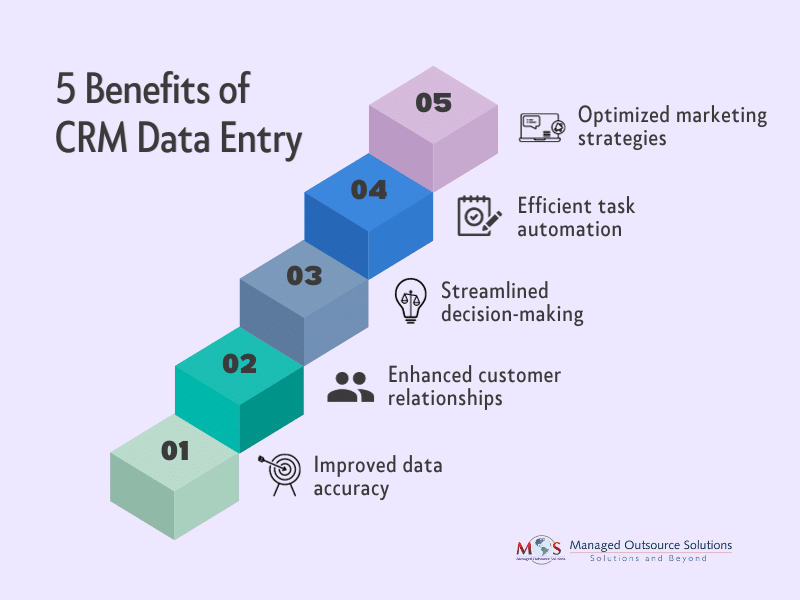
5 Best Practices for Efficient CRM Data Entry
If you’re wondering how to improve accuracy in CRM data entry, start by implementing standardized data entry formats, setting clear guidelines for your team, and using automated validation tools to reduce human errors. Here are five best practices for efficient CRM data entry:
- Regulate data entry protocols:
To maintain an organized CRM database, steadiness is key. One of the best ways to streamline CRM data entry processes is to establish clear rules which ensure that all team members adhere to a set of guidelines when entering data. It is crucial to establish clear and standardized protocols, covering important aspects such as – contact details, lead sources, and categorization. This practice reduces errors, boosts data accuracy, and confirms uniformity across the system, contributing to a unified and organized database.
For example, clear and standardized protocols for CRM data entry in a retail business is to use a standardized format for entering phone numbers to ensure consistency. Instead of variations like (555) 123-4567, 555-123-4567, and 555.123.4567, adopt a uniform format such as +1 (555) 123-4567.
- Provide user training:
Invest in comprehensive training programs for your data entry team. Equip them with a deep understanding of the CRM system’s features and the importance of accurate input. Training offers a multitude of benefits, starting with improved efficiency and accuracy in data entry. Well-trained personnel are more likely to adhere to best practices, reducing the risk of errors. User training also enhances the understanding of the system’s features, allowing for the usage of advanced functionalities that contribute to a more streamlined data entry process.
- Implement automation for repetitive tasks:
Automating repetitive tasks can enhance efficiency and reduce the likelihood of human error to a great extent. The first step is to identify areas where automation can be applied, such as lead assignment, and implement tools or features within your CRM system. The use of application programming interfaces (APIs) can help boost communication between the CRM system and other relevant tools, thus automating the data transfer process across platforms.
In a sales CRM, leads generated through various channels (website forms, social media, events) are automatically assigned to respective sales representatives based on predefined criteria such as geographical location or product interest. Here, automation ensures leads are promptly distributed, minimizing response time and avoiding the risk of human oversight in lead allocation.
- Regularly audit and cleanse data:
Data quality degrades over time, and redundant or obsolete information can clutter your CRM. Maintaining customer information accuracy is essential for building trust and making informed business decisions. Implement cleansing proceduresto ensure your database remains up-to-date, relevant, and aligned with the evolving needs of your business. The process involves establishing audit schedules, identifying key data points, running data quality reports, addressing duplicate entries, reviewing historical data, and educating teams on data quality. When your CRM contains clean, verified, and up-to-date information, your teams can work more efficiently and avoid costly mistakes.
- Encourage user feedback and collaboration:
- Improved Lead Management: Data entry providers ensure that your CRM is regularly updated with the correct lead data. This enables sales teams to segregate leads according to its priority and act accordingly, thereby boosting conversion rates.
- Enhanced Sales Forecasting: One thing CRM data entry experts specialize is the prompt entry of key metrics like sales history, pipeline data, and customer interactions/preferences, which provides your team with detailed insights required to make accurate sales predictions and set goals accordingly.
- Advanced Personalization: With the availability of structured CRM data, marketing teams can categorize customers based on purchase pattern, preferences, and demographics. This leads to the creation of hyper-targeted campaigns that resonate with your audience, boosting engagement and loyalty.
- Rapid Customer Response: Properly managed CRM systems empower customer service teams to tackle issues promptly as it provides access to customer profiles and previous interactions. This improves the overall customer experience, leading to customer retention.
- Better Collaboration: When your CRM data is well-organized, it encourages better communication between departments within your company. Sales, marketing, and customer support teams can work in tandem, reducing inefficiencies and redundancies.
- Improve Supply Chain Efficiency: Customer data doesn’t just support marketing; it also helps you streamline operations. Understanding purchasing trends helps prevent overstocking or understocking, reducing waste and ensuring products are available when needed.
- Eliminate Data Errors and Duplicates: A cluttered CRM filled with outdated or conflicting records can harm your outreach efforts. Regular data cleaning helps remove duplicates, resolve inconsistencies, and ensure your team always has access to accurate customer insights.
- Leverage Predictive Analysis: Analysing clean CRM data allows you to forecast future buying patterns, identify customer values, and align your product offerings or services with evolving preferences.
- Data entry and verification: These services perform accurate and efficient data entry into your CRM system, ensuring that all relevant information is captured and validated for consistency and accuracy.
- Database cleanup: Experts can help you clean and organize your existing CRM database, eliminating duplicate entries, updating outdated information, and enhancing overall data integrity.
- CRM migration support: If you’re transitioning to a new CRM platform, these services provide seamless data migration services, ensuring that your data is transferred accurately and securely without disruptions to your business operations.
- Data formatting and standardization: These services assist in standardizing data formats, applying consistent naming conventions, and ensuring uniformity across your CRM database for better data management and analysis.
- Ongoing data entry support: Whether you require daily, weekly, or monthly data entry support, their team is here to assist you on an ongoing basis, ensuring that your CRM database remains up-to-date and reliable.
Users who use the CRM system daily often have valuable insights into its strengths and weaknesses. Key strategies to foster a culture of engagement and collaboration include creating open channels for communication, regularly seeking input, acknowledging and appreciating contributions, implementing user-friendly interfaces, encouraging cross-departmental collaboration, and setting up a user advisory group.
The Impact of Clean CRM Data on Sales and Marketing
How Professional Data Entry Services Can Help
The role of data entry in customer relationship improvement is often underestimated. When customer information is complete and correct, your team can respond promptly, personalize service, and make data-backed decisions. Outsourcing CRM data entry ensures your records are consistent, freeing your staff to focus on core customer-facing activities.
AI-integrated data entry services further strengthen efficient CRM data entry by automating tasks that typically slow teams down. Instead of manually updating customer records, AI captures, validates, and organizes information with remarkable accuracy, ensuring your CRM remains clean and consistent. It reduces duplicate entries, minimizes human errors, and keeps customer insights updated in real time—making it easier for sales, marketing, and support teams to work more effectively. By enhancing overall customer information accuracy, AI-driven processes help businesses maintain a reliable database that supports faster decision-making, stronger customer engagement, and long-term CRM efficiency.
Clean, reliable CRM data doesn’t just support your marketing, it shapes your entire business strategy. From targeting the right customers to improving product delivery and preventing fraud, the benefits are endless. When you invest in CRM data entry services, you’re not just outsourcing a task, you’re investing in the accuracy and effectiveness of your customer engagement strategy. Businesses that recognize the value of data processing services for accurate data entry for CRM can build stronger relationships, gain better insights, and ultimately, drive growth in a competitive market.
Get Accurate Data Faster.