Despite handling high volumes of repetitive tasks, many BPO organizations continue to face operational delays, errors, and rising costs. The challenge lies in the limitations of manual, process-heavy workflows that struggle to scale efficiently while maintaining consistency.
This is where RPA applications in BPO are redefining the BPO landscape—particularly when integrated with AI. Traditional robotic process automation in BPO leverages software bots to automate rule-based tasks such as data entry, invoice processing, customer data management, and employee record handling. When augmented with AI capabilities such as those offered by DeepKnit AI, RPA evolves into a more intelligent system capable of handling variability, interpreting data, and supporting decision-making. For BPO services, this enables streamlined operations, reduced manual intervention, and greater consistency across complex, high-volume processes.
According to a Grand Research Review article, the global robotic process automation market is projected to reach USD 35.84 billion by 2033, growing at a CAGR of 29.0% between 2026 and 2033. One of the main drivers of this growth is the increasing demand for reduced operational costs across industries. RPA also enables organizations to manage complex business processes more efficiently, which further supports market expansion.
AI-powered RPA can analyze patterns, adapt to changing workflows, and process complex data with greater accuracy. This not only reduces manual effort but also speeds up operations, minimizes errors, and improves overall efficiency. With automation capable of cutting operational costs by up to 40%, AI-driven RPA is rapidly transforming BPO into a smarter, faster, and more scalable industry.
Key RPA Applications in the BPO Industry
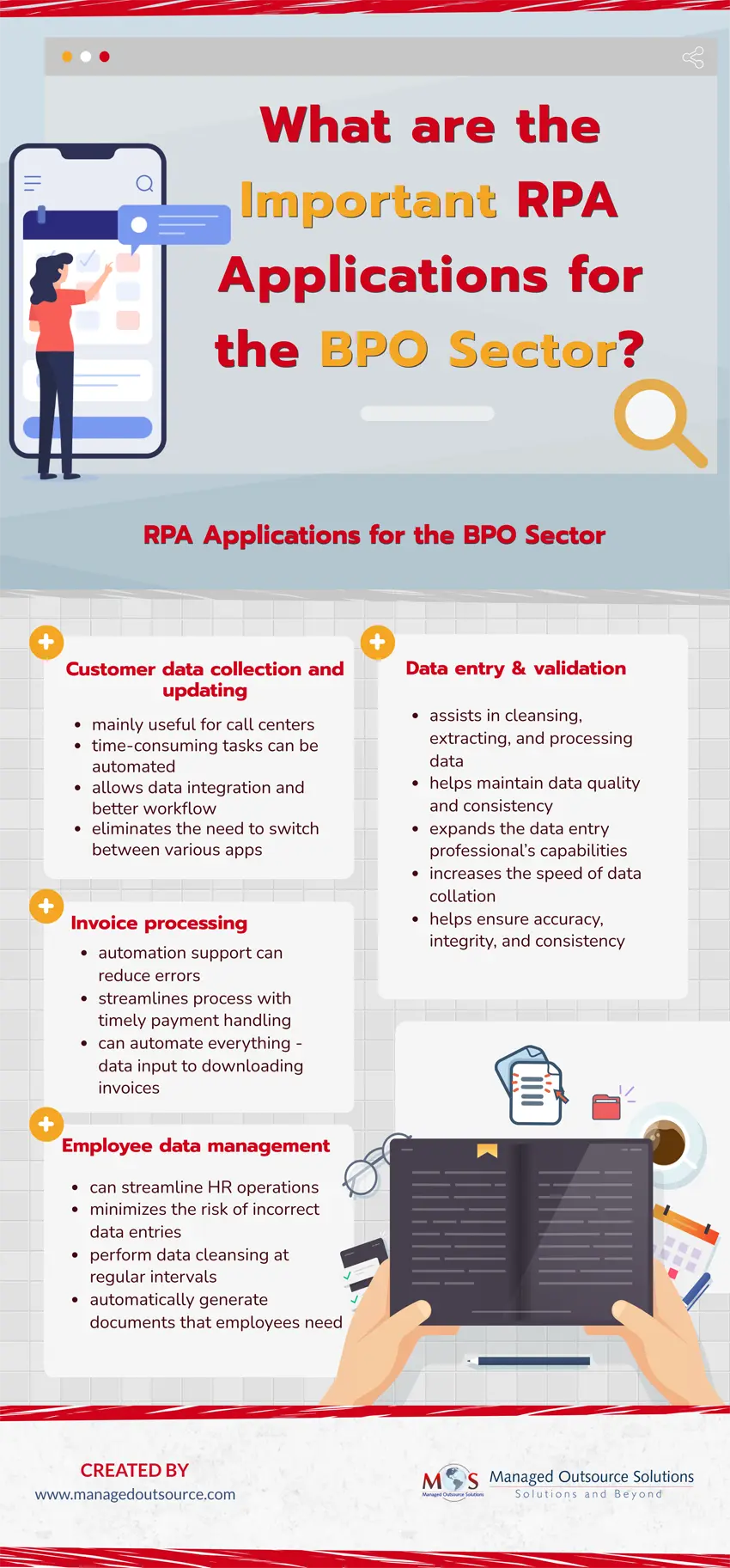
Robotic Process Automation (RPA) supports several operational areas in the BPO industry by automating repetitive and rule-based processes. These applications help organizations manage large volumes of data, streamline workflows, and maintain process consistency across departments. The following examples represent some of the major RPA use cases in business process outsourcing operations.
- Customer data collection and updating
RPA bots can gather customer information from multiple digital sources such as forms, emails, and internal databases. The bots automatically enter the collected information into CRM systems and update records when new details become available. This form of RPA for customer data processing reduces manual data entry work and ensures that customer records remain updated across platforms.
- Automated data entry and validation
Data entry is one of the most repetitive tasks handled by outsourcing teams. RPA tools can capture data from documents, spreadsheets, and digital forms and enter it into the required system fields. Bots can also validate entries by checking formats, verifying the required fields, and comparing information with existing records. This helps maintain consistency and reduces the chance of incorrect entries.
- Data cleansing and integration
In many BPO environments, data is stored in multiple systems. RPA bots can extract information from different sources, clean duplicate or outdated records, and integrate the information into a single system. Automated cleansing improves data quality and allows organizations to maintain structured databases.
- Customer query processing support
RPA can assist customer service teams by retrieving customer information quickly from backend systems. When a service representative receives a query, the bot can gather relevant account details, previous interactions, or order information. This reduces the time spent switching between systems and supports faster response handling.
- Invoice processing
RPA tools can automate multiple steps in invoice management. Many organizations implement RPA for invoice processing to extract invoice details from digital documents, enter the data into accounting systems, and verify information such as vendor details and payment amounts. Automation also supports downloading invoices, updating payment records, and forwarding invoices for approval when necessary.
- Payment verification and reconciliation
Bots can compare transaction records from accounting systems with bank statements or payment platforms. If discrepancies are found, the bot can flag the issue for manual review. This helps accounting teams identify mismatches faster and maintain accurate financial records.
- Report generation and data compilation
BPO companies generate operational and financial reports for internal monitoring or client communication. RPA bots can collect data from various applications, compile the information into predefined templates, and generate reports automatically. This reduces manual data gathering and ensures the reports are generated at scheduled intervals.
- Compliance documentation support
Many industries require regular documentation for regulatory compliance. RPA bots can collect the required data from different systems, organize it into structured documents, and store it in designated folders. This helps organizations maintain consistent documentation and reduces the time spent preparing reports manually.
- System data migration
When BPO organizations upgrade software platforms or migrate to new systems, large datasets must be transferred. RPA bots can automate the extraction of information from old systems and enter it into new platforms while preserving formatting and data accuracy. This reduces the time required for manual migration.
How AI Improves RPA Capabilities in BPO
- Handling unstructured data with ease
Traditional automation struggles with unstructured inputs like emails, PDFs, scanned files, or voice notes. When AI is integrated with RPA, technologies like NLP and OCR enable bots to extract, interpret, and process this data seamlessly. This enables BPO companies to automate tasks that previously required manual intervention.
- Enabling smarter decision-making
AI adds a cognitive layer to RPA by allowing bots to analyze patterns and make informed decisions. Instead of following fixed rules, these bots can adapt to different scenarios, reducing dependency on human oversight and improving overall efficiency.
- Powering chatbots and virtual assistants
With AI integration, RPA can support intelligent chatbots that understand natural language and respond contextually. This helps businesses automate customer interactions, improve response times, and deliver a more personalized experience.
- Driving predictive insights
AI-powered RPA can go beyond task execution by analyzing historical data to predict outcomes such as customer behavior or demand trends. This enables businesses to take proactive actions rather than reactive ones.
- Improving continuously over time
One of the biggest advantages of combining AI with RPA is continuous learning. AI algorithms monitor performance, identify inefficiencies, and optimize workflows—making automation smarter and more effective with each iteration.
The evolution of automation is redefining how BPO services operate, and AI-enabled RPA is at the center of this transformation. By combining automation with intelligence, businesses can streamline complex processes, handle unstructured data, and make faster, more accurate decisions. This not only improves efficiency and reduces costs but also enhances service quality and scalability across BPO operations.
However, while AI-powered RPA brings significant advantages, human involvement remains essential. Critical thinking, emotional intelligence, and contextual understanding are areas where humans continue to play a vital role—especially in handling exceptions, making strategic decisions, and ensuring quality control.
Ultimately, the real value lies in striking the right balance. AI-enabled RPA can take over repetitive and data-driven tasks, while human expertise ensures adaptability, accuracy, and a personalized approach