
Anyone who has worked with genealogy records understands the challenge—messy formats, inconsistent spellings, missing dates, and scattered sources that refuse to align.
Without standardized genealogy data entry, even the most valuable family history can quickly turn into a confusing puzzle. A single name may appear differently across records, dates may follow inconsistent formats, and locations can be recorded in multiple ways. Over time, these inconsistencies don’t just slow you down, they also compromise the accuracy and reliability of your entire family tree.
This is where technology is changing the game. With the help of AI-powered tools, genealogy data can now be cleaned, organized, and structured with far greater precision. AI can identify patterns, correct inconsistencies, and ensure uniformity across large datasets, making the process faster and far less prone to human error. What once required hours of manual effort can now be streamlined into an efficient, scalable process for ancestry record standardization.
Taking it a step further, advanced data entry services combine human expertise with intelligent automation to deliver truly reliable results. These services don’t just input data, they validate, standardize, and structure it according to best practices, ensuring your genealogy records are both accurate and easy to navigate. The result is a well-organized, trustworthy database that leaves you free to focus on uncovering stories from the past rather than fixing errors in the present.
Standardized genealogy data entry improves accuracy by ensuring consistent formats for names, dates, locations, and relationships. Using AI-powered tools and structured practices helps reduce errors, organize records efficiently, and support reliable genealogy data management.
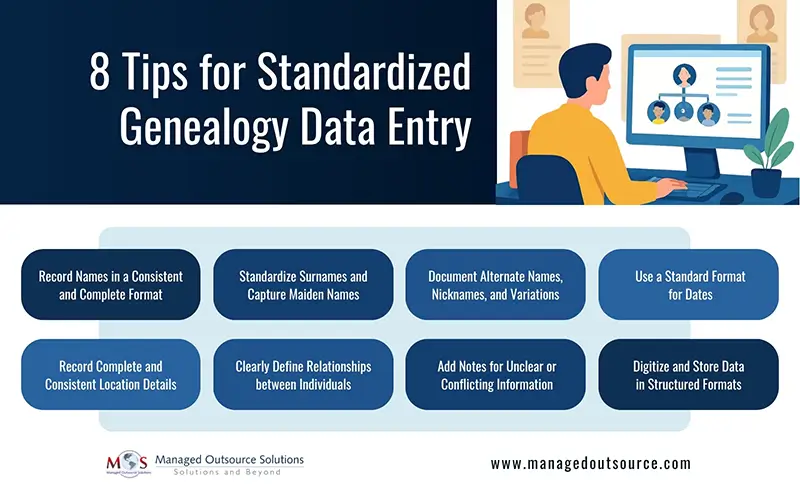
Tips for Standardized Genealogy Data Entry
Effective genealogy data management starts with consistent and well-structured data entry practices. Here are the key tips to ensure accuracy and uniformity:
- Record Names in a Consistent and Complete Format– Always enter names in the order of first, middle, and last name, using full names instead of initials wherever possible. This reduces ambiguity and ensures clarity across records. AI-powered data entry tools can extract names from unstructured documents and map them into standardized fields, ensuring uniformity even when working with historical or handwritten data.
- Standardize Surnames and Capture Maiden names– Use a consistent format for surnames (such as capitalizing them) and always include maiden names for women to preserve lineage accuracy. This is crucial for connecting family lines correctly. With AI, surname variations and maiden names can be identified and linked, preventing loss of critical ancestral connections during digitization.
- Document alternate names, nicknames, and variations– Record all known aliases, nicknames, and spelling variations. These variations often appear in different records and can lead to confusion if not documented properly. AI systems can recognize similar name patterns and group them under a single individual profile, improving searchability and reducing duplication.
- Use a Standard Format for Dates– Dates such as birth, marriage, and death should always follow a consistent format (for example, DD-MM-YYYY). Inconsistent date formats can lead to errors and misinterpretation. AI-powered tools can automatically detect and convert different date styles into a unified format, ensuring accuracy across all records.
- Record Complete and Consistent Location Details– Always include full place names of village/town, city, state, and country, when recording events. Avoid abbreviations unless they are standardized. AI can standardize geographic data across formats.
- Clearly Define Relationships Between Individuals– Genealogy data is built on relationships such as parent, spouse, child, sibling and these must be recorded clearly and consistently. AI-powered systems can automatically establish and validate relationships by analyzing patterns across datasets.
- Add Notes for Unclear or Conflicting Information– Whenever there are duplicate names, conflicting dates, or uncertain details, include notes to provide context. AI tools flag such inconsistencies during data entry and prompt for clarification.
- Digitize and Store Data in Structured Formats– All genealogy records should be digitized and stored in a structured database for easy access and long-term preservation. AI-powered data entry solutions can convert physical records, PDFs, and handwritten notes into structured, searchable formats, enabling efficient storage, quick retrieval, and scalable genealogy data management.
How DeepKnit AI Transforms Standardized Genealogy Data Entry
When working with large volumes of genealogy records, the real challenge isn’t just entry, it’s standardizing and digitizing data at scale without losing accuracy. This is where DeepKnit AI stands out, when it comes to improving accuracy in genealogy documentation.
DeepKnit AI is designed to handle unstructured data from multiple sources including handwritten documents, scanned records, PDFs, and legacy files and convert it into clean, structured, and standardized digital formats. Instead of manual sorting, the platform intelligently captures and organizes key genealogy fields like names, dates, locations, and relationships into predefined templates.
What makes this especially useful for genealogy is its ability to apply consistent formatting rules automatically, ensuring uniformity across all records without repetitive manual effort.
DeepKnit AI also includes built-in validation mechanisms that identify inconsistencies, missing fields, or irregular patterns during processing. This helps maintain data quality right at the point of entry, which is critical for reliable genealogy databases.
Another key strength is its adaptive learning capability. As it processes more records, the system improves its understanding of data patterns, such as historical naming conventions or regional variations, making future data entry faster and more consistent. With intelligent extraction, structured formatting, and automated validation, DeepKnit AI enables organizations to digitize genealogy records efficiently while maintaining a high level of standardization and accuracy.
Importantly, it combines automation with a human-in-the-loop review process, allowing final verification for sensitive or complex records. This ensures that while speed and efficiency are improved, accuracy and reliability are never compromised.
In the context of standardized genealogy data entry, DeepKnit AI doesn’t just speed up the process, it transforms it. By automating extraction, ensuring consistency, validating accuracy, and structuring data intelligently, it enables organizations and researchers to build reliable, scalable, and well-organized genealogy data management with ease.
Standardizing genealogy data is essential for building accurate and reliable family histories. By following consistent data entry practices and leveraging modern technology, organizations can eliminate inconsistencies and unlock the true value of their records. With the support of advanced data entry services, genealogy data can be efficiently digitized, validated, and structured at scale, ensuring long-term accuracy and accessibility. The result is a streamlined, trustworthy database that allows researchers to focus on discoveries rather than data corrections.
FAQs
Why is standardized genealogy data entry important?
It ensures consistency in records, reduces errors, and helps build accurate and reliable family trees.
How does AI improve genealogy data entry processes?
AI extracts, organizes, and standardizes data from unstructured sources, reducing manual effort and errors.
What types of genealogy data can be digitized using AI-powered data entry?
Names, dates (birth, death, marriage), locations, and family relationships from documents, PDFs, and images.
How does DeepKnit AI ensure accuracy in genealogy documentation?
It uses intelligent extraction, validation checks, and human review to maintain high data accuracy.