
Accurate and timely data is a basic requirement for every business. Sales reports, customer records, inventory, billing, compliance reports, and analytics all depend on the data entry process. When execution is weak, errors spread across systems, decisions slow down, and teams lose confidence in the numbers.
Many organizations understand that they need an effective approach, but they are not sure how to implement a data entry system that will work well for daily operations. Successful teams treat data entry as an organized system. They set clear goals, standardize the flow of information, choose tools, and keep improving based on actual results.
This post outlines five proven strategies for a successful data entry system, based on recommendations from data quality management experts. It focuses on steps that any organization can follow, whether they manage it in-house or work with outsourced services.
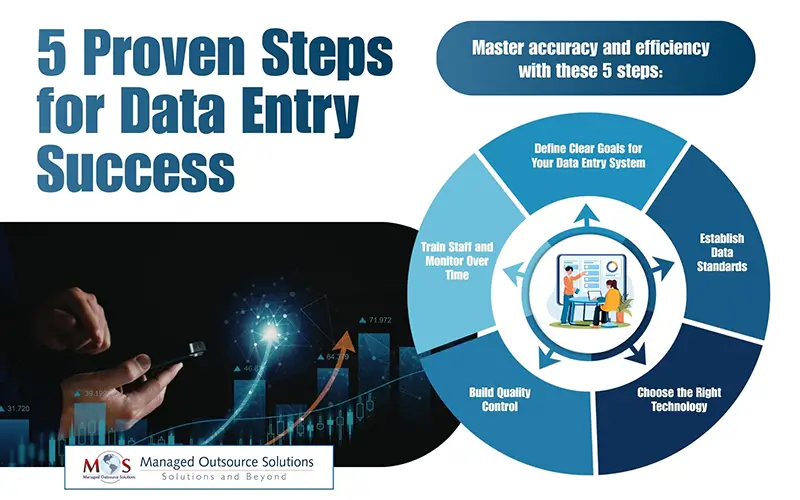
Key Steps to Build a Successful Data Entry System
1. Define Clear Goals for Your Data Entry System
Before purchasing software or redesigning workflows, an organization needs to decide what its data entry system must deliver. Many projects fail because teams move straight to tools without first identifying the problems they want to solve.
The first step is to map the role of information within the business:
- Which decisions rely on this information, such as billing, reporting, forecasting, or compliance?
- Which entry fields are truly essential, and which fields are useful but not critical?
- Where does the information originate, whether paper forms, emails, web forms, APIs, or IoT devices?
- Who uses the information and in which systems do they access it?
A simple list of requirements, similar to those suggested by experienced data entry providers, should include both business needs and current challenges. For example:
- Expected data types, such as text, numbers, images, or scanned documents
- Average and peak data volumes
- Required integrations with CRM, ERP, accounting, or industry-specific platforms
- Existing issues, such as duplicate records, missing fields, or slow turnaround times
This stage is the right time to set clear expectations for quality. When an organization defines targets for data entry accuracy and turnaround time, the team gains a strong base for system design. For example, customer-facing records may need very high accuracy and same-day updates, while internal reference lists may allow greater flexibility.
Finally, the organization should record any constraints and non-negotiable requirements, such as regulatory rules, data residency policies, and security standards. This early clarity supports better decisions later when the team compares tools, designs approval flows, and chooses what to automate or keep manual.
2. Establish Data Standards
Even the most advanced data entry system will fail if people use it differently. Data standardization ensures consistency and makes sharing and use across teams and applications easier.
Organizations should begin with input standards. Common guidelines include:
- Consistent formats for dates, phone numbers, and addresses
- Agreed codes for products, locations, and status fields
- Clear rules for capitalization, abbreviations, and naming
- Defined differences between required and optional fields
Standardized entry rules support stronger data quality management across the organization, especially when multiple teams work on the same records. When everyone follows the same formats, it becomes easier to combine, compare, and report on data from different systems.
There are several practical methods to enforce these standards:
- Use drop-down menus, checkboxes, and radio buttons instead of free text where possible
- Limit long text fields to special or rare situations
- Display examples or tooltips near each field to guide users
- Pre-fill common values based on context, such as branch, department, or location
Clear, written procedures are equally important. A short process guide should explain who enters which data, in what sequence, and how the team should handle exceptions. This guidance reduces confusion and helps new staff or vendors learn the system more quickly.
One real-world example comes from a regional healthcare provider that standardized how front desk staff recorded patient demographics across all clinics. Before this change, each location used different abbreviations and formats. After the organization introduced common rules and templates, analysts could rely on reports for coverage, visit patterns, and billing.
Throughout this effort, the organization should on data entry accuracy rather than speed alone. Simple and clear rules help staff enter correct data the first time without creating delays.
3. Choose the Right Technology
Technology choices strongly affect the success of any data entry system. The goal is not to select the most complex platform, but to choose tools that match the organization’s data types, volumes, and budget.
Modern data entry solutions include a range of features, such as:
- Optical Character Recognition (OCR) and Intelligent Character Recognition (ICR) for scanned documents
- Web and mobile forms with built-in validation rules
- Integration connectors for CRM, ERP, and other databases
- Dashboards and error reports designed for supervisors
More teams now use AI data entry tools that classify documents, extract fields, and improve through repeated corrections over time. AI-assisted data capture uses artificial intelligence, machine learning, and automation to collect, process, verify, and organize data with minimal human intervention. Unlike fully automated systems that operate independently, AI-assisted solutions incorporate human oversight and feedback to ensure greater speed, accuracy, and reliability.
When organizations apply these tools correctly, they can reduce manual typing and allow staff to focus on exceptions instead of routine keystrokes.
When decision makers review technology options, it is helpful to:
- Match tools to the complexity and volume of data, not just advertised features
- Check that users can configure validation rules without heavy custom coding
- Confirm that the system supports audit trails and role-based access control
- Ensure that export formats align with existing reporting and analytics tools
Planning the implementation is just as important as selecting the platform. Industry experts recommend installing, configuring, testing, and training users before the organization goes live. A phased rollout, starting with a pilot team or a single business unit, gives the project team time to resolve issues before broader deployment.
Many organizations also combine software with third-party support. A specialist provider might manage the platform, clear backlogs, or handle complex forms that are difficult to automate in-house. In some cases, the provider delivers the system as a service and manages upgrades, while the client focuses on process design and quality goals.
When an organization combines strong technology with clear standards and effective training, AI data entry components can work smoothly alongside manual tasks instead of creating new confusion or errors.
4.Build Quality Control
A successful data entry system treats quality as an ongoing activity, not as a one-time effort. This approach requires regular checks, reviews, and feedback within the daily workflow.
In most organizations, strong quality control includes three main layers:
- Pre-entry controls
-
- Clear forms and user interfaces that guide the person entering data
- Field validation, such as limits on length, allowed values, and date ranges
- Lookups against reference tables for items such as products or postcodes
- In-process checks
-
- Double-entry verification for important records, where two operators enter the same information and the system flags differences
- Real-time error messages when data appears incomplete or invalid
- Automated checks to detect duplicate customer or vendor records
- Post-entry review
-
- Sampling and audits, especially after system changes or when new staff join
- Automated reports that list common errors by field, team, or source system
- Regular clean-up activities to merge duplicates and fix common issues
All of these activities form part of a wider data quality management framework, which sets out how the organization measures and improves accuracy, completeness, and consistency over time. For instance, teams can monitor:
- The percentage of records that pass validation checks
- The number of corrections per thousand records
- The time required to resolve high-priority problems
These measures help leaders understand whether new processes, training programs, or tools are effective. They also point to areas that need extra support, such as specific branches or sources.
In one case, a financial services company began to use weekly quality reports that highlighted fields with frequent errors, such as account types and branch codes. Supervisors used these reports to guide staff and adjust on-screen prompts. Within a few months, customer complaints about incorrect details on statements decreased, and manual rework dropped noticeably.
A systematic approach to quality also supports compliance and audit needs. When data follows a traceable path with checks at each stage, it becomes easier for organizations to show how their controls operate in practice.
5.Train Staff and Monitor Over-time
Even with strong rules and good technology, a data entry system only works when people use it correctly. Training and ongoing support help keep the process stable as staff changes, data volumes grow, and business needs evolve.
Effective training programs include:
- Short, targeted sessions on data standards and how to use the system
- Practical exercises that use realistic examples from daily work
- Simple job aids that display correct formats and common error messages
- Refresher training sessions after system updates or changes in procedures
Supervisors play a key role in this area. They need to understand both the process and the quality reports so they can guide staff, set clear expectations, and recognize strong performance. When managers link performance reviews to agreed measures, such as error rates and turnaround times, they encourage consistent behavior across the team.
For some organizations, working with a data entry company is the most realistic way to expand operations while maintaining high standards. External specialists can provide trained staff, established processes, and dedicated quality control teams that smaller in-house groups may find hard to maintain.
When organizations select or review such partners, they should look for:
- Written procedures and relevant certifications
- Strong security practices and clear policies on data handling
- Open reporting on quality metrics and regular performance updates
- Flexibility to change volumes and service levels as business needs shift
Even when a business outsources work, internal teams must retain ownership of rules, priorities, and data governance. The best outcomes occur when internal leaders see the external provider as an extension of their own process rather than as a separate, hidden service.
Continuous monitoring completes the strategy. Organizations should:
- Review dashboards and error reports on a fixed schedule
- Update standards when new products, markets, or regulations appear
- Involve business users who rely on reports so they can report issues early
When organizations manage these steps properly, cooperation between internal teams and a trusted data entry company creates a reliable base for accurate, business-ready data.
Turning Best Practices to Daily Operations
The most effective data entry system does not rely on a single tool or policy. Instead, it depends on how all parts of the process work together in daily operations. Clear goals, standard processes, suitable technology, strong quality control, and steady training all support one another.
Today, AI has simplified the entire data entry process through automation. By combining robotic process automation (RPA) and AI-assisted data entry with human expertise, organizations can achieve faster, more accurate data processing at a significantly lower cost than traditional methods.
Organizations that treat data entry as a structured discipline find that other data projects become easier. Analytics, automation, and regulatory reporting all depend on stable and trustworthy input data. When leaders focus on basic quality and consistency, they avoid many hidden costs that come from correcting errors later.
These five best practices can act as a helpful checklist when organizations plan upgrades, bring in new teams, or review vendors. Any discussion about best practices for data entry management should begin with one simple question: does the current process reliably produce accurate, complete, and usable data for the people who need it?
When the organization answers this question and applies these best practices, it can build an efficient data entry system that supports growth, protect customers, and ensure decisions are based on solid, reliable information.
Want a successful data entry system?
Partner with us to apply these proven strategies and eliminate errors from your operations.
Contact Us