
Margins in food service remain under constant pressure. Rising labor costs, fluctuating ingredient prices, delivery platform fees, and changing customer expectations continue to challenge profitability. In this environment, operational efficiency becomes essential rather than optional. One area that many operators overlook is restaurant data entry, a process that directly affects inventory visibility, payroll accuracy, vendor payments, menu consistency, and customer experience. When businesses manage information inefficiently, errors multiply across systems, increase operating costs, and reduce profitability. Outsourcing administrative workflows can help operators improve accuracy, reduce internal workload, and focus more resources on customer service and revenue generation.
Why Information Accuracy Matters in Food Service Operations
Every hospitality business depends on accurate operational records to function efficiently. Point-of-sale transactions, supplier invoices, menu updates, employee schedules, online orders, and inventory logs all generate large volumes of information daily. Even small inaccuracies can disrupt workflows and create avoidable expenses.
For example:
- Incorrect menu updates can result in pricing inconsistencies across delivery platforms
- Invoice mismatches may lead to overpayments or supplier disputes
- Payroll errors can affect employee satisfaction and retention
- Inventory inaccuracies contribute to waste or stock shortages
Operational precision becomes especially important for multi-location brands where consistency directly influences customer trust and financial performance.
National Restaurant Association research consistently identifies labor and food costs among the most significant operating expenses for food service businesses, making operational efficiency increasingly important for profitability.
When internal teams spend excessive time correcting avoidable administrative mistakes, businesses lose valuable resources that could support growth initiatives.
Understanding the Scope of Restaurant Data Entry
Many operators associate administrative processing only with invoice management or sales reporting. Information handling spans multiple operational areas and directly influences profitability.
Menu and Pricing Updates
Businesses frequently modify menus due to supplier costs, seasonal availability, or promotional campaigns. Teams must maintain consistency across:
- POS systems
- Delivery apps
- Online ordering platforms
- In-store digital menus
Inaccurate updates create customer dissatisfaction and refund requests.
Vendor Invoice Processing
Operators manage invoices from multiple suppliers, each using different formats and schedules. Delayed or incorrect recording creates accounting discrepancies and cash flow complications.
Inventory Records
Accurate stock tracking helps businesses:
- Reduce food waste
- Improve purchasing decisions
- Avoid stockouts
- Maintain margin control
Payroll and Workforce Administration
Employee schedules, overtime, tip reporting, and attendance records require careful management to avoid payroll discrepancies.
Customer and Order Information
Delivery platforms generate large volumes of customer and order-related records that require consistent organization and reconciliation.
As these workflows intersect with financial performance, errors in administrative handling can directly reduce profitability.
How Outsourcing Improves Operational Efficiency
Outsourcing creates a dedicated support structure that improves operational consistency.
Reduced Administrative Burden
Managers spend less time processing invoices, updating systems, or reconciling records. This shift enables leadership teams to focus on:
- Customer experience
- Staff management
- Sales growth
- Operational strategy
Faster Processing Cycles
External specialists process information using standardized workflows, reducing turnaround times and minimizing delays.
Improved Accuracy
Dedicated teams follow established validation processes that reduce inconsistencies across platforms and systems.
Scalability during High-demand Periods
Seasonal fluctuations, promotions, and expansion can dramatically increase administrative volume. Outsourced teams help businesses scale without rapidly increasing headcount.
This operational flexibility helps organizations maintain service quality while controlling labor costs.
The Financial Impact of Administrative Errors
Administrative inefficiencies rarely appear as a single major expense. Instead, they accumulate through recurring small losses that affect profitability over time.
Common hidden costs include:
- Refunds from pricing discrepancies
- Inventory waste caused by inaccurate tracking
- Labor spent correcting mistakes
- Delayed invoice reconciliation
- Payroll disputes and overtime corrections
Research by McKinsey highlights that organizations increasingly adopt automation to reduce operational inefficiencies and improve productivity across high-volume business environments.
For operators working with narrow margins, reducing recurring inefficiencies can produce meaningful bottom-line improvements.
Where Administrative Mistakes Quietly Reduce Margins
Many operators underestimate how small administrative inaccuracies accumulate into measurable financial losses. The impact rarely appears as a single operational failure. Instead, profitability declines through repeated inefficiencies that affect purchasing, labor allocation, and customer trust.
Consider menu pricing synchronization. A location updates in-store pricing but fails to reflect the same change across delivery marketplaces. Customers place orders using outdated prices, forcing managers to absorb margin losses or issue refunds. When this issue occurs repeatedly across multiple platforms, profitability declines without immediate visibility.
Inventory discrepancies create another overlooked problem. Suppose a kitchen team records ingredient usage inconsistently across shifts. Purchasing teams may overestimate available stock and delay reordering. This can result in emergency supplier purchases at higher prices or menu unavailability during peak periods.
Vendor invoice mismatches also create avoidable leakage. Duplicate invoices, incorrect quantities, or inconsistent item descriptions may pass through unnoticed during busy service periods. Over time, these discrepancies affect cash flow and purchasing decisions.
Labor administration introduces similar risks. Minor payroll inaccuracies, tip allocation inconsistencies, or missed overtime calculations can create employee dissatisfaction and administrative corrections that consume management time.
Operators who address these friction points systematically gain stronger cost control and clearer operational visibility.
Why Restaurant Data Entry Becomes Difficult to Manage Internally
- High Transaction Volume
- Multiple Platforms
- POS software
- Delivery platforms
- Reservation systems
- Accounting tools
- Inventory management systems
- Staffing Constraints
- Rapid Business Changes
- Use varying naming conventions
- Record supplier information inconsistently
- Apply pricing updates unevenly
- Maintain separate inventory practices
- Financial reporting accuracy
- Operational transparency
- Vendor reconciliation
- Menu consistency
- Faster invoice processing
- Better synchronization across platforms
- Reduced manual workload
- Improved operational visibility
- Vendor invoice processing
- Menu uploads and updates
- POS reconciliation
- Payroll-related administration
- Inventory records management
- Online order reconciliation
- Reduced administrative workload
- Lower error rates
- Faster invoice turnaround
- Improved payroll accuracy
- Better inventory visibility
- Increased managerial focus on customer experience
Hospitality businesses process large numbers of orders, supplier invoices, receipts, and schedule changes daily. Manual handling increases the likelihood of inconsistencies.
Modern operators rely on several systems simultaneously, including:
Keeping information synchronized across platforms requires continuous effort.
Front-of-house and management teams typically prioritize guest experience over administrative tasks. As a result, internal record management may become inconsistent.
Menu modifications, staffing changes, vendor substitutions, and promotional pricing require constant updates.
Without dedicated operational support, internal teams may struggle to maintain consistency across systems.
Restaurant Data Entry and Multi-location Consistency
For businesses operating multiple locations, administrative consistency becomes significantly more challenging.
Different locations may:
These inconsistencies create reporting problems and reduce visibility into business performance.
Centralized processing creates uniform standards that improve:
Leaders gain clearer visibility into performance across locations, which improves decision-making.
How AI Is Transforming Administrative Workflows
Artificial intelligence continues to reshape operational support functions across industries, including hospitality. Instead of relying entirely on manual handling, organizations increasingly adopt AI-assisted workflows to improve efficiency and accuracy.
AI-Assisted Invoice Processing
AI-enabled systems extract information from invoices automatically and organize it for review. This reduces repetitive manual work and accelerates reconciliation.
AI-Driven Validation
Modern tools identify inconsistencies in pricing, supplier details, and transaction records before they affect downstream systems.
Automated Menu Synchronization
AI tools support faster updates across ordering platforms, reducing mismatched pricing and outdated menu listings.
Predictive Inventory Insights
AI-driven analytics help operators anticipate purchasing requirements based on historical trends and seasonal demand.
National Restaurant Association industry research indicates that operators increasingly prioritize technology investments that improve efficiency and workforce productivity.
These developments demonstrate how intelligent automation supports stronger operational control.
The Role of AI Data Entry Services in Hospitality
Modern AI data entry services combine automation with human oversight to improve workflow reliability. Rather than replacing staff entirely, these solutions improve how businesses manage repetitive administrative functions.
Key advantages include:
AI-assisted approaches also help businesses adapt more easily to fluctuations in transaction volume.
Choosing the Right Tasks to Outsource
Not every administrative process requires external support. Operators should prioritize workflows that consume excessive time or create recurring inaccuracies.
Good candidates include:
Selecting high-impact functions produces measurable efficiency gains without disrupting daily operations.
What to Look for in Outsourcing Partners
Choosing the right data entry provider requires more than cost comparison. Operators should evaluate partners based on operational reliability and hospitality experience.
Key considerations include:
Industry Knowledge
Providers should understand hospitality-specific systems and workflows.
Accuracy Controls
Validation protocols reduce inconsistencies and improve reliability.
Scalability
Support teams should manage volume increases during seasonal demand or expansion.
Technology Integration
Providers must work effectively with POS systems, inventory tools, and accounting software.
Businesses seeking data entry services should prioritize providers that demonstrate operational discipline and process transparency.
Overcoming Common Concerns About Outsourcing
Some operators hesitate to externalize administrative functions due to concerns about quality or control. However, these concerns can be addressed through structured workflows and performance monitoring.
Loss of Oversight
Clear reporting mechanisms maintain visibility into performance.
Quality Concerns
Defined quality benchmarks improve consistency.
Security Risks
Strong providers implement controlled access and secure handling practices.
Workflow Disruption
Gradual implementation reduces operational friction and simplifies transition.
Organizations that take a strategic approach to outsourced data entry services generally achieve smoother implementation and stronger long-term outcomes.
Measuring the Return on Investment
Outsourcing decisions should produce measurable operational improvements.
Businesses can evaluate impact through:
These improvements collectively strengthen profitability by reducing waste and improving operational efficiency.
Strengthening Profitability Through Smarter Operations
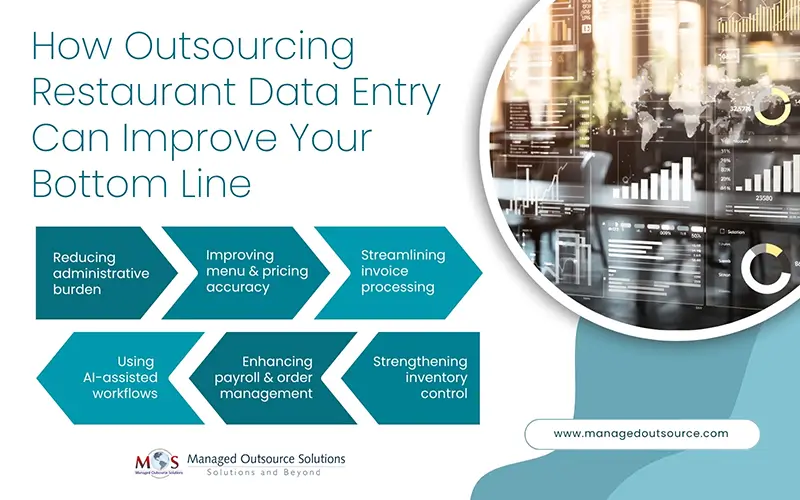
Profitability in hospitality depends on operational precision as much as customer demand. Administrative inefficiencies quietly reduce margins through avoidable errors, wasted labor, and inconsistent workflows. By improving accuracy, reducing internal workload, and strengthening operational visibility, outsourcing can help operators focus on service quality and growth. As AI-assisted technologies continue to improve efficiency, businesses gain stronger tools to manage complex workflows at scale. Companies that invest in efficient restaurant data entry processes and strategic data entry outsourcing position themselves to reduce costs, improve consistency, and strengthen long-term financial performance.
Want to improve profitability through better operational control?