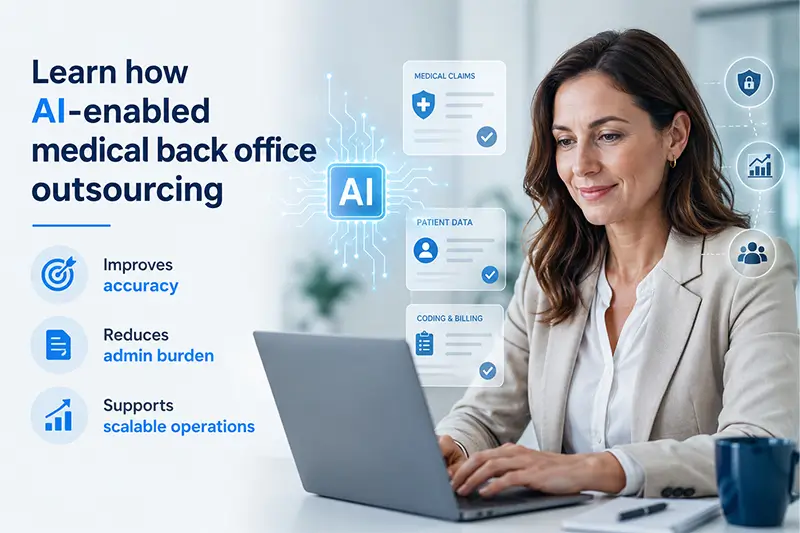
Healthcare practice owners across the United States confront an operational environment of mounting complexity. Administrative workloads are expanding, compliance expectations are tightening, and reimbursement cycles are growing more unpredictable. In this evolving landscape, medical back office outsourcing is no longer just a staffing strategy; it is becoming an AI-enabled transformation model that fundamentally reshapes how administrative work gets done.
What makes this different from previous outsourcing cycles is the emergence of intelligent workflow ecosystems powered by embedded AI that can interpret data, predict risks, and continuously optimize execution. Healthcare practices are no longer simply delegating tasks; they are deploying intelligent automation layers that interpret data, predict risks, prioritize actions, and support faster decision-making. Technologies like DeepKnit AI are redefining how back office functions operate with precision, adaptability, and scale.
The urgency behind this shift is driven by multiple industry pressures. Administrative volumes continue to rise as patient demand increases. Documentation complexity has grown due to payer requirements and coding updates. Compliance risks are intensifying under regulatory scrutiny. Time pressures on staff are accelerating due to staffing shortages and operational backlogs. These pressures create a fragile operating environment where delays, inaccuracies, and inefficiencies quickly translate into financial and reputational risk.
This post explores how AI-driven transformation is reshaping back office operations for healthcare practices. Specifically, it covers the key challenges driving adoption, how AI-enabled workflows function, the role of human expertise, business advantages of AI-assisted operations, real-world use cases, implementation considerations, and the future trajectory of AI-enabled administrative ecosystems.
Reduce medical administrative burden.
Transform workflows with DeepKnit AI-powered outsourcing.
Call: (800) 670-2809
Medical Back Office Outsourcing in the AI Era
Traditional outsourcing models were built around task delegation. Administrative functions were transferred to external teams to reduce overhead and manage workload. While this model improved efficiency to a certain extent, it relied heavily on manual execution and static workflows. That approach struggles to keep pace with modern operational demands.
Today, medical back office outsourcing is evolving into an intelligent operational model powered by embedded AI engines like DeepKnit AI. Instead of simply executing assigned tasks, outsourced workflows are becoming AI-assisted environments capable of interpreting incoming data, identifying anomalies, and optimizing execution sequences in real time.
This shift matters because healthcare administrative workflows are no longer linear. Claims, eligibility verification, documentation review, coding, and compliance monitoring are interconnected processes. A delay or error in one stage creates cascading impacts across the entire workflow chain. AI-enabled outsourcing addresses this interconnected complexity by enabling dynamic workflow orchestration.
For healthcare practice owners, this represents a strategic pivot from reactive administration to predictive operational control.
Key Industry Challenges Driving AI Adoption
Healthcare back office operations face persistent structural challenges that cannot be solved through staffing increases alone. AI-driven outsourcing is gaining momentum because it directly addresses these underlying pressures.
Rising Administrative Volume
Healthcare practices are handling significantly higher administrative volumes than in previous years. Increased patient visits, expanded documentation requirements, and evolving payer guidelines create continuous workflow expansion. Manual systems struggle to maintain pace, resulting in processing delays and backlog accumulation.
AI-assisted systems address this challenge by automatically categorizing incoming documentation, routing tasks to appropriate workflows, and prioritizing time-sensitive activities.
Workflow Complexity and Fragmentation
Administrative workflows span multiple systems, teams, and documentation formats. Fragmented data sources create inefficiencies and increase the likelihood of data inconsistencies.
DeepKnit AI integrates workflow streams by consolidating data from multiple sources into a unified operational environment. This reduces fragmentation and supports synchronized workflow execution.
Compliance Pressure
Regulatory compliance is a constant concern in healthcare operations. Errors in documentation, coding, or data handling can result in audits, penalties, or revenue losses.
AI-enabled compliance monitoring systems continuously scan workflows to detect inconsistencies and flag potential risks before submission or processing.
Time Pressure and Staffing Limitations
Healthcare practices frequently face workforce shortages. Administrative staff operate under intense time pressure, leading to fatigue-driven errors.
AI-assisted automation reduces repetitive workloads and shifts human staff focus toward tasks requiring interpretation, judgment, and oversight.
Documentation Complexity
Healthcare documentation requirements continue to evolve. Variations in payer rules and coding updates increase administrative burden.
AI-driven natural language processing models analyze documentation patterns and align them with standardized requirements, improving consistency and accuracy.
How AI Works Inside Back Office Operations
Understanding how AI functions within outsourced workflows is essential for evaluating its operational value. DeepKnit AI acts as an embedded orchestration engine that continuously analyzes, prioritizes, and executes administrative processes.
AI-assisted Data Intake
Incoming documentation arrives in multiple formats, including digital forms, scanned records, structured templates, and provider notes. AI-enabled intake systems automatically extract relevant data fields and validate completeness.
This reduces manual entry requirements and minimizes transcription errors.
Intelligent Workflow Routing
Once data is captured, DeepKnit AI assigns tasks to appropriate workflow queues based on urgency, payer type, documentation complexity, and historical performance patterns.
This ensures that time-sensitive tasks receive immediate attention while lower-priority tasks are scheduled strategically.
Predictive Error Detection
One of the most transformative capabilities of AI-driven systems is predictive validation. Before workflows advance to the next stage, the system analyzes data for anomalies, missing fields, or inconsistencies.
For example, during medical claims processing, AI-assisted validation engines compare documentation inputs against payer-specific rules and identify discrepancies that may result in denials.
Adaptive Learning Mechanisms
AI systems improve continuously through learning cycles. Each processed transaction contributes to the system’s predictive model, enhancing its ability to recognize recurring errors and optimize workflows.
DeepKnit AI leverages adaptive learning to refine processing accuracy over time.
Exception Management
Not all workflows can be fully automated. Some cases require human intervention due to unusual documentation or regulatory complexities.
AI-driven exception detection isolates these cases, routing them to specialized personnel for review.
The Role of Human Expertise in AI-Assisted Operations
AI transformation does not eliminate human involvement. Instead, it elevates the role of human expertise within administrative workflows.
Judgment-based Decision Making
Certain administrative tasks require contextual interpretation. Human experts validate AI recommendations and apply professional judgment when necessary.
Compliance Oversight
Human specialists remain responsible for verifying adherence to regulatory requirements. AI systems provide alerts, but compliance accountability remains human-driven.
Exception Handling
Complex or atypical cases require manual resolution. AI systems identify these exceptions and route them to experienced professionals for efficient intervention.
Continuous Workflow Improvement
Human teams analyze AI performance metrics to refine operational strategies and improve workflow design.
This collaborative model, which combines AI precision with human expertise, creates a balanced operational ecosystem.
Business Benefits of AI-driven Outsourcing
AI-enabled outsourcing delivers measurable operational advantages that extend beyond cost reduction.
Improved Financial Predictability
AI-assisted workflows reduce delays and inaccuracies that disrupt revenue cycles. Faster processing improves financial forecasting reliability.
Reduced Operational Volatility
Automated validation reduces variability in workflow outcomes. This creates consistent performance across administrative cycles.
Enhanced Revenue Accuracy
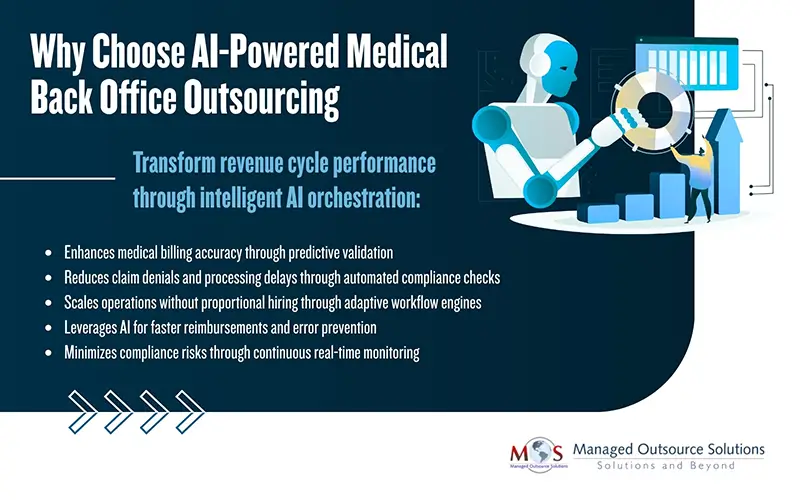
AI-driven validation improves the accuracy of medical billing workflows by ensuring proper documentation alignment before submission.
Workflow Transparency
AI-enabled dashboards provide real-time performance insights. Practice owners gain visibility into workflow status, backlog levels, and processing timelines.
Scalability without Workforce Expansion
AI-assisted operations scale dynamically as workflow volumes increase. This enables practices to expand services without proportional staffing growth.
Strengthened Compliance Posture
Continuous monitoring reduces regulatory risk exposure and supports audit readiness.
Real-world Scenario-based Use Cases
AI-driven outsourcing demonstrates measurable value across multiple operational scenarios.
Scenario 1: Eligibility Verification Acceleration
A multi-specialty practice receives hundreds of daily patient scheduling requests. Manual verification processes create delays and scheduling bottlenecks.
With AI-assisted eligibility validation, DeepKnit AI automatically cross-checks insurance data against payer databases and confirms eligibility in seconds.
Result:
- Faster appointment confirmation
- Reduced administrative workload
- Improved patient satisfaction
Scenario 2: Denial Prevention through Predictive Validation
During medical claims processing, incomplete documentation frequently results in payer rejections.
AI-driven validation engines identify missing documentation before submission, reducing denial frequency and accelerating reimbursement cycles.
Result:
- Fewer rework cycles
- Reduced processing delays
- Improved cash flow stability
Scenario 3: Coding Consistency Optimization
Complex documentation leads to coding inconsistencies.
AI-enabled coding support systems analyze provider notes and recommend standardized coding patterns aligned with payer guidelines.
Result:
- Improved coding consistency
- Reduced compliance risk
- Enhanced workflow accuracy
Scenario 4: Queue Prioritization Intelligence
Administrative backlogs occur during peak seasons.
AI-assisted queue prioritization identifies high-risk cases and processes them first, preventing cascading delays.
Result:
- Reduced backlog accumulation
- Improved operational stability
Scenario 5: Revenue Cycle Visibility Enhancement
Limited visibility into workflow status makes it difficult to identify bottlenecks.
AI-enabled reporting dashboards provide real-time insights into medical billing performance and backlog trends.
Result:
- Data-driven decision-making
- Improved workflow management
Implementation Challenges and Strategic Considerations
While AI-driven outsourcing delivers substantial advantages, implementation requires careful planning and execution.
System Integration Complexity
Healthcare practices rely on multiple legacy systems. Integrating AI-enabled workflows into existing infrastructure requires strategic planning and technical coordination.
Data Standardization Requirements
AI systems rely on consistent data formats. Inconsistent documentation structures must be standardized before implementation.
Governance Framework Development
Clear governance policies must define workflow ownership, validation protocols, and escalation procedures.
Workforce Transition Management
Staff adoption plays a critical role in implementation success. Training programs are necessary to align teams with AI-enabled workflows.
Security and Compliance Safeguards
Data security remains a top priority. AI systems must operate within strict regulatory frameworks, including HIPAA compliance standards.
Vendor Capability Evaluation
Healthcare practice owners must evaluate outsourcing providers based on AI maturity, scalability potential, and compliance capabilities.
Selecting outsourced solutions supported by embedded AI engines ensures long-term operational resilience.
Future Trends in AI-Enabled Back Office Transformation
The next generation of healthcare administrative systems will be defined by predictive intelligence and autonomous workflow optimization.
Predictive Compliance Monitoring
AI-enabled systems will forecast potential compliance risks before they occur, enabling proactive corrections.
Autonomous Workflow Routing
Future AI engines will assign tasks dynamically based on workload conditions and performance history.
Generative Documentation Support
AI-assisted documentation generation tools will help providers create structured records more efficiently.
Performance Forecasting Models
AI-driven forecasting tools will predict workflow bottlenecks and recommend preventive adjustments.
Hyper-Personalized Workflow Optimization
Administrative processes will adapt dynamically to practice-specific patterns and operational preferences.
Organizations that adopt AI-enabled outsourced solutions early will establish operational advantages that compound over time.
Why AI-Enabled Outsourcing Is No Longer Optional
Healthcare administration faces structural transformation from rising volumes, tightening compliance, and workforce constraints. Traditional outsourcing cannot sustain performance in this environment. AI-enabled medical back office outsourcing, powered by orchestration engines like DeepKnit AI, delivers automation, predictive intelligence, and adaptive workflows that secure revenue stability and operational continuity.
Practices that recognize this transformation early and invest strategically in AI-driven administrative ecosystems will build the resilience required for healthcare’s future.