
Have you ever wondered why your CRM insights or marketing reports don’t always match your expectations – even with advanced tools in place? The answer often lies in the quality of your data. When business data is cluttered with duplicates, outdated entries, or inconsistencies, even the best systems deliver poor results. That’s where data cleansing comes in.
In today’s data-driven business landscape, success depends on the quality of the information powering your systems. Data cleansing, the process of detecting and correcting inaccurate, incomplete, or irrelevant records, ensures that your business decisions are based on reliable information.
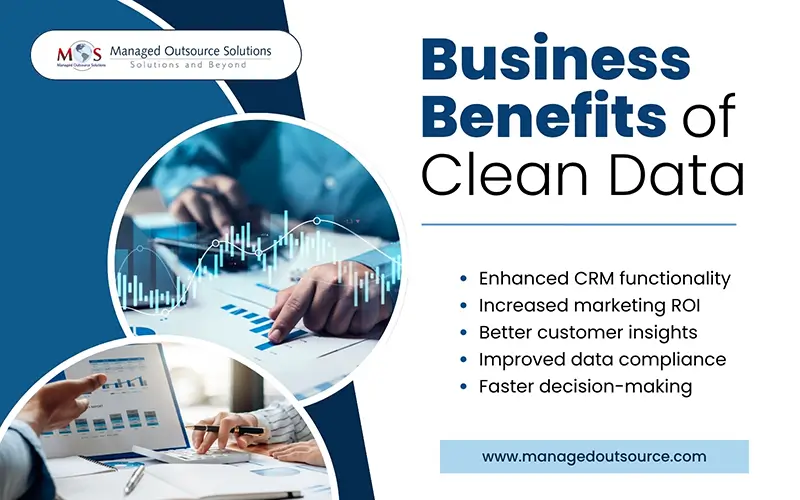
By investing in professional data cleansing services and ongoing data quality management, organizations can improve customer relationship management (CRM) accuracy. Accuracy is key for effective marketing campaigns and confident decision making that can drive better ROI across every department.
In this post, we look into how data cleansing improves CRM performance, boosts marketing accuracy, and supports smarter, data-driven decision-making for sustainable business growth.
Why Data Cleansing Matters for Every Business
The process involves using advanced tools and techniques to remove duplicates, correct errors, and fill in missing or incomplete information within datasets.
Poor-quality or “dirty” data filled with inaccuracies can have far-reaching consequences. According to Gartner, poor data quality can cost businesses an average of around $9.7 million annually.
Inaccurate contact details can cause lost leads, missed sales opportunities, and impact customer trust. Decisions made based on unreliable information results in resource wasted on ineffective initiatives and missed market opportunities, ultimately affecting a company’s competitiveness and long-term growth. AI data analytics platform Secoda reports that poor data quality can cost businesses 15% to 25% of their annual revenue through wasted efforts, inaccurate targeting, and inefficient processes.
Business data cleaning involves standardization, validation, and deduplication to enhance data quality. The process begins with a comprehensive audit to identify inaccurate or outdated records, followed by automated tools and manual verification to correct errors and update information. AI-powered data cleansing further improves efficiency by detecting patterns, predicting missing values, and validating data faster than human teams – helping maintain data integrity while saving time and resources.
How Data Cleansing Improves CRM Performance
CRM data hygiene ensures accurate customer records and profiles by removing duplicates, correcting errors, standardizing formats, and filling in missing information. This improves customer segmentation, personalization, and trust in analytics, leading to better customer service, marketing, and sales.
For example, suppose a retail company that finds CRM system inconsistencies such as multiple entries for the same customer, outdated contact details, and incomplete purchase histories. These issues led to duplicate marketing emails, missed follow-ups, and poor customer engagement.
The company implements a data cleansing initiative for standardizing customer names, merging duplicate records, and updating missing contact information. This resulted in accurate, unified customer profiles, which improved personalized campaigns, open rates, and customer satisfaction scores.
Importance of Clean Data in Marketing Campaigns
Accuracy is essential for effective marketing as it directly improves the quality of targeting and the reliability of campaign analytics. When information is correct and well-organized, marketers to segment audiences based on genuine characteristics, behaviors, and preferences, supporting highly personalized and relevant messaging. The key benefits of accurate data for marketing campaigns are:
- Improved lead quality: With accurate information, marketing teams can create well-defined audience segments and target the right people with customized messages. This results in stronger engagement and better ROI from every campaign.
- Reduced bounce rates: By removing invalid, outdated, and unengaged email addresses from a list, data cleansing reduces bounce rates. Focusing efforts on customers who are genuinely interested in your product/services leads to higher open and click-through rates – and potentially higher conversion rates.
- Avoids wasted ad spend: Accurate contact information (e.g., email addresses, phone numbers) ensures messages are delivered successfully, minimizing wasted ad spend on non-existent or unreachable prospects.
According to HubSpot, a publishing house that implemented data cleansing to validate their datasets, and reduce duplicates and undelivered mail, saw a 12% increase in orders and saved $800,000 in wasted mailing costs.
Better Decision-Making through Clean Data
Executives and analysts rely on clean, consistent inputs for forecasting, budgeting, and performance tracking. Duplications, outdated entries, and errors can distort insights and hinder strategic decision-making.
Data cleaning:
- Enables precise financial modeling: Clean financial data supports accurate modeling and forecasting, helping organizations predict future trends and prepare effectively.
- Enhances automation efficiency: High-quality inputs allows automation tools – such as analytics dashboards and transaction processing systems – to perform more efficiently, reducing the need for manual intervention.
- Promotes transparency and accountability: Maintaining strong hygiene fosters a culture of accuracy, transparency, and excellence within finance teams, setting higher standards across operations.
Cleaning and standardizing data ensures seamless data integration in various areas, supporting unified business intelligence and collaboration across all departments.
Data Cleansing: The Value of Expert Support
In a world where every business decision depends on data, accuracy is essential. Clean, reliable data leads to stronger CRM performance, more effective marketing campaigns, and smarter decision-making at every level. Yet, maintaining data quality takes time, tools, and expertise.
Partnering with a professional data cleansing service can ensure a strong strategy to ensure your databases remain accurate, up to date, and ready to deliver meaningful insights. From removing duplicates to validating records and automating quality checks, expert support helps you turn raw information into a powerful business asset – driving efficiency, growth, and lasting customer trust.