
The construction sector generates an extraordinary volume of information across every project phase, spanning procurement records, subcontractor agreements, compliance documentation, payroll inputs, and materials tracking. Managing this information with speed, consistency, and accuracy has become a defining operational challenge. Innovative data entry solutions help contractors and project managers organize and manage large volumes of administrative work more efficiently, reducing delays in billing, audits, and project reporting. For firms processing records at scale, data entry automation further strengthens throughput by reducing manual handling at every stage of the document lifecycle.
For an industry where margins are already under pressure, inaccurate or slow information handling compounds risk at every level of project execution. Delays in document processing translate directly into delayed invoicing, stalled procurement approvals, and gaps in regulatory compliance.
Why Information Handling in Construction Demands Attention
Few industries generate administrative complexity at the pace of large-scale construction. A single project may involve dozens of subcontractors, multiple regulatory bodies, layered insurance requirements, materials sourcing from several vendors, and real-time workforce tracking across rotating shifts.
A joint report by Autodesk and FMI Corporation estimated that inaccurate or incomplete project information may have cost the global construction industry approximately $1.85 trillion in 2020 alone, with bad data linked to 14% of otherwise avoidable rework, amounting to roughly $88 billion in unnecessary costs.
The impact cascades across departments:
- Incorrect materials entries disrupt inventory planning and procurement coordination
- Inaccurate payroll inputs create compliance exposure and delay disbursements
- Duplicate contract records create version control problems during audits
- Delayed subcontractor invoice processing strains vendor relationships
- Inconsistent documentation formats slow down regulatory submissions
These are not isolated incidents. They reflect systemic weaknesses in how construction organizations capture, verify, and route administrative records, weaknesses that worsen as project scale increases.
Where Construction Workflows Break Down
Understanding where inefficiency originates is the first step toward correcting it. Across the sector, several recurring failure points emerge regardless of project size or geography.
Fragmented Document Ecosystems
Construction projects operate across multiple platforms simultaneously, including project management software, accounting systems, procurement tools, and workforce management applications. When these systems do not communicate with each other, teams must re-enter the same records across platforms, increasing both workload and the likelihood of discrepancy.
Inconsistent Input Standards
Field teams, site supervisors, and back-office personnel may each follow different formatting conventions when recording materials received, hours logged, or change orders submitted. Without standardized inputs, reconciliation becomes time-consuming and error-prone.
High Document Volumes Under Time Pressure
Large-scale projects may generate thousands of daily records, including inspection checklists, delivery receipts, workforce logs, and equipment usage reports. Processing these at speed without structured workflows leads to backlogs that delay billing and reporting.
Manual Exception Handling
Missing fields, mismatched invoice amounts, or incomplete compliance records require manual intervention. Without a defined escalation process, exceptions create bottlenecks that slow broader administrative workflows.
Innovative Data Entry Solutions for the Construction Industry
Addressing these documentation challenges in the construction sector requires more than additional administrative headcount. It demands structured solutions built to handle volume, enforce consistency and integrate with existing project management ecosystems.
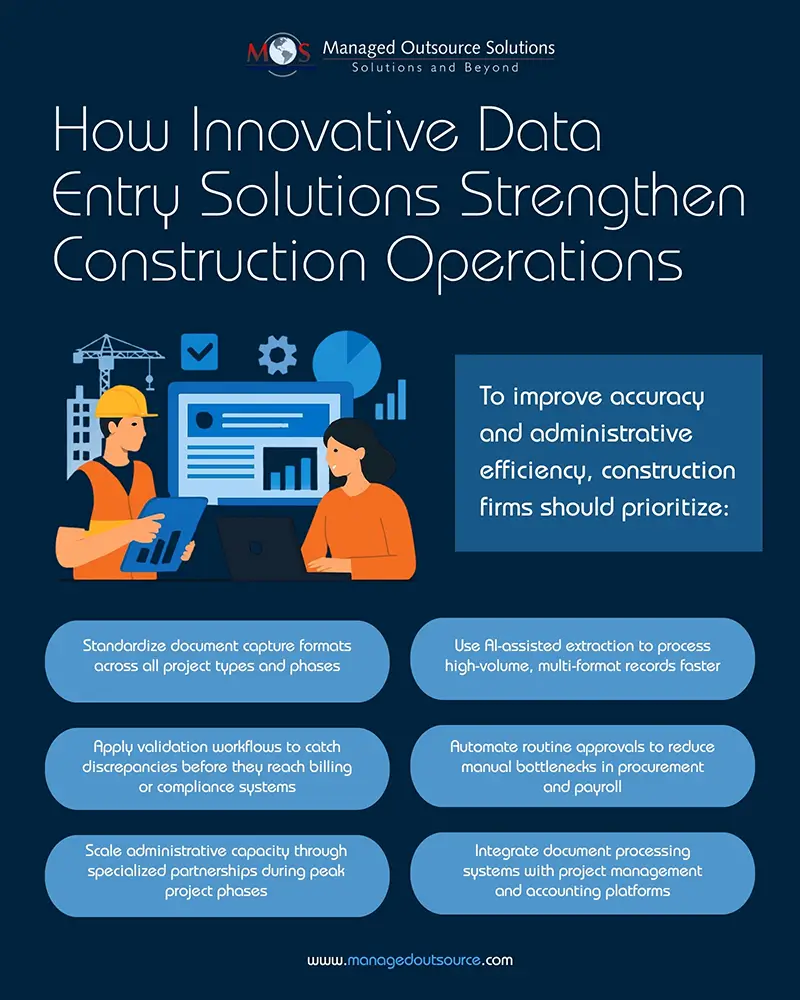
Standardized Capture Frameworks
Professional information capture services designed for the construction sector work from standardized templates aligned to the types of records projects generate, including subcontractor invoices, purchase orders, materials receipts, inspection logs, and workforce timesheets. Standardization reduces formatting inconsistencies from the point of entry, not after the fact.
Multi-format Document Processing
Construction records arrive in multiple formats: handwritten field notes, scanned delivery receipts, digital purchase orders, and emailed subcontractor invoices. Specialized processing services handle this format diversity without requiring field teams to restructure how they submit information.
Dual-layer Quality Verification
High-accuracy administrative services employ multi-stage verification, cross-referencing entries against source documents, applying field-level validation rules, and flagging inconsistencies before records enter project management or accounting systems.
Scalable Capacity for Peak Project Phases
Construction projects do not generate information at a uniform rate. Mobilization phases, project closeout periods, and simultaneous multi-site operations create spikes in administrative volume. Scalable service models match capacity to demand without requiring permanent internal staffing adjustments.
How AI Is Transforming Administrative Operations in Construction
Artificial intelligence is reshaping the administrative side of construction with meaningful precision. Where traditional workflows depend on manual review and sequential approvals, AI-enabled systems introduce speed, pattern recognition, and exception management capabilities that manual processes cannot replicate at scale.
AI-assisted Document Extraction
Construction projects process a high volume of structured and unstructured documents, ranging from handwritten delivery receipts to digital subcontractor agreements. AI-assisted extraction tools capture critical fields from these documents automatically, reducing manual input effort and accelerating processing timelines.
This is particularly impactful during project closeout phases, when large volumes of records such as punch lists, compliance certificates, final invoices, and lien waivers must be processed under tight deadlines.
AI-enabled Validation and Discrepancy Detection
Matching purchase orders against delivery receipts and vendor invoices is a routine but time-intensive task in construction procurement.
AI-enabled validation systems cross-reference these records automatically, flagging:
- Invoice amounts that deviate from approved purchase orders
- Duplicate entries across vendor accounts
- Missing compliance or certification fields
- Discrepancies between field-submitted quantities and documented deliveries
This reduces reconciliation time without sacrificing accuracy, a critical advantage for projects under audit or regulatory review.
AI-driven Workflow Routing
Not all construction records carry equal urgency. AI-driven routing systems prioritize document queues intelligently, escalating time-sensitive subcontractor invoices, flagging compliance records approaching regulatory deadlines, and processing routine approvals without manual intervention. This improves throughput without creating oversight gaps.
AI-powered Workforce and Payroll Processing
Workforce administration in construction is complicated by shift patterns, multi-site deployments, union classifications, and overtime rules. AI-powered payroll processing systems apply classification rules automatically, reducing the manual review burden on HR and finance teams while improving disbursement accuracy.
For organizations managing AI data entry services through a third-party provider, these AI-enabled capabilities integrate into existing project management and accounting platforms without requiring extensive internal reconfiguration.
The Case for Data Entry Automation in Project Billing and Compliance
Two areas where administrative quality has the most direct financial consequence in construction are project billing and regulatory compliance.
Project Billing Accuracy
Billing errors caused by missed change orders, incorrect quantities, or delayed subcontractor invoices can disrupt revenue and cash flow. Data entry automation helps transfer labor, materials, and field updates accurately into billing systems, reducing delays, disputes, and revenue gaps.
Regulatory and Contractual Compliance
Construction firms must manage safety reports, wage records, insurance documents, and contract milestones. Automated workflows with validation checks help ensure records are complete, accurate, and submitted on time, reducing compliance risks and penalties.
How Outsourcing Services Deliver Strategic Advantage
For construction firms scaling operations across multiple projects or geographies, building internal administrative capacity at the same rate as project growth is neither practical nor cost-effective. This is where outsourcing services deliver measurable operational value.
Specialized administrative partners bring:
- Trained personnel familiar with construction document types and industry-specific workflows
- Technology infrastructure capable of handling multi-format, high-volume document processing
- Quality assurance frameworks that enforce accuracy standards consistently
- Flexible capacity models that scale with project demand rather than fixed headcount
The strategic case is straightforward: when skilled site teams are spending time on administrative backfill, organizations are misallocating resources. Dedicated external support redirects that capacity toward project execution.
Industry-specific Applications
While the administrative principles are consistent, application priorities differ across construction segments.
General Contractors
General contractors coordinate information from subcontractors, suppliers, compliance authorities, and owners simultaneously. Structured processing support manages subcontractor invoice workflows, certified payroll documentation, and materials reconciliation at the volume and speed that multi-trade projects demand.
Specialty Trade Contractors
Electrical, mechanical, and plumbing contractors maintain detailed materials and labor records that feed directly into project billing and warranty documentation. Accurate processing of these records protects margin and supports dispute resolution.
Civil and Infrastructure Projects
Infrastructure projects generate substantial regulatory documentation, including environmental assessments, safety audit records, equipment inspection logs, and government progress reports. Structured administrative workflows ensure these records remain current and audit-ready throughout project execution.
Commercial Developers
Commercial development projects carry significant financial reporting requirements across multiple stakeholder groups. Accurate processing of acquisition, construction, and financing records supports investor reporting and lender compliance.
Building a Foundation for Operational Reliability
The construction sector’s complexity, encompassing document volume, format diversity, multi-party coordination requirements, and regulatory depth, demands administrative infrastructure that matches that complexity.
When information moves reliably through procurement, billing, compliance, and payroll systems, project teams make faster, better-informed decisions. When it does not, the operational consequences are measurable: delayed billing, compliance exposure, vendor disputes, and cost overruns driven by reconciliation gaps rather than field conditions.
Innovative data entry solutions, including AI-enabled tools and workflow systems, provide construction organizations with the administrative support needed to improve project performance. For firms managing growth, navigating compliance requirements, or scaling across multiple simultaneous projects, outsourcing services provide the specialized capacity and process expertise needed to sustain accuracy without overstretching internal teams.
Frequently Asked Questions
Why does information handling accuracy matter more in construction than in other industries?
Construction projects involve multi-party coordination, strict regulatory requirements, and tight billing cycles. Inaccurate or delayed administrative records affect cash flow visibility, procurement coordination, compliance standing, and vendor relationships simultaneously, creating compounding operational risks that other industries may not face at the same scale.
What types of construction records benefit most from structured processing support?
Subcontractor invoices, purchase orders, materials delivery receipts, certified payroll records, workforce timesheets, compliance documentation, and change order logs are among the highest-volume and highest-risk document categories in construction administrative workflows.
How does AI improve accuracy in construction document processing?
AI-assisted tools extract key fields from structured and unstructured documents automatically, cross-reference records for discrepancies, and flag exceptions for human review. This reduces manual input burden while strengthening validation, particularly valuable in high-volume processing environments.
When should a construction firm consider external administrative support?
When project volume outpaces internal processing capacity, when administrative backlogs begin affecting billing cycles or compliance submissions, or when multi-site operations create coordination complexity that existing teams cannot absorb without quality trade-offs.
How does structured administrative processing support project billing?
Accurate and timely processing of field records, covering materials usage, labor hours, and change events, ensures billing data reflects actual project activity without delay. This reduces billing cycle length, minimizes disputes, and improves cash flow predictability.
Want to reduce administrative delays and strengthen project accuracy?
Discover how smarter workflows can improve speed, reliability, and compliance across your construction operations.
Contact Us Today!