
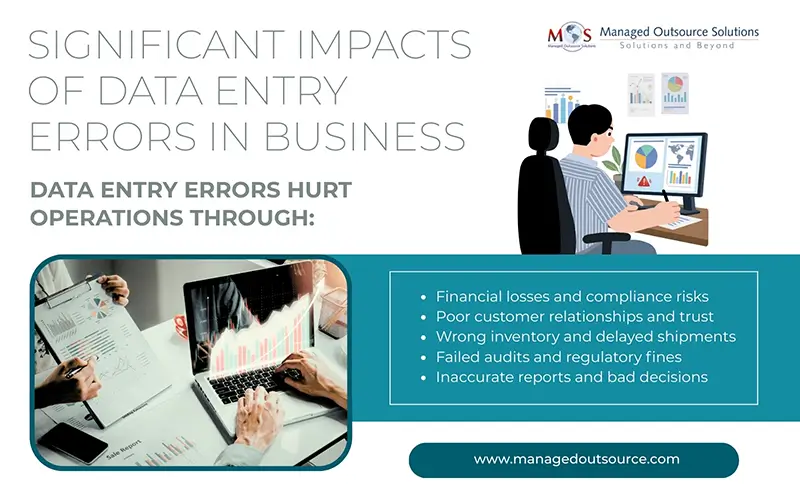
Data entry errors create serious challenges for businesses in sectors such as healthcare, finance, retail, real estate, and manufacturing. Operators accidentally enter incorrect information, omit required fields, or misread handwritten documents. These errors lead to outcomes ranging from financial loss to damaged customer relationships. Even in 2026, errors persist because staff handle most of this work manually.
Recent statistics reveal the scope of this widespread problem. IBM reports that poor data quality costs the U.S. economy $3.1 trillion annually. Gartner reports that an average organization loses $12.9 million each year because of data quality issues.
Eliminate Errors.
Partner with our experts for accurate data processing.
Call: (800) 670-2809
Understanding the Root Causes of Data Entry Errors
Several factors combine to create data entry errors. Typically, many of these mistakes arise from human limitations and working conditions. Operators frequently work under strict deadlines that push them to value speed more than accuracy. This pressure leads to transposition mistakes, such as typing 1234 as 1324 because their hands move faster than they can verify on the screen. Fatigue builds during long screen sessions, which reduces attention to detail in repetitive tasks like entering addresses, invoice values, or inventory counts.
Handwritten source materials present additional challenges. Poor handwriting can make the digit 8 resemble the letter B or the number 0 look like the letter O. Operators must sometimes guess these characters, and their choices may prove incorrect. Inconsistent data formats increase confusion. One employee may record dates in the MM/DD/YYYY format while another uses DD/MM/YYYY, which leads to errors when systems combine or compare records. Insufficient training leaves new staff unsure about rules for international phone numbers, currency formats, and common abbreviations within the industry.
Common Types of Errors in Data Entry
Common errors in data entry tend to follow patterns that routine audits can detect and correct. Organizations most frequently encounter the following error types:
- Transcription errors, which occur when operators make typing mistakes because they work too quickly. Examples include “maintenance” as “maintenace” or changing the customer name “Johnson” to “Jonson,” which prevents accurate searches later.
- Transposition errors, which swap neighboring characters or digits, turning a phone number like 555-1234 into 555-1324 or a street address from 1600 Main Street into 1060 Main Street.
- Omission errors, which happen when workers leave entire fields blank, such as missing an email address and weakening the effectiveness of marketing campaigns.
- Insertion errors, which add extra characters, such as unnecessary spaces or commas that disrupt alphabetical sorting or cause financial reports to fail.
- Substitution errors, which confuse visually similar characters, for example treating the combination “rn” as the letter “m” or replacing the letter “O” with the number “0” in account numbers.
- Formatting errors, which break system rules by entering values as $1,000.00 when the application expects 1000.00 or by mixing incompatible date formats.
- Selection errors, which arise when operators choose the wrong option from dropdown lists, such as selecting an incorrect product SKU and causing shipment of the wrong item.
- Unit conversion errors, which involve mixing units like kilograms and pounds, leading to shipping delays and conflicts with suppliers.
- Duplication errors, which repeat entire records or lines and inflate data sets artificially, which in turn distorts analysis.
Quality reviews find that these categories of errors appear in 20 to 30% of the batches they examine across different industries.
Real-world Case Studies
Several well-known cases illustrate how data entry errors can lead to severe and unexpected outcomes. Zillow closed its iBuying program in 2021 after input errors introduced incorrect home values into its pricing algorithms. The company had to write write down $569 million and cut 25% of jobs.
In another example, a rural county lost millions in oil lease revenue when a spreadsheet error omitted thousands of acres of productive land out of its tax calculations.
Strategies That Reduce Errors
Managers reduce data entry errors effectively by designing appropriate workplaces and processes that help ensure accuracy. They maintain adequate staffing, including backup resources, so that employees do not need to rush during busy periods.
Organizations also put standardization at the center of their approach. They create templates for frequently used forms, maintain glossaries of approved abbreviations, and define clear formatting rules for dates, currencies, addresses, and other fields. Performance systems then recognize and reward accuracy, not only speed. Regular team meetings and training sessions reinforce the real financial and operational consequences of poor data quality.
Quality Control Measures That Work
Layered quality control procedures detect common data entry errors early, before they impact business operations. Individual operators perform an initial check by reviewing their work against original documents. Peer reviewers then inspect a sample of daily records and look for patterns like frequent digit swaps or recurring omissions that indicate the need for more training.
Supervisors carry out final audits on records that have high financial value or legal importance. This establishes three levels of verification and can detect up to 95% of errors before they reach production databases. Centralized logs track the type and source of repeated errors, which allows targeted coaching and process changes.
Technology Solutions for Data Entry
AI data entry solutions play a major role in improving data accuracy through technologies such as optical character recognition (OCR) and intelligent character recognition (ICR). These tools read printed and handwritten text from documents and convert it into digital data with accuracy rates that can reach 99.99%. Robotic process automation (RPA) systems fill in repeated fields by extracting information like invoice numbers, customer names, and totals from source files and transferring them directly into enterprise resource planning platforms. Real-time validation rules immediately reject inputs that do not meet set criteria, such as mismatched ZIP codes, invalid dates, or incorrectly formatted email addresses.
Application programming interfaces (APIs) link separate applications so that customer information that already exists in one system can automatically fill related fields in another system, which reduces duplicate typing. Voice recognition tools help field staff record data by speaking instead of typing, while natural language processing modules correct common pronunciation-related errors. Regular software maintenance and updates remove known user interface problems that can cause incomplete records or frozen screens.
Best Practices for Data Entry Operators
Experienced operators use daily routines that greatly lower the chance of data entry errors. These practices include:
- Verifying each completed entry by checking it against the original source document
- Working with standardized checklists for each type of batch to ensure that all required fields are complete
- Taking a brief break every hour to maintain concentration and reduce fatigue
- Grouping similar document types into batches so that patterns become familiar and work speeds up without losing accuracy
- Applying consistent formats for dates, currencies, and addresses throughout the session before submitting records
- Reviewing the previous day’s error log at the start of a shift to avoid repeating the same mistakes
- Finishing each shift with a short review of the final batch to confirm quality before final approval
Over time, these habits lead to major improvements in accuracy and reduce the need for rework.
Benefits of Partnering with a Data Entry Company
Many organizations with high volumes of data choose to work with a data entry company when in-house teams cannot manage the workload while maintaining quality. These providers use AI data entry tools alongside multi-step quality processes to achieve accuracy rates around 99.5% with trained specialists and modern verification software. They can quickly scale their resources to handle seasonal peaks such as tax periods or year-end reporting. This leaves internal staff free to focus on activities that directly generate revenue rather than repetitive entry tasks. Long-term outsourcing agreements include quality guarantees and dedicated account managers who oversee performance.
Measuring Success and Continuous Improvement
Leading organizations monitor performance indicators to assess data entry errors and drive steady improvement. They track the number of errors per 1,000 records and aim for a rate below 0.5%. They also measure the average time needed to correct each error and calculate the total cost per incident, including both labor and impacts on downstream processes. Real-time dashboards show trends by shift, individual operator, and error category. Managers respond quickly when issues arise. Monthly review meetings examine root causes and test new process changes. These meetings help build a culture that values continuous improvement in data quality.
Emerging Trends Shaping Data Entry in 2026
Several new trends influence how organizations manage data entry errors in 2026. Voice-activated tools are becoming more common. These tools allow warehouse and field staff to record information verbally while language models improve transcription accuracy. Blockchain-based systems create permanent and traceable records of data changes, including timestamps and user identities, which helps with regulatory audits. Predictive analytics can identify high-risk data entries before they are finalized, based on patterns observed in past errors, and prompt additional verification when needed. Hybrid workflows that combine human oversight with automated tools are emerging as the standard. Machines handle repetitive tasks while people review complex or sensitive cases.
Building a Data-driven Future
Organizations that aim for sustainable growth invest in accuracy programs that combine ongoing training, modern technology, strong quality controls, and careful measurement. A top data entry company makes this a priority for their clients. Companies that neglect persistent errors in data entry will continue to lose competitive advantage, customer confidence, and profit to those that treat clean and reliable data as a core strategic asset. Managers who schedule detailed process audits and follow a clear roadmap can begin to build systems that support decision-making with accurate information at every stage.