
Modern organizations operate in an environment shaped by rapid technological innovation. Understanding emerging technologies that shape business processes is critical for companies aiming to stay competitive, improve efficiency, and deliver superior customer experiences. These technologies, ranging from AI and IoT to blockchain, RPA, and AR/VR, are redefining how workflows are designed, executed, and monitored. While each technology brings unique capabilities, AI-assisted solutions such as DeepKnit AI demonstrate how intelligent systems can integrate with other emerging tools to enhance operational effectiveness, reduce errors, and enable real-time decision-making.
This post examines key challenges organizations face in modernizing processes, explains how AI and other technologies transform workflows, highlights the ongoing role of human expertise, explores tangible business benefits, presents real-world use cases, and identifies considerations and future trends for technology-driven process innovation.
Improve Workflow Efficiency Now.
Partner with experts to strengthen process accuracy and speed.
Call: (800) 670-2809
Key Challenges Addressed by Emerging Technologies that Shape Business Processes
Modern business processes face multiple pressures that hinder efficiency and scalability.
- Operational Complexity
As organizations grow, processes span multiple systems, geographies, and regulatory frameworks. Managing these manually increases the likelihood of errors, delays, and inefficiencies. - Data Overload
Enterprises generate massive volumes of structured and unstructured data. Extracting actionable insights without automation is difficult, slowing decision-making. - Regulatory Compliance
Industries like finance, healthcare, and logistics must adhere to strict regulations. Ensuring compliance across multiple systems and locations requires continuous monitoring and governance. - Resource Limitations
Manual workflows demand extensive manpower. Employees spend time on repetitive tasks instead of strategic, high-value work. - Integration of Technologies
Incorporating multiple emerging technologies into existing systems without disruption is a major challenge, requiring careful planning and expertise.
How Emerging Technologies Transform Business Processes
Multiple emerging technologies now play complementary roles in shaping business processes.
- Artificial Intelligence (AI)
- Intelligent Automation: Streamlines repetitive tasks, such as invoice processing or workflow approvals, reducing manual errors.
- AI-Driven Analytics: Analyzes large datasets to uncover patterns, predict bottlenecks, and optimize operations.
- Intelligent Decision Support: Synthesizes information across departments to provide actionable recommendations.
AI-enabled platforms, including DeepKnit AI, provide predictive analytics, intelligent automation, and decision support.
AI integration with other technologies, like IoT or blockchain, amplifies its impact. For instance, AI-assisted predictive maintenance powered by IoT data can prevent equipment failures.
- Internet of Things (IoT)
- Real-Time Tracking: IoT sensors track inventory, production metrics, or fleet status.
- Predictive Insights: Coupled with AI, IoT data can anticipate supply chain issues or maintenance needs.
- Workflow Efficiency: Continuous monitoring reduces downtime and improves resource allocation.
IoT devices generate real-time operational data, enabling process monitoring and optimization.
- Robotic Process Automation (RPA)
- Workflow Automation: RPA handles data entry, report generation, and transaction processing efficiently.
- Integration with AI: When combined with AI, RPA can adapt to changing scenarios, handling exceptions automatically.
- Scalability: Supports business expansion without proportionally increasing human resources.
RPA automates repetitive, rule-based tasks across systems, complementing AI insights.
- Blockchain
- Transaction Verification: Ensures data integrity across decentralized systems.
- Supply Chain Transparency: Tracks products from origin to delivery, reducing fraud and errors.
- Regulatory Compliance: Immutable records facilitate audits and reporting.
Blockchain provides secure, transparent, and tamper-proof process validation.
- Augmented and Virtual Reality (AR/VR)
- Immersive Training: Employees can simulate processes in a virtual environment.
- Remote Assistance: AR overlays assist technicians in real-time repair or assembly.
- Process Visualization: Complex workflows can be mapped and optimized through interactive models.
- Intelligent analytics and RPA streamline operations, reduce manual errors, and optimize workflows.
- IoT monitoring provides real-time insights, minimizing operational disruptions.
- Automation and AI-assisted processes lower operational costs.
- Businesses can reallocate human resources to higher-value initiatives.
- AI-driven predictive insights improve planning and forecasting.
- Blockchain ensures data integrity, supporting more confident decisions.
- AI in business process outsourcing helps companies scale efficiently while maintaining quality during capacity expansion.
AR/VR transforms training, remote collaboration, and process visualization.
Role of Human Expertise in Technology-Enhanced Processes
Even with advanced intelligent systems, human oversight remains critical.
Strategic Oversight
Executives interpret insights from AI, RPA, and other technologies to align operations with organizational objectives.
Ethical and Compliance Management
Humans ensure emerging technologies comply with regulations and ethical standards, preventing biased AI outcomes and maintaining data security.
Creative Problem Solving
Novel challenges require human creativity, particularly when technologies encounter unstructured or unpredictable scenarios.
Collaboration with AI
AI-enhanced platforms like DeepKnit AI work alongside employees, augmenting efficiency without replacing essential human judgment.
Business Benefits of Emerging Technologies
Emerging technologies, when applied strategically, provide measurable business value.
Improved Efficiency and Accuracy
Cost Optimization
Enhanced Decision-Making
Scalable Operations
Real-World Use Cases
Financial Services
Intelligent fraud detection and RPA-powered transaction processing streamline operations. DeepKnit AI analyzes patterns and predicts anomalies, mitigating risk while improving efficiency.
Healthcare
Intelligent predictive diagnostics and IoT-driven patient monitoring enhance patient care. DeepKnit AI optimizes staff allocation and streamlines claims processing, reducing administrative bottlenecks.
Manufacturing
IoT sensors and AI-driven predictive maintenance prevent equipment downtime. DeepKnit AI integrates IoT data and historical production records, improving workflow efficiency and reducing costs.
Future Trends
Hyper-Automation
Intelligent orchestration of RPA, IoT, and analytics platforms will enable end-to-end automation.
Collaborative Human-AI Teams
Future processes will balance AI-driven insights with human creativity and judgment for maximum efficiency.
Integration with Emerging Technologies
AI will increasingly interface with blockchain, AR/VR, and edge computing to create secure, transparent, and immersive operational environments.
Predictive and Prescriptive Analytics
Intelligent platforms like DeepKnit AI will provide foresight, helping businesses anticipate disruptions and optimize strategies proactively.
Challenges and Considerations for Implementation
Data Quality and Integration
High-quality, structured data is essential for AI and RPA effectiveness. Integrating technologies with legacy systems can require significant resources.
Change Management
Employee training and adaptation are critical. Transparent communication ensures smooth adoption of intelligent automation processes.
Security and Privacy
AI systems handling sensitive information must comply with regulations, implement encryption, and monitor for breaches.
Ethical Considerations
Regular audits ensure AI algorithms remain unbiased, ethical, and compliant, safeguarding trust and accountability.
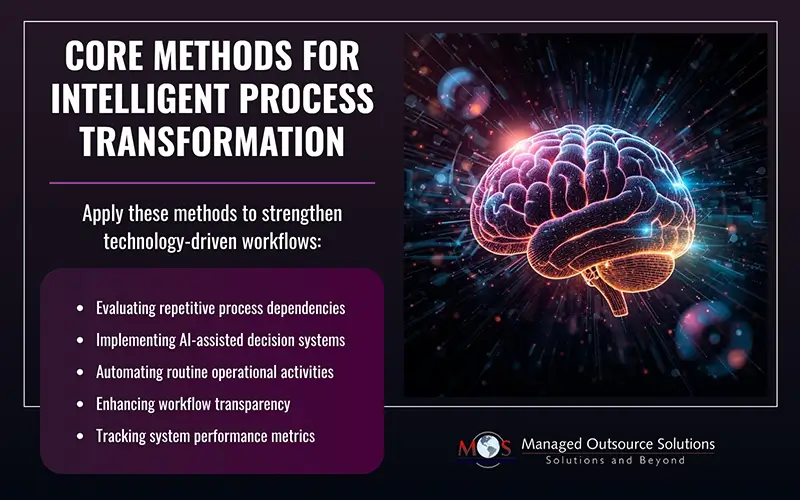
Implementation Roadmap for Adopting Emerging Technologies in Business Processes
Adopting emerging technologies requires disciplined execution rather than isolated experimentation. Many organizations invest in advanced systems yet struggle to generate measurable outcomes because implementation lacks a clear progression. A structured roadmap reduces uncertainty, aligns stakeholders, and ensures that emerging technologies contribute measurable value to operational workflows.
Platforms such as DeepKnit AI play a central role in this journey by supporting coordinated deployment across interconnected business functions.
Phase 1: Process Assessment and Technology Mapping
The first phase begins with a detailed evaluation of existing business processes. Organizations must identify inefficiencies, redundant steps, and areas where manual intervention slows productivity. Without a clear understanding of operational bottlenecks, introducing advanced technologies may complicate workflows rather than improve them.
Workflow mapping reveals critical bottlenecks. Teams trace information flows across departments to pinpoint delays and repetitive tasks. Emerging technologies, particularly AI-assisted process discovery tools, help analyze large volumes of workflow data and reveal hidden inefficiencies that traditional reviews might overlook.
DeepKnit AI supports this phase by analyzing operational patterns and identifying opportunities for automation and optimization. By examining historical workflow behavior, the platform generates insights into where emerging technologies can produce the greatest impact. This targeted approach reduces guesswork and strengthens decision-making.
Technology mapping also involves evaluating compatibility with existing infrastructure. Cloud readiness, data architecture, and integration capabilities must be assessed carefully to prevent downstream complications. A comprehensive readiness assessment ensures that subsequent phases progress smoothly.
Phase 2: Pilot Program Development
After completing the assessment phase, organizations move into pilot implementation. This stage introduces emerging technologies within a controlled environment, reducing risk while generating measurable performance insights.
Pilot programs focus on specific workflows that present clear improvement opportunities. For example, invoice processing, customer support ticket management, or supply chain tracking frequently serve as effective starting points. These workflows generate predictable data patterns, making them suitable for AI-enabled experimentation.
DeepKnit AI assists in configuring pilot workflows that simulate real-world operational conditions. By monitoring processing times, accuracy rates, and workflow throughput, the platform generates performance metrics that help decision-makers evaluate feasibility. This controlled experimentation prevents premature large-scale deployment.
Feedback loops remain essential during pilot execution. Employees interacting with pilot systems provide practical insights regarding usability and workflow alignment. These insights guide system refinements before expansion to broader operational environments.
A well-designed pilot program builds organizational confidence. It demonstrates tangible results while minimizing disruption, creating a foundation for broader technology adoption.
Phase 3: Scaled Integration across Departments
Once pilot initiatives demonstrate measurable value, organizations transition to large-scale deployment. This phase expands emerging technologies across multiple departments, aligning workflows and data streams within a unified operational framework.
Scaled integration introduces new complexities. Departments operate with varying systems, priorities, and performance expectations. Coordinating these variables requires centralized orchestration to prevent fragmentation.
Centralized orchestration platforms manage these complexities during scaled deployment. They synchronize data exchanges, handle workflow dependencies, and ensure consistent execution across departments, reducing duplication and strengthening operational cohesion.
Change management becomes especially important during scaled deployment. Employees must understand how emerging technologies influence daily responsibilities. Training sessions, role redefinition, and performance guidance help maintain productivity while new systems become operational.
Integration also requires continuous testing to verify compatibility with legacy systems. Gradual expansion, supported by staged deployment plans, reduces operational risks and ensures sustained performance stability.
Phase 4: Performance Monitoring and Optimization
Technology implementation does not conclude with deployment. Continuous performance monitoring determines whether emerging technologies deliver long-term operational value.
Organizations must track key performance indicators that reflect workflow efficiency, accuracy, and processing speed. AI-driven analytics tools provide real-time visibility into system performance, identifying anomalies and performance deviations.
DeepKnit AI strengthens this stage by analyzing operational data and generating predictive insights. These insights guide system refinements, helping organizations identify opportunities to reduce cycle times and improve workflow precision.
Optimization also involves workforce alignment. As emerging technologies reshape operational processes, employee responsibilities evolve. Teams shift from repetitive tasks toward analytical and supervisory roles. Continuous training ensures that personnel remain capable of managing advanced systems effectively.
Regular performance reviews create a cycle of continuous improvement. This adaptive model ensures that emerging technologies remain aligned with evolving business requirements.
Phase 5: Continuous Innovation and Technology Evolution
Emerging technologies evolve rapidly. Organizations that treat implementation as a one-time initiative risk falling behind competitors who maintain continuous innovation strategies.
The final phase focuses on sustaining technological adaptability. Leaders must monitor advancements in automation, predictive analytics, and intelligent workflow orchestration. Evaluating new capabilities ensures that operational systems remain competitive and responsive to market changes.
Modern platforms support ongoing innovation through modular architectures. These systems enable incremental upgrades and seamless integration of new capabilities without disrupting existing workflows.
Continuous evaluation also strengthens long-term planning. Technology roadmaps should include periodic reviews that assess system performance, identify modernization opportunities, and anticipate future technological shifts.
Organizations that adopt this forward-looking approach maintain operational resilience. They remain capable of integrating emerging innovations while preserving process stability and performance continuity.
Building Future-Ready Operations with Emerging Technologies
Advanced technologies transform the way businesses operate, innovate, and compete. DeepKnit AI and similar platforms enhance process efficiency, accuracy, and decision-making while integrating with IoT, RPA, blockchain, and AR/VR. By leveraging these technologies strategically, businesses in financial services, healthcare, manufacturing, and beyond can optimize operations, scale effectively, and maintain a competitive advantage.
Forward-looking organizations that embrace AI in business process outsourcing and other emerging technologies position themselves for sustainable success. They ensure that technology enhances human expertise rather than replaces it in driving operational excellence.