
Since businesses increasingly rely on data to drive decisions, unstructured information has become a significant operational challenge. Contracts, invoices, handwritten records, scanned files, emails, and archived paperwork contain valuable business intelligence, yet much of this information remains difficult to access and analyze in its original format. This is where document conversion becomes strategically important. Organizations that invest in professional document conversion services can transform fragmented records into searchable, structured, and business-ready assets that improve efficiency, accessibility, and long-term decision-making.
For many enterprises, the challenge is not the absence of information but the inability to retrieve and use it efficiently. Legacy files stored in cabinets, aging repositories, or inconsistent digital formats create operational friction that affects productivity, compliance, and customer responsiveness. Forward-looking organizations increasingly recognize that converting unstructured content into usable digital assets is no longer an administrative initiative. It has become a business imperative tied directly to operational performance and competitive resilience.
Why Unstructured Information Creates Business Bottlenecks
Organizations generate enormous volumes of business information every day. However, a large portion of enterprise knowledge remains trapped in formats that systems cannot interpret efficiently.
For example:
- Paper invoices stored across departments create retrieval delays during audits
- Handwritten records reduce searchability and increase processing errors
- Legacy scanned images without indexing limit accessibility
- Decentralized archives make collaboration difficult across locations
These inefficiencies create ripple effects throughout business operations. Employees spend excessive time locating files, compliance teams struggle to retrieve historical records, and leadership teams face delayed access to operational insights.
According to research from the global consulting firm IDC, employees spend substantial portions of their workweek searching for information or recreating unavailable content, affecting productivity and operational continuity.
The challenge becomes even greater in industries governed by strict regulatory requirements, where inaccessible records can affect legal defensibility, reporting accuracy, and customer trust.
Document Conversion: Turning Information into Business Intelligence
Modern enterprises no longer view file transformation as a clerical process. Instead, they approach it as a strategic initiative that improves how information supports daily operations.
Document Conversion Services and Their Business Impact
Professional document conversion initiatives extend beyond simple scanning. The objective is to transform fragmented and inaccessible content into structured, searchable, and interoperable digital assets.
Key components of this process include:
- Optical Character Recognition (OCR) for text extraction
- Metadata tagging for faster retrieval
- File indexing and categorization
- Data validation for accuracy assurance
- Legacy archive modernization
- Format standardization across enterprise systems
When organizations modernize their information ecosystem, teams gain quicker access to operational records, historical data, contracts, customer interactions, and compliance materials.
The business value becomes particularly evident in environments where speed, precision, and accessibility directly influence outcomes.
For instance:
- Healthcare organizations need rapid access to patient records
- Legal firms depend on searchable case histories and contracts
- Financial institutions require organized archives for compliance and audits
- Logistics providers rely on digitized shipment records for operational continuity
Without systematic modernization, businesses risk inefficiencies that compound over time.
Operational Benefits of Transforming Unstructured Content
The impact of structured digital information extends far beyond storage improvements. Organizations experience measurable gains across multiple operational areas.
Improved Information Accessibility
Employees can retrieve records in seconds rather than manually searching physical storage systems.
This improves:
- Decision-making speed
- Cross-department collaboration
- Customer response times
- Internal productivity
Centralized access also reduces duplication of effort caused by repeated data searches.
Better Compliance and Risk Management
Many industries must maintain detailed records for regulatory oversight.
Searchable digital repositories support:
- Faster audit preparation
- Better retention management
- Improved version control
- Reduced risk of lost or damaged records
In regulated sectors, poor record accessibility can create operational and legal exposure.
Increased Workflow Efficiency
Manual information handling slows processes across departments.
Digitized and indexed records help organizations streamline:
- Invoice processing
- Contract management
- Claims handling
- Employee onboarding
- Procurement workflows
As information becomes easier to retrieve, process timelines become more predictable.
Improved Business Continuity
Physical records remain vulnerable to loss through fire, water damage, deterioration, or misplacement.
Digitized systems support:
- Secure backups
- Disaster recovery planning
- Remote access capabilities
- Long-term preservation of business information
This becomes increasingly important in distributed and hybrid work environments.
How AI Is Transforming Content Digitization
Artificial intelligence is reshaping how enterprises process unstructured information. Traditional workflows relied heavily on manual indexing, categorization, and verification. Today, AI-driven systems improve speed, accuracy, and scalability.
AI-assisted Content Extraction
Traditional OCR systems struggled with handwritten notes, poor scan quality, and inconsistent layouts.
AI-assisted extraction tools now identify patterns across:
- Handwritten text
- Multi-format records
- Low-quality scans
- Complex layouts such as invoices and contracts
This reduces manual intervention and improves processing quality.
AI-enabled Classification and Categorization
Large organizations process thousands of files daily.
AI-enabled systems classify content automatically based on:
- Content type
- Business function
- Department ownership
- Compliance requirements
Instead of manually organizing archives, enterprises can establish automated categorization workflows that improve retrieval speed.
AI-driven Accuracy Validation
Errors during digitization create downstream operational issues.
AI-driven validation systems identify:
- Missing information
- Duplicate entries
- Formatting inconsistencies
- Extraction inaccuracies
This strengthens quality assurance while reducing manual review requirements.
AI-powered Search and Metadata Tagging
Searchability determines whether digitized information creates measurable business value.
AI-powered indexing systems improve discoverability through:
- Smart tagging
- Context-aware search
- Semantic recognition
- Automated metadata creation
This helps organizations retrieve information based on meaning rather than exact keywords.
According to a recent report from McKinsey, generative AI and intelligent automation continue to influence enterprise productivity initiatives, particularly in information-heavy workflows where manual processing limits efficiency.
Industries Benefiting from Structured Information Management
The demand for modernized records spans virtually every industry, though use cases vary considerably.
Healthcare
Healthcare providers manage extensive patient histories, insurance files, consent forms, and diagnostic records.
Digitized repositories support:
- Faster patient information retrieval
- Better care coordination
- Administrative efficiency
- Regulatory readiness
Legal Services
Legal organizations depend on rapid access to contracts, litigation records, and case files.
Searchable archives improve:
- Research efficiency
- Case preparation
- Record traceability
- Document preservation
Financial Services
Banks and financial institutions maintain highly regulated information environments.
Structured systems improve:
- Audit preparedness
- Risk management
- Customer record access
- Transaction verification
Logistics and Supply Chain
Logistics companies generate substantial operational paperwork.
Digitization improves:
- Shipment tracking visibility
- Vendor coordination
- Proof-of-delivery access
- Operational transparency
Challenges Organizations Face During Modernization
Despite the clear advantages, many enterprises encounter barriers during transformation efforts.
Legacy Data Complexity
Older archives may include:
- Faded records
- Handwritten notes
- Mixed file formats
- Damaged materials
These conditions complicate extraction and indexing.
Volume Management
Large-scale modernization projects may involve millions of records.
Without standardized workflows, organizations face delays, inconsistencies, and escalating operational costs.
Security and Confidentiality Risks
Sensitive information requires strong governance.
Organizations must prioritize:
- Secure transfer protocols
- Access restrictions
- Encryption practices
- Compliance-ready storage environments
Quality Assurance
Inaccurate extraction reduces trust in digital systems.
Validation frameworks become essential for maintaining reliability and operational confidence.
How High-performing Organizations Approach Information Transformation
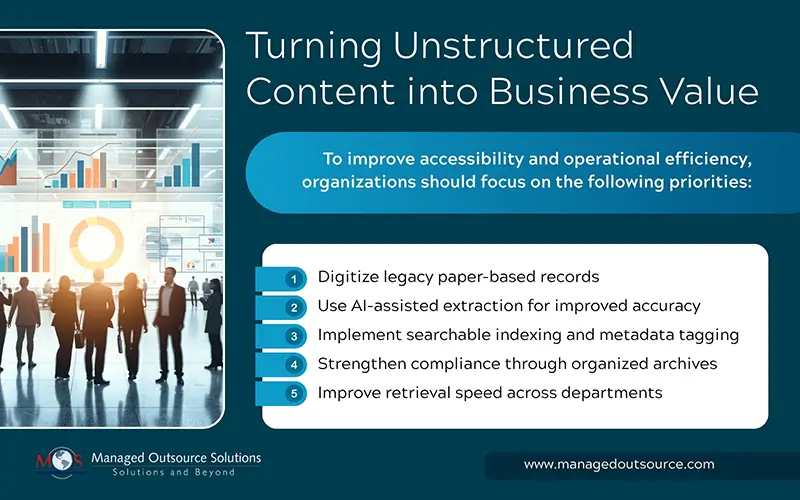
Organizations that derive measurable value from modernization initiatives follow a systematic approach rather than treating digitization as a one-time activity.
Effective enterprises typically:
- Prioritize high-value business records first
- Define metadata standards before migration
- Establish quality validation checkpoints
- Integrate searchable repositories with enterprise systems
- Continuously improve classification accuracy using analytics and AI insights
For example, an organization modernizing procurement records may begin with vendor contracts and invoices before expanding to historical operational archives. This phased strategy improves adoption while reducing disruption.
Businesses that view information as a strategic asset consistently outperform organizations relying on fragmented storage environments.
The Role of Specialized Expertise
Large-scale transformation initiatives require technical expertise, operational planning, and quality assurance capabilities. Many organizations partner with providers specializing in content digitization and records modernization to manage complex workflows efficiently.
Experienced providers help enterprises address:
- High-volume processing requirements
- OCR and extraction accuracy challenges
- Secure handling of sensitive records
- Regulatory and retention requirements
- Metadata consistency across systems
These partnerships help organizations maintain operational continuity while accelerating modernization initiatives.
Turning Unstructured Content into Measurable Business Value
The true value of business information emerges only when teams can access, search, analyze, and use it effectively. Organizations that continue relying on fragmented records face growing operational inefficiencies, delayed decision-making, and increased compliance risks. In contrast, enterprises that prioritize document conversion gain stronger visibility into their information ecosystem and improve organizational agility. By partnering with a trusted document conversion company, businesses can transform disconnected records into structured digital assets that strengthen productivity, improve accessibility, and support long-term growth.
Ready to transform unstructured business content into searchable digital assets?
Discover how the right strategy can improve accessibility, compliance, and productivity.
Contact Us Today!