Libraries are evolving from physical repositories into connected digital ecosystems. Researchers, students, and institutions now expect instant access to books, archives, journals, newspapers, and research records from any location. This shift is driving libraries to modernize collections through AI-assisted digitization and document conversion services.
Traditional library systems depended heavily on physical storage, manual cataloging, and in-person access. Managing growing collections created challenges related to storage space, preservation, and information retrieval. Digital platforms address these limitations by converting printed materials into searchable electronic records that users can access remotely.
AI-enabled technologies are accelerating this transition. Intelligent document classification, OCR-based text extraction, and metadata generation help libraries process large collections with greater speed and consistency. By partnering with document digitization services, library teams can use AI-supported workflows to identify document types, extract searchable text, and organize records into structured digital archives.
What is Digitization and Document Conversion in Libraries?
Library digitization refers to the process of converting physical materials such as books, manuscripts, newspapers, photographs, and archival records into digital formats. Document conversion for libraries extends this process by transforming scanned content into structured, searchable, and usable digital files.
The workflow usually includes:
- High-resolution scanning of physical records
- OCR-based text extraction from printed pages
- AI-driven layout detection and document classification
- Metadata tagging and indexing
- Conversion into formats such as PDF, XML, TIFF, or searchable text files
Traditional conversion processes required substantial manual effort to organize and validate files. AI-assisted OCR and intelligent extraction tools now improve processing speed while preserving document structure and readability. These systems can identify headings, tables, handwritten elements, and page layouts more efficiently across large collections.
For libraries managing historical archives or fragile materials, digitization also reduces physical handling of original documents. Digital copies can be accessed repeatedly without exposing rare collections to wear and deterioration.
Reasons for Library Digitization
Libraries are digitizing collections to improve accessibility, preserve historical records, and manage growing volumes of information more efficiently. AI-assisted workflows are also changing how large archives are processed, indexed, and retrieved.
Growing Need for Remote Access
Users now expect continuous access to library materials across devices and locations. Digital collections support:
- Remote research and learning
- Simultaneous access for multiple users
- Faster retrieval of records and archives
- Mobile-friendly access to digital resources
AI-supported search and indexing tools further improve accessibility by identifying keywords, subjects, dates, and document categories automatically.
Space and Storage Challenges
Large physical collections create long-term storage and maintenance pressures. Libraries managing newspapers, manuscripts, and archival records require:
- Climate-controlled storage environments
- Physical preservation resources
- Additional shelving and archival space
- Manual catalog maintenance
Digitization reduces dependency on physical storage while preserving records in searchable digital formats.
Increase in Digital Usage
Researchers and students increasingly rely on searchable databases instead of manual catalog systems. This shift is pushing libraries toward AI-enhanced digital ecosystems that support:
- Intelligent document classification
- OCR-based text extraction
- Automated metadata tagging
- Faster archival organization
AI-enabled library digitization services also reduce manual workload during high-volume digitization projects.
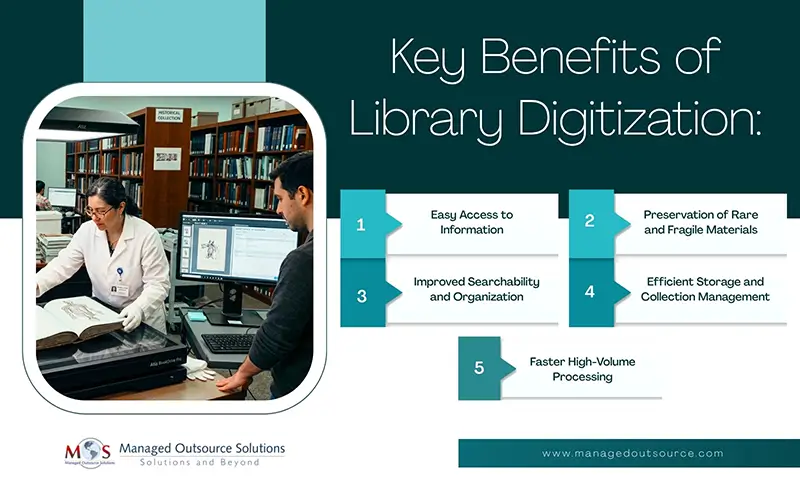
Key Benefits of Library Digitization
Digitization is improving how libraries preserve, organize, and share information. AI-assisted processing is also helping institutions manage large-scale archives with greater speed and consistency.
- Easy Access to Information: Digital collections support remote and 24/7 access to books, journals, newspapers, and archival records. AI-enabled search and indexing tools help users retrieve relevant information faster through keyword recognition, metadata tagging, and contextual search capabilities.
- Preservation of Rare and Fragile Materials: Historical newspapers, manuscripts, photographs, and research archives deteriorate through repeated handling and environmental exposure. Digitization preserves original records while creating searchable digital copies for research and public access.
- Improved Searchability and Organization: AI-driven OCR and intelligent document classification convert printed materials into searchable digital text. Libraries can categorize, index, and retrieve records more efficiently across large collections.
- Efficient Storage and Collection Management: Converting physical archives into digital formats reduces dependency on physical storage infrastructure. Cloud-based digital library systems also simplify bulk archival management, backup processes, and long-term preservation planning.
- Faster High-Volume Processing: AI-assisted workflows accelerate large-scale digitization projects through automated extraction, layout detection, and metadata generation. This reduces manual workload while improving processing consistency across extensive collections.
Library digitization improves accessibility, preservation, searchability, and collection management while AI-assisted systems strengthen large-scale archival processing.
Role of Document Conversion in Modern Libraries
Document conversion plays a central role in building searchable, structured, and scalable digital library systems. AI-enhanced conversion workflows are helping libraries process large collections with greater speed and consistency while preserving document quality and structure.
- Standardizing Multiple File Formats: Libraries manage records in different formats, including printed books, newspapers, manuscripts, photographs, TIFF images, and scanned PDFs. Document conversion transforms these materials into standardized digital formats such as PDF, XML, HTML, and searchable text files for easier storage and retrieval.
- Improving Searchability Through OCR: AI-driven OCR technology extracts text from scanned pages and converts static image files into searchable digital content. Users can search keywords, dates, subjects, and publication references without manually reviewing physical records.
- Supporting Intelligent Indexing and Metadata Tagging: AI-assisted classification tools identify headings, sections, layouts, and document categories automatically. This improves metadata generation and helps libraries organize archives more efficiently.
- Preserving Document Structure and Readability: Historical records and aging newspapers frequently contain faded text, damaged pages, or inconsistent layouts. AI-enabled layout detection and image enhancement tools improve readability while preserving the original structure of the document.
- Strengthening Digital Library Infrastructure: Structured and searchable digital files integrate more efficiently with cloud-based archives, online repositories, and digital library platforms. This improves long-term accessibility and collection management.
Document conversion is evolving from basic scanning into AI-enhanced intelligent processing that improves searchability, standardization, and large-scale digital library management.
Large-Scale Digitization Projects
Libraries and research institutions are expanding digitization initiatives to preserve historical records and improve global accessibility through AI-assisted processing and collaborative archival systems.
- Mass Digitization Initiatives: Universities and public libraries are digitizing newspapers, manuscripts, research archives, and historical collections in large volumes.
- AI-Assisted Bulk Processing: AI-enabled OCR and automated classification tools are accelerating document conversion while reducing manual workload.
- Institutional Collaboration: Libraries are partnering with technology providers and research institutions to minimize duplicate scanning and improve resource sharing.
- Cloud-Based Archival Expansion: Cloud-supported repositories are helping institutions manage growing digital collections with greater scalability and accessibility.
- Global Access to Historical Records: Large-scale digitization projects are improving public access to rare materials previously restricted to physical archives.
Large-scale digitization projects are expanding global access to historical records while AI-enhanced workflows improve processing efficiency and archival management.
Emerging Trends in Digital Libraries
Digital libraries are evolving beyond basic archival systems as AI-assisted technologies improve accessibility, automation, and large-scale information management.
- AI-Driven Document Processing: AI-enabled OCR, intelligent classification, and automated metadata tagging are improving the speed and consistency of document conversion workflows.
- Cloud-Based Digital Libraries: Cloud infrastructure is supporting scalable storage, centralized archival management, and remote access to expanding digital collections.
- Mobile Accessibility: Libraries are developing mobile-friendly platforms that support continuous access to research materials across devices and locations.
- Intelligent Preservation Workflows: AI-supported image enhancement and layout detection tools are helping preserve older and damaged archival records more effectively.
- Data-Driven Collection Management: Analytics and AI-assisted tracking systems are helping libraries monitor usage trends and optimize digital resource management.
Emerging technologies are transforming digital libraries into more accessible, scalable, and intelligently managed knowledge systems.
Challenges in Library Digitization
Despite the advantages of digital transformation, libraries still face operational, technical, and resource-related challenges during large-scale digitization projects.
- High Infrastructure Costs: Large digitization initiatives require investment in scanners, storage systems, software platforms, and digital preservation infrastructure.
- Managing Large Data Volumes: Libraries processing extensive archives must organize, store, and maintain growing volumes of digital records efficiently.
- Maintaining Data Quality: Poor scans, inconsistent formatting, and incomplete metadata can reduce searchability and long-term usability of digital collections.
- Handling Fragile Materials: Historical manuscripts, newspapers, and aging records require careful handling during scanning and conversion processes.
- Complex File Standardization: Libraries managing records from multiple sources must standardize formats and structures across different digital systems.
Successful library digitization depends on balancing technology, data quality, preservation standards, and scalable archival management strategies. AI-assisted workflows accelerate processing, while expert validation remains necessary for quality control and contextual accuracy.
Case Study: AUB and US Libraries Digitizing Historical Arabic Collections
The Arabic Collections Online (ACO) project highlights how collaborative digitization initiatives are preserving historical records while improving global research accessibility through AI-enhanced digital library systems.
- Collaborative Digitization Initiative: The ACO project brought together New York University Libraries, AUB Libraries, and partner institutions to digitize large volumes of Arabic-language collections.
- Preservation of Historical Archives: The project focused on preserving rare books, manuscripts, photographs, journals, and research materials vulnerable to physical deterioration.
- Expansion of Digital Accessibility: Digitized collections became accessible to researchers, students, and institutions worldwide through online platforms.
- AI-Assisted Searchability: OCR and intelligent indexing technologies improved the searchability and organization of Arabic-language archival materials.
- Support for Academic Research: Structured digital repositories simplified access to historical references across multiple disciplines and research areas.
The ACO initiative demonstrates how collaborative digitization projects can preserve historical collections while expanding global research access through AI-assisted digital systems.
Future of Digital Libraries
Digital libraries continue to expand as institutions seek faster information access, stronger preservation, and more efficient archive management. AI-assisted technologies such as intelligent OCR, automated indexing, metadata generation, and layout detection are improving the speed and consistency of large-scale conversion projects while reducing manual effort. Expert review remains essential to ensure document quality, contextual accuracy, and archival standards.
With expanding digital collections and growing user expectations, libraries can partner with professional document digitization services for smarter preservation and retrieval systems. Outsourcing helps institutions manage these projects more efficiently while maintaining the integrity and usability of valuable records.
Unlock better access to library collections with our advanced document conversion services.