
As organizations increasingly rely on digital systems to support operations, decision-making, and customer engagement, maintaining information accuracy has become a strategic necessity. Errors such as duplicate entries, incomplete records, outdated contact details, and inconsistent formatting can quietly disrupt workflows and distort reporting. This is why has become essential for enterprises seeking operational reliability. Many organizations now rely on professional data validation services to improve record accuracy and strengthen confidence in operational information. Rather than treating information accuracy as a technical requirement, forward-looking organizations recognize it as a business priority that influences efficiency, compliance, forecasting, and customer trust.
For many enterprises, the challenge is not the lack of information but declining confidence in the reliability of existing records. Inaccurate entries affect analytics, reduce operational visibility, and create friction across departments. A sales team working with outdated customer profiles, a finance department processing incorrect billing details, or a supply chain team relying on inconsistent inventory records can experience significant inefficiencies. High-performing organizations increasingly understand that information quality directly influences organizational performance.
Key Takeaways
- Data validation in business databases prevents costly errors before they reach operations.
- Poor information quality costs U.S. organizations an estimated $3.1 trillion annually (IBM).
- AI-powered tools are transforming how enterprises identify and manage quality issues.
- Professional data validation services, data cleansing services, and data processing services support scalable enterprise systems.
Why Information Accuracy Matters More Than Ever
Modern enterprises process enormous volumes of information every day. Customer interactions, transactions, inventory movements, operational logs, financial records, and supplier details continuously flow into enterprise systems. As these repositories grow, information quality becomes harder to maintain at scale — and the consequences of inaccuracy become more significant.
Several issues commonly emerge across enterprise environments:
- Duplicate entries across systems
- Missing fields that interrupt workflows
- Outdated customer or vendor information
- Inconsistent naming conventions
- Formatting discrepancies between departments
These issues may appear minor in isolation, but their cumulative impact can be substantial. For example:
- Incorrect billing details may delay payments
- Inaccurate contact information can affect customer communication
- Duplicate records distort sales forecasting
- Inconsistent inventory information disrupts supply chain planning
Without proper oversight, these errors create operational blind spots that weaken decision-making. According to Gartner, poor information quality costs organizations millions annually through operational inefficiencies, lost productivity, and avoidable errors. As enterprises expand digital operations, the cost of inaccurate records continues to increase.
Data Validation in Business Databases: A Critical Layer of Quality Control
Data validation in business databases serves as a systematic process for verifying whether information meets predefined standards for accuracy, consistency, completeness, and relevance. Rather than simply identifying errors after they occur, validation mechanisms help organizations detect issues before they affect operations.
This process may include:
- Format verification for phone numbers, emails, and addresses
- Duplicate detection across repositories
- Mandatory field checks
- Consistency monitoring between systems
- Logic-based verification for numerical or transactional values
For instance, an order management platform may flag incomplete shipping details before processing begins. A financial system may detect inconsistencies in payment records before reconciliation. By strengthening information reliability at the point of entry and throughout operational workflows, organizations reduce costly downstream disruptions.
The Hidden Cost of Poor Information Quality
Organizations frequently underestimate how inaccurate records affect operational performance. The impact extends far beyond administrative inconvenience — it touches decision-making, customer relationships, compliance obligations, and day-to-day efficiency.
Reduced Decision Accuracy
Leadership teams rely on reports to make strategic decisions. When reporting contains inconsistencies, the effects cascade quickly:
- Revenue forecasting becomes unreliable
- Demand planning weakens
- Performance metrics lose credibility
- Budget allocation decisions become less precise
Even sophisticated analytics platforms cannot generate reliable insights from flawed inputs.
Customer Experience Challenges
Customer trust depends heavily on consistency and accuracy. Poor-quality records may lead to:
- Duplicate communication
- Delayed responses
- Incorrect order fulfillment
- Misaligned personalization efforts
These issues create friction that affects customer confidence and retention.
Compliance and Regulatory Exposure
Industries such as healthcare, finance, insurance, and legal services maintain strict reporting obligations. Inaccurate records can create:
- Audit complications
- Reporting inconsistencies
- Documentation gaps
- Regulatory risk exposure
Maintaining reliable enterprise records becomes increasingly important in highly regulated sectors.
Operational Inefficiencies
Employees spend unnecessary time correcting mistakes or searching for missing information. This creates:
- Workflow delays
- Reduced productivity
- Increased operational costs
- Poor interdepartmental coordination
The result is slower execution across critical business functions.
Common Causes of Information Inaccuracy
Information quality issues rarely emerge from a single source. Most organizations face problems caused by multiple operational factors.
Manual Entry Errors
Human error remains one of the most common causes of inconsistencies. Examples include:
- Typographical mistakes
- Missing entries
- Incorrect formatting
- Duplicate submissions
Disconnected Enterprise Systems
Many organizations operate across multiple platforms. When systems fail to synchronize correctly, inconsistencies emerge between:
- CRM platforms
- Financial systems
- Inventory repositories
- Customer support environments
Legacy Records
Older information environments may contain outdated or incomplete records accumulated over years. Without periodic review, historical inaccuracies continue affecting operations.
Lack of Standardized Governance
When departments follow different naming conventions or formatting standards, inconsistencies become difficult to manage at scale. Standardization becomes essential for maintaining long-term reliability.
How AI Is Transforming Information Validation
Artificial intelligence is reshaping how enterprises identify and manage quality issues. Traditional validation methods relied heavily on manual review and rule-based verification.
Today, intelligent systems improve accuracy, speed, and scalability across enterprise systems of all sizes.
AI-assisted Error Detection
AI-assisted tools identify anomalies that traditional systems may overlook. These tools detect:
- Duplicate entries
- Missing values
- Suspicious inconsistencies
- Formatting abnormalities
This strengthens accuracy while reducing manual intervention.
AI-Enabled Pattern Recognition
AI-enabled systems evaluate historical trends to recognize patterns linked to inaccurate records. For example:
- Unusual transaction values
- Inconsistent purchasing behavior
- Repeated entry anomalies
This proactive approach improves quality management before errors escalate.
AI-driven Predictive Monitoring
Instead of reacting to problems, AI-driven monitoring predicts where inconsistencies are likely to emerge. Organizations can:
- Prioritize high-risk areas
- Improve operational efficiency
- Reduce validation bottlenecks
- Strengthen forecasting reliability
AI-powered Workflow Automation
AI-powered systems automate repetitive quality assurance tasks. This may include:
- Entry verification
- Duplicate removal
- Standardization checks
- Real-time alerts for inconsistencies
As enterprise information environments expand, automation becomes increasingly important for maintaining reliability at scale.
According to IBM, poor-quality information costs organizations an estimated $3.1 trillion annually in the United States, highlighting the financial impact of inaccurate records across industries.
Industry-wide Impact of Poor Information Quality
Nearly every industry depends on reliable enterprise records. However, the consequences of inaccuracies vary significantly.
Healthcare
Healthcare organizations rely on accurate patient details, treatment histories, and insurance information. Inconsistencies may affect:
- Care coordination
- Claims processing
- Appointment scheduling
- Compliance readiness
Financial Services
Banks and financial institutions depend on reliable customer and transactional information. Strong validation practices improve:
- Fraud detection
- Regulatory reporting
- Risk assessment
- Customer onboarding
Retail and E-Commerce
Retailers rely on accurate product, inventory, and customer information. Poor-quality records may result in:
- Stock discrepancies
- Delayed shipments
- Incorrect recommendations
- Customer dissatisfaction
Logistics and Supply Chain
Logistics operations depend heavily on precision. Reliable information improves:
- Shipment tracking
- Vendor coordination
- Route planning
- Delivery timelines
The Role of Specialized Support Services
As information ecosystems become more complex, many organizations rely on external expertise to maintain quality standards.
Professional data validation services help enterprises identify inconsistencies, standardize records, and improve reliability across systems.
Similarly, data cleansing services help organizations remove duplicate, outdated, and incomplete entries that affect operational performance.
In large-scale environments, specialized data processing solutions help organize, integrate, and prepare enterprise information for reporting and analytics.
These services help businesses maintain higher operational standards while reducing internal workload.
How High-performing Organizations Maintain Reliable Records
Leading enterprises treat information quality as a continuous operational priority rather than a one-time cleanup effort. Effective organizations typically:
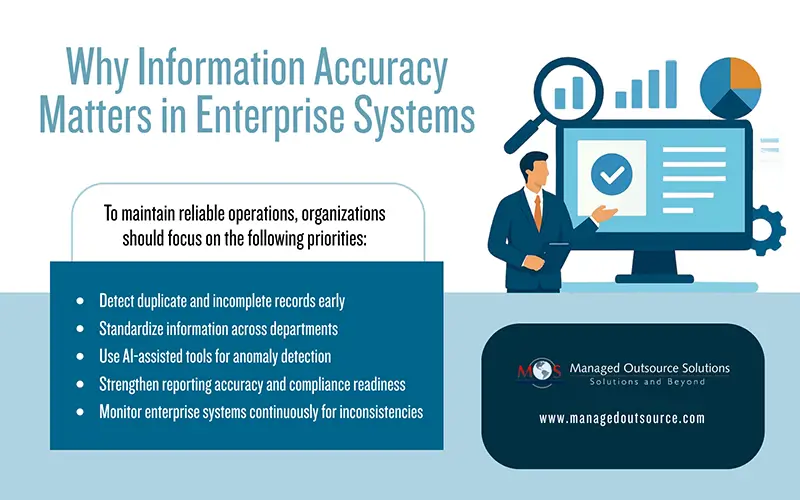
- Establish validation rules at the point of entry
- Standardize formatting conventions across departments
- Conduct periodic quality audits
- Monitor duplicate records continuously
- Integrate AI-enabled monitoring systems
For example, organizations managing large customer repositories may implement automated verification before records enter CRM systems. This reduces downstream corrections and improves reliability across departments.
This proactive approach helps organizations maintain confidence in reporting, forecasting, and customer-facing operations. It also reinforces the value of investing in robust data validation services and data cleansing services as part of a long-term information management strategy.
Why Reliable Information Creates Competitive Advantage
Reliable enterprise information strengthens every layer of operations. From reporting accuracy and customer communication to compliance and strategic planning, organizations depend on trustworthy records to function effectively. Businesses that ignore inconsistencies risk operational inefficiencies, poor visibility, and declining confidence in decision-making. In contrast, organizations prioritizing data validation in business databases create stronger operational foundations, improve forecasting accuracy, and support sustainable growth through more reliable information management. For enterprises managing large and complex information environments, partnering with providers offering data cleansing services can further improve accuracy, consistency, and long-term operational reliability.
Frequently Asked Questions
Why is data validation important in enterprise systems?
Data validation helps organizations maintain accurate, complete, and consistent records across enterprise systems. Reliable information quality improves reporting accuracy, operational efficiency, compliance readiness, and decision-making.
What happens when organizations neglect information accuracy?
Poor information quality can lead to duplicate records, reporting errors, delayed workflows, and customer communication issues. Over time, these problems increase operational costs and reduce confidence in business insights.
How does AI improve validation processes?
AI-assisted systems identify anomalies, duplicate entries, and inconsistencies faster than manual review processes. AI-driven monitoring also helps organizations detect quality issues earlier and improve accuracy at scale – transforming how enterprises identify and manage quality issues across their operations.
What is the difference between validation and cleansing?
Validation focuses on identifying inaccuracies and preventing errors before they affect operations, while cleansing corrects existing issues such as duplicate or outdated records. Professional data validation services and data cleansing services work together to improve information reliability.
How frequently should organizations review enterprise records?
The review frequency depends on operational complexity and how quickly information changes. Many organizations combine real-time monitoring with periodic audits to maintain consistency and reduce operational risk. Ongoing use of data processing services can further support timely data management at scale.
Want to improve the reliability of your enterprise records?
Discover how stronger validation practices can support better decisions and operational performance.
Contact Us Today!