
Logistics companies, carriers, and freight forwarders deal with large volumes of invoices that include multiple line items, varying rate structures, fuel surcharges, accessorial charges, and contract-specific pricing. Freight invoice processing may appear simple at first glance but it can be far more complex than standard accounts payable workflows. It requires accuracy and efficiency throughout the process, from creating invoices to collecting payments. Even a small data entry error can lead to overpayments, disputes, delayed shipments, or strained vendor relationships. Outsourcing data entry can make a significant difference by ensuring the fast, accurate capture and systematic management of freight invoice information.
Let’s explore how professional logistics data entry services enhance freight bill processing efficiency.
Improve accuracy and speed in freight billing with our expert data entry services today.
Understanding the Freight Invoicing Process
The freight invoicing process involves generating, reviewing, and approving invoices for transportation services provided by carriers. Unlike standard invoices, freight invoices typically include multiple components such as item descriptions (including quantity and weight), pickup date and time, and the delivery deadline. It also contains essential information about the shipper and carrier, required signatures, a breakdown of charges (freight fees, surcharges, and taxes), and the payment terms or mode of payment.
The process usually begins when a carrier issues an invoice after completing a shipment. This invoice must then be matched against supporting documents such as the bill of lading (BOL), purchase order, delivery receipt, and agreed-upon rate contract. Accurate shipment details such as weight, distance, freight class, and service type are essential to ensure billing accuracy.
Most businesses rely on standardized freight billing systems to streamline the invoicing process, improve accuracy, and ensure consistent documentation. However, since freight invoicing involves high volumes, variable pricing structures, and strict timelines, maintaining accuracy and efficiency throughout the process is critical to controlling transportation costs and preventing revenue loss.
Key Statistics on Freight Invoicing Problems
Here are some industry stats on transportation billing documentation issues:
- Some analyses suggest freight bill error rates ranging from 7% to 12% of total freight spend, which can translate into substantial overpayments annually (PW Consulting). Common problems identified include data entry errors and non-standard invoice formats.
- 20% to 25% of logistics invoices contain errors, and manual or paper-based processing can lead to 8%–15% error rates in some cases (LinkedIn).
- According to industry reports, only about 17% of freight invoices are error-free, meaning the majority require some level of audit or correction. (360 ResearchReports).
- A study cited by logistics sources found around 22% of invoices contain exceptions requiring manual intervention, and billing errors can cost companies 3% to 7% of total freight spend (Zero Down Supply Chain Solutions).
- Audit data from large invoice samples shows about 4.5% of LTL invoices had billing issues, with inaccurate accessorial charges being the most common problem (AFS Logistics).
- Reports estimate that 80% of freight invoices may contain some type of error, highlighting the importance of auditing and verification (FreightAmigo)
Key Challenges of Freight Invoice Data Entry and Processing
Shipping invoice management involves several operational and financial challenges.
- Managing high volumes of freight invoices within tight payment cycles
- Handling multiple document formats in freight bill processing (PDFs, scanned invoices, EDI files)
- Capturing detailed shipment data such as freight class, weight, and accessorial charges accurately
- Preventing data entry errors in freight billing that can lead to overpayments or disputes
- Matching invoices with bills of lading, proof of delivery, and rate agreements
- Verifying carrier rates and fuel surcharges during freight invoice processing
- Avoiding duplicate invoices and missed billing records
- Maintaining accurate logistics data entry for reporting and cost analysis
- Reducing processing delays caused by manual data entry
- Ensuring consistent and standardized freight billing documentation
- Managing exceptions and discrepancies in transportation invoices
- Supporting timely freight audit and payment workflows
Logistics companies, carriers, and freight forwarders can overcome these challenges by choosing the right data capture approach for their needs.
Overview of Data Entry Approaches for Freight Invoice Processing
Data entry services play a vital role in freight invoicing by ensuring that shipment details, carrier charges, surcharges, and supporting document data are accurately captured and recorded in billing or accounting systems. Freight invoice data can be captured manually or automated approaches.
Manual entry typically involves human operators entering shipment details, carrier information, and charges from non-standard or handwritten invoices and documents. Data entry operators then verify data against bills of lading, rate sheets, and delivery records and correct any discrepancies. While manual data capture is useful for complex invoices, low-volume operations, and documents with inconsistent formats
Automation leverages OCR or AI tools for extracting data from PDFs and scanned invoices. Fields such as invoice numbers, dates, and amounts are automatically validated and integrated with accounting or transportation management systems. Automated solutions ensure faster processing and reduced turnaround time
Advanced and proactive data entry outsourcing services offer a hybrid approach, combining automated and manual data entry solutions for freight invoices that enhances billing accuracy and efficiency.
How Advanced Hybrid Data Entry Services Enhance Freight Bill Processing
A hybrid approach combines automation with expert oversight to improve both efficiency and accuracy in freight invoice processing.
Automation for High-Volume Data Capture
OCR and AI-driven tools automatically extract key invoice data—invoice numbers, shipment details, freight charges, fuel surcharges, and taxes—from PDFs, scanned documents, and digital files. OCR and AI in freight bill processing speeds up freight bill processing, and ensures standardized data formatting across systems.
Robotic Process Automation (RPA) is playing an increasingly important role in freight bill processing by automating repetitive and rule-based tasks such as data extraction, invoice matching, and validation against rate agreements. RPA bots can capture shipment details, check invoices for missing information, and flag discrepancies much faster than manual workflows. This reduces processing time, minimizes data entry errors, and helps ensure timely approvals and payments.
Human Validation for Exceptions and Complex Charges
Experienced reviewers verify rate agreements, accessorial fees, weight classifications, and contract terms. They handle non-standard invoices, resolve discrepancies, and prevent duplicate or incorrect payments—strengthening shipping invoice management, freight audit and billing accuracy. When combined with human oversight and data entry expertise, RPA enables logistics companies to handle high invoice volumes more efficiently while improving accuracy and cost control.
Faster Turnaround with Greater Accuracy
By combining automated bill of lading data entry with manual quality checks, businesses can reduce processing delays, minimize billing errors, and maintain better control over freight spend. The hybrid model supports scalable, accurate, and cost-effective freight invoice management.
Improving Freight Bill Processing with Reliable Data Entry Support
Efficient freight bill processing is essential for controlling transportation costs, maintaining vendor relationships, and ensuring smooth supply chain operations. However, high invoice volumes, complex rate structures, and manual data entry challenges often lead to delays, discrepancies, and financial leakage.
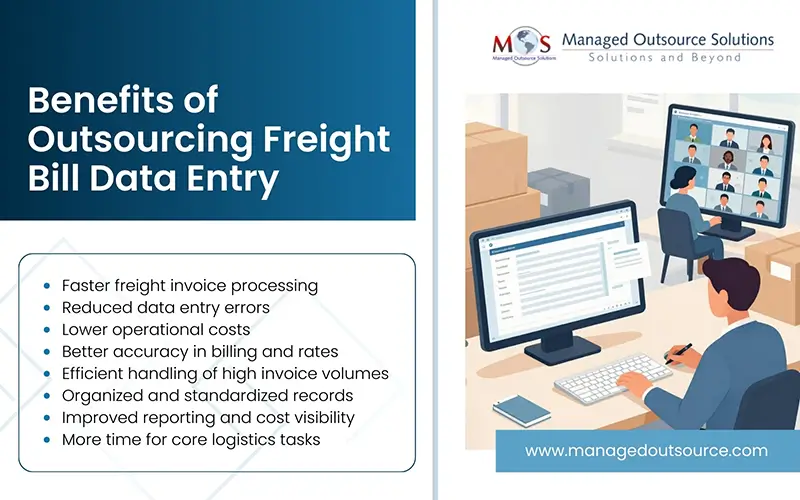
Professional back-office data entry services enhance freight bill processing efficiency by ensuring accurate data capture, faster turnaround times, and structured documentation management. These services help businesses implement best practices for accurate freight bill processing and verification. By reducing errors, ensuring rate verification, and improving visibility into freight spend using human verified automation, they helps businesses streamline workflows and strengthen their freight audit and payment processes.
For logistics companies, carriers, and 3PL providers, investing in reliable data capture and verification support is a strategic step toward greater accuracy, cost control, and sustained growth.