Over the last decade, the global business environment has undergone a dramatic transformation. Technologies such as automation, artificial intelligence (AI), and cloud computing are enabling companies to operate faster, cheaper, and with fewer employees. This shift has intensified discussions around the impact of automation and BPO on hiring, especially for startups and new businesses that are redefining how they build and manage teams. Instead of building large internal teams, many companies now rely on automated systems, scalable cloud infrastructure, and business process outsourcing (BPO) services to manage operations efficiently.
According to the latest Empowering Small Business report from the U.S. Chamber of Commerce, nearly 60% of small businesses nationwide are already using AI, with adoption continuing to grow rapidly. The report notes that 82% of small businesses using AI increased their workforce over the past year, highlighting that AI adoption often supports business growth and job creation rather than simply replacing workers.
Automation, AI, cloud computing, and outsourcing can reduce the need for large workforces, especially in routine roles. Research by Goldman Sachs indicates that generative AI alone could automate nearly 25% of all work hours. This shift does not necessarily eliminate all jobs, but it significantly reduces the need for large teams performing repetitive tasks. New businesses are increasingly prioritizing scalable technologies, cloud platforms, and AI-assisted business process outsourcing services to streamline operations and maintain efficiency without significantly expanding their internal workforce. This evolving landscape is reshaping how companies start, grow, and scale.
The Impact of Automation and BPO on Hiring Trends in Modern Businesses
Automation, cloud computing, and BPO are among the biggest technological drivers restricting hiring by new businesses. Instead of building large internal teams to manage operations, companies can now rely on intelligent systems that perform repetitive tasks faster and more accurately. As these technologies mature, startups are increasingly adopting them to operate efficiently with smaller teams. Let’s explore how advanced technologies reduce the need for large workforces, especially in routine roles.
- AI-driven Task Automation
Automation and AI are increasingly taking over repetitive or transactional tasks, reducing the number of employees required for certain functions. Generative AI tools are now capable of handling tasks such as content creation, translation, data analysis, and even basic programming. Here are some statistics on AI-driven task automation in startups and new businesses:
- Up to 41% of small businesses adopted AI within the past year, showing strong momentum in automation among new and growing firms, according to a recent report from Scheduling Kit.
- Reporting on AI usage trends in 2025, SQ Magazine highlighted that 83% of startups launched in 2025 include AI features in their core product offerings from day one.
- In 2024, Goldman Sachs reported that generative AI adoption in certain sectors is expanding more rapidly. For example, in the information services sector, adoption was projected to increase from 16% to 23%.
As these tools become more widely used, new businesses can automate many administrative and knowledge-based tasks that once required dedicated employees. With automation reducing workforce demand for routine and repetitive tasks, many new businesses are able to operate efficiently with smaller teams.
The rapid adoption of AI among small businesses highlights how technology is leveling the playing field and creating new opportunities for innovation and growth. The Empowering Small Business report highlighted that 82% of small businesses using AI increased their workforce over the past year. Here are the implications of these finding:
- AI Supports Business Growth Rather Than Job Cuts
- AI Automates Tasks, Not Entire Jobs
- Increased Efficiency Drives Expansion
- Shift Toward Skilled Roles
If 82% of small businesses using AI increased their workforce, it suggests that AI tools often help companies grow faster. Automation improves efficiency and productivity, enabling businesses to expand operations and hire more employees.
Most small businesses use AI to automate repetitive or administrative tasks such as data entry, scheduling, customer support responses, and marketing analytics. This allows employees to focus on higher-value work rather than replacing them entirely.
When AI reduces operational bottlenecks and saves time, businesses can handle more customers, larger workloads, and new markets, which may require additional hiring.
While AI may reduce demand for some routine tasks, it increases the need for employees with digital, analytical, and strategic skills who can work alongside AI tools.
- Reduced Operational Costs
Hiring employees involves multiple expenses including salaries, benefits, infrastructure, and training. Automation software, in contrast, typically requires only a one-time investment or a subscription-based model while operating continuously with minimal oversight. Startups often prioritize these tools because they help maintain lean operational budgets while still achieving high productivity.
- Cloud-based Infrastructure reduces IT Hiring
Traditionally, companies needed specialized internal IT teams to manage servers, storage systems, and enterprise software. With cloud computing transforming business operations, startups can access scalable technology infrastructure without investing heavily in in-house IT resources. As a result, startups can launch digital services without hiring full IT departments, reducing early-stage staffing requirements.
- Higher Productivity with Smaller Teams
Automation tools allow employees to focus on strategic work while routine tasks are handled by AI systems. Even in recruitment functions, technology is improving efficiency. Research shows that 52% of talent acquisition leaders consider identifying suitable candidates from large applicant pools to be the most challenging part of recruiting. AI-powered systems now assist in screening resumes, ranking candidates, and managing recruitment workflows, reducing the need for large HR teams.
- Flexible and Fractional Work Models
The workforce itself is becoming more flexible. The share of US professionals working as freelancers increased from 34% in 2014 to 38% in 2023, reflecting a growing shift toward project-based employment. Startups increasingly rely on freelancers, contractors, and gig workers rather than hiring permanent staff for every function.
Together, automation and cloud computing enable startups to scale operations while maintaining lean teams. These technologies are reshaping how businesses allocate resources and manage talent, fundamentally altering traditional hiring patterns in the modern digital economy.
BPO and AI-Driven Outsourcing Are Replacing Traditional Hiring
Another major factor limiting hiring by new businesses is the increasing use of BPO services combined with AI-powered outsourcing solutions. Outsourcing allows companies to access specialized services without building internal departments. This change is closely connected to the BPO services and workforce trends that are redefining how organizations manage talent and operational workflows.
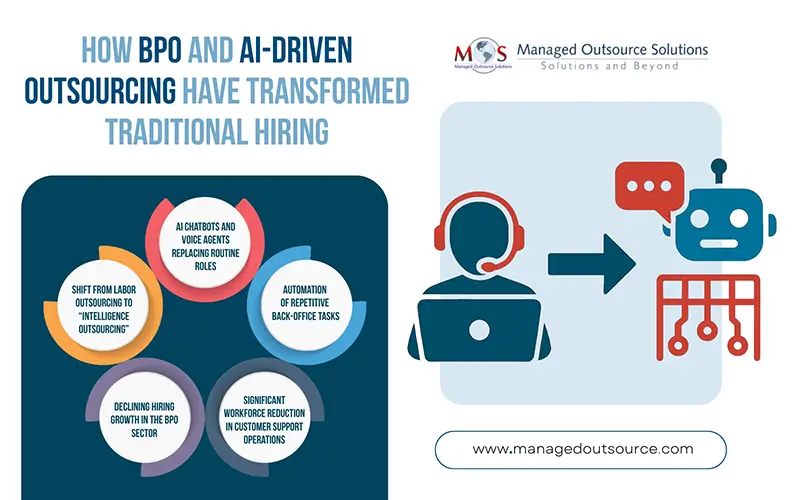
The BPO industry itself is evolving rapidly due to automation and AI integration.
- AI chatbots and voice agents replacing routine roles
- Automation of repetitive back-office tasks
- Significant workforce reduction in customer support operations
- Declining hiring growth in the BPO sector
- Shift from labor outsourcing to “intelligence outsourcing”
AI-powered chatbots are increasingly handling customer service interactions that once required large call center teams. In many cases, automated systems can resolve the majority of customer queries without human intervention, significantly reducing staffing needs.
Traditional BPO services handled tasks such as data entry, claims processing, documentation, and customer support. Today, many of these processes are being automated with AI agents that can process information, validate data, and trigger workflows automatically.
This shift allows companies to outsource entire workflows rather than hire internal administrative staff, illustrating how AI and outsourcing are changing workforce demand in modern organizations.
Some AI chatbot systems can handle up to majority of customer interactions, drastically reducing the number of employees needed to manage support operations.
For new businesses, implementing AI-powered support systems is often cheaper than hiring customer service teams.
Hiring growth in the call-center and business process management sector has slowed significantly in recent years as automation becomes more widely adopted. The increasing use of AI-driven tools and automated systems is reducing the need for large workforces in many routine service and support functions. This trend highlights how technology is reshaping employment patterns even in industries historically known for large-scale hiring.
Modern BPO models combine AI tools with smaller human teams. Automated systems handle repetitive work, while skilled employees manage complex issues that require judgment, empathy, or strategic thinking.
For startups, outsourcing services combined with AI-powered automation provide access to global expertise without committing to permanent hiring. This allows companies to remain agile while minimizing operational costs.
The Future of Hiring in a Technology-Driven Economy
Automation, cloud computing, and BPO services are transforming how businesses approach hiring. While these technologies reduce the need for large workforces, they do not eliminate employment opportunities entirely. Instead, they shift demand toward higher-value roles that require creativity, strategic thinking, and technical expertise.
Although AI may displace certain jobs, it will also create new opportunities as industries evolve. Historically, technological innovation has consistently reshaped the labor market rather than completely replacing it.
For new businesses, the challenge is not simply deciding whether to hire employees but determining which tasks should be automated, outsourced, or handled internally. Understanding how automation and cloud computing reduce hiring in startups is becoming essential for founders looking to balance efficiency with growth. At the same time, leveraging business process outsourcing services allows companies to access specialized expertise without expanding their internal workforce.
As technology continues to advance, the startup ecosystem is moving toward leaner teams supported by intelligent systems. This transformation may restrict hiring in traditional roles, but it also opens the door for new skill sets, innovative job categories, and more productive ways of working in the digital economy.