
In today’s rapidly evolving business landscape, AI data entry in finance and accounting is not just a trend. It represents a fundamental shift that is redefining how organizations manage financial information, improve accuracy, and drive strategic decision-making. With the advent of AI data entry solutions and advanced automation technologies, traditional accounting workflows are being replaced by innovative systems capable of transforming massive datasets into actionable insights. From automating routine tasks to reshaping the role of finance professionals, artificial intelligence is changing the game in profound and lasting ways.
Discover how AI data entry can streamline your finance and accounting workflows today.
AI and the Evolution of Financial Accounting
In financial accounting, AI’s capabilities facilitate the automation of repetitive tasks, the mitigation of human error, and the improvement of decision-making through data-driven insights. AI’s integration into financial accounting software offers unprecedented opportunities to enhance efficiency, speed, and accuracy in accounting processes.
Historically, finance and accounting departments have relied heavily on manual processes. Tasks like entering transaction data, categorizing invoices, reconciling statements, and preparing reports were often time-consuming, repetitive, and prone to human error. These manual routines not only slowed down operations but also left organizations vulnerable to inaccuracies that could impact financial reporting and planning.
AI, at its core, is a system of algorithms designed to mimic human intelligence. It is capable of learning from experience, recognizing patterns, and making decisions. In financial accounting, AI’s capabilities facilitate the automation of repetitive tasks, the mitigation of human error, and the improvement of decision-making through data-driven insights. AI’s integration into financial accounting software offers unprecedented opportunities to enhance efficiency, speed, and accuracy in accounting processes.
Today, AI data entry tools leverage machine learning, natural language processing (NLP), and intelligent document understanding to automate these tasks with remarkable speed and precision. For example, AI systems can scan invoices, receipts, bank statements, and other financial documents — extracting and categorizing relevant fields without the need for manual input. This shift drastically reduces errors and frees up valuable time for finance teams to perform higher-value work. Instead of endless hours spent on basic data entry and processing, professionals can now focus on analysis, forecasting, and strategic guidance.
Why AI Data Entry Matters in Finance and Accounting
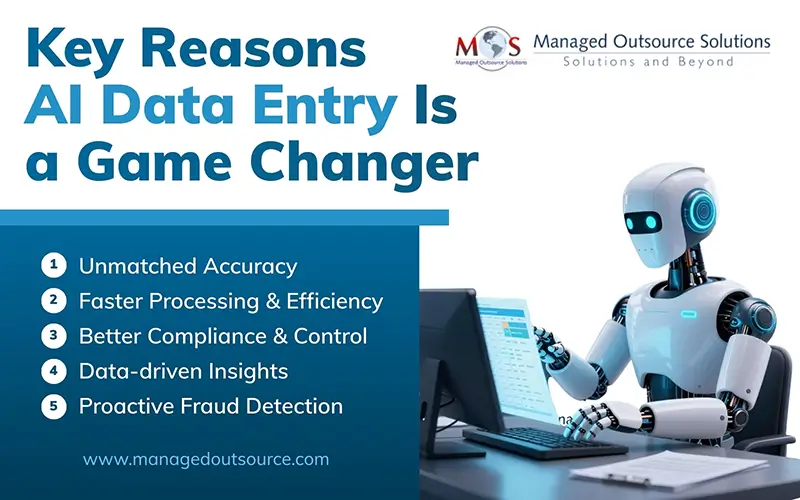
Poster Content
Key Reasons AI Data Entry Is a Game Changer
- Unmatched Accuracy
- Faster Processing & Efficiency
- Better Compliance & Control
- Data-driven Insights
- Proactive Fraud Detection
AI data entry is significant in finance and accounting because it automates repetitive tasks while significantly improving accuracy and efficiency. By reducing manual errors and processing time, it enables finance teams to focus on strategic analysis and decision-making. Below discussed are some of the key benefits of AI data entry in accounting firms:
- Unmatched Accuracy and Error Reduction: One of the most immediate benefits of AI data entry in finance and accounting is its ability to drastically reduce human errors. Manual data entry is inherently imperfect — miskeyed figures, forgotten entries, and misclassification of transactions can lead to significant discrepancies in financial records. These inaccuracies can lead to issues with compliance, audits, budgeting, and strategic planning. AI-driven systems, however, apply consistent logic and pattern recognition to ensure data is input and classified correctly. They learn from historical data and continuously improve extraction accuracy, which strengthens the integrity of financial datasets over time. With fewer mistakes and anomalies, organizations gain clearer, more dependable information for making critical decisions.
- Massive Time Savings and Operational Efficiency: Finance teams often waste countless hours on mundane tasks — entering vendor invoices, matching purchase orders, reconciling accounts, and preparing closing entries. AI data entry solutions relieve teams from these repetitive duties by automating workflows that once required manual intervention. According to industry research, automation powered by artificial intelligence significantly accelerates transaction processing, cash flow tracking, and reporting cycles. AI systems can analyze and interpret large volumes of data faster than any human, meaning month-end and year-end closes can be completed more efficiently. Not only does this result in faster operations, but it also allows finance professionals to redirect their efforts toward strategic initiatives such as performance analysis, risk evaluation, and financial planning — tasks that deliver greater value to the business.
- Better Compliance and Financial Control: Traditional manual processes can miss important regulatory changes or fail to check every transaction for compliance issues, thereby increasing the risk of fines or legal complications.AI simplifies compliance by applying up-to-date rule sets and automatically validating entries against them. For example, automated systems can enforce internal controls, ensure that expenses align with company policy, and flag suspicious transactions for review. Continuous monitoring increases governance and reduces the chance of costly compliance errors. As AI tools improve, they are beginning to incorporate real-time checks that minimize compliance risk while maintaining accurate financial records that stand up to audit scrutiny.
- Predictive Analytics and Forecasting: AI algorithms can analyze historical financial data and identify patterns that humans might overlook. These insights can fuel predictive models that forecast revenue, cash flow, customer behavior, and budget variances. When combined with market or economic indicators, AI-driven forecasting tools enable finance teams to anticipate financial outcomes, assess risks, and prepare more resilient strategic plans.
- Fraud Detection and Risk Management: Another capability of artificial intelligence in accounting is fraud detection. AI systems can continuously monitor transaction streams, looking for unusual patterns that may signal fraudulent activity or internal control breaches. Instead of relying on periodic sample testing or retrospective audits, AI enables proactive surveillance and real-time risk alerts that protect financial integrity.
Challenges and the Road Ahead
While the benefits of AI data entry are significant, its adoption isn’t without challenges. Implementation requires investment in technology, data governance practices, cyber security measures, and up skilling of finance teams. Organizations must also ensure ethical use and transparency of AI-based decisions — especially in areas like risk assessment and compliance. Even so, studies and industry voices consistently emphasize the potential for AI to transform finance functions while preserving the need for human judgment, creativity, and ethical oversight.
AI data entry in finance and accounting represents one of the most impactful applications of artificial intelligence today. From automating routine tasks, enhancing accuracy, improving compliance, and accelerating reporting cycles to empowering strategic insights and predictive analytics, AI is revolutionizing the industry in meaningful ways.
As organizations continue to look for competitive advantages, embracing AI data entry solutions isn’t optional — it’s essential. By combining technology with human expertise, finance and accounting professionals are better equipped to navigate the complexities of modern business and benefit from high-value outcomes.