
Data accuracy and integrity are crucial for reliable business operations. In retail, maintaining product data accuracy enhances decision making and improves operational efficiency. Inaccurate, incomplete, or inconsistent information can wreck marketing campaigns.
Imagine a retailer launching a seasonal promotion online, only to find that the discounted price doesn’t align with in-store systems and the product shows “out of stock” on the website despite full shelves in the warehouse. The result? Lost sales, frustrated customers, and unnecessary returns. These issues are usually caused by poor data quality.
Retailers now use professional data cleansing services to remove errors and inconsistencies from their database and ensure accurate, consistent information ready for analytics, reporting, and business operations.
This post explores how accurate retail data drives success by supporting better decision-making, smoother operations, and stronger customer trust.
What is “Data Quality” in Retail?
Accurate data in retail implies that a retailer’s data is accurate, complete, consistent, and reliable across all systems and channels. High-quality, clean data in retail ensures that product, pricing, inventory, customer, and transaction information is correct and usable for daily operations, analytics, and decision-making. In practical terms, this means:
- Accurate product data – correct descriptions, stock keeping units (SKUs), pricing, and images across online and in-store platforms.
- Consistent inventory data – the same stock levels reflected in POS systems, warehouses, and e-commerce sites.
- Complete customer data – valid contact details and purchase histories for personalized marketing and service.
- Timely updates – real-time or near real-time data that reflects current availability, promotions, and sales.
- Reliable transaction data – error-free sales and return records for reporting, forecasting, and compliance.
In retail, poor data quality can lead to stock shortages, pricing errors, lost sales, and reduced customer trust. Data quality directly impacts customer experience, inventory management, supply chain efficiency, and profitability, making it a critical foundation for retail success.
Why Accurate Retail Data is Important for Business Success
From product listings and inventory levels to pricing and customer information, retailers rely on data to make day-to-day decisions and long-term strategic plans. When data is accurate and consistent across systems, businesses can operate efficiently and respond quickly to market demands.
Better Inventory Management
Inventory data in retail provides a comprehensive record of a business’s stock, covering item descriptions, quantities, locations, costs, sales, and movement. Inventory management is one of the most challenging aspects of retail operations, where data accuracy directly impacts the bottom line. Precise inventory data allows you to maintain optimal stock levels, avoiding costly stockouts and excess inventory.
The benefits of accurate inventory information include:
- Reduced Costs: Lower holding costs, less waste from obsolescence, fewer emergency orders.
- Increased Customer Satisfaction and Sales: Meeting demand, fewer lost sales from stockouts.
- Better Decisions: Data-driven marketing, pricing, and promotions.
- Improved Efficiency: Streamlined operations through automation and accurate records.
Accurate demand forecasting reduces inventory carrying and storage cost while simultaneously improving product availability to meet seasonal demand.
Enhances Pricing Accuracy
Pricing issues destroy customer trust and reduce margins. When product, pricing, and inventory data are accurate, retailers can apply the right prices and discounts across point-of-sale systems, e-commerce platforms, and marketplaces without mismatches. Pricing and promotion accuracy prevents issues such as overcharging, undercharging, or promotions appearing online but not in-store.
Clean, reliable data also enables precise promotion setup and timing. Suppose a retailer is running a “20% off weekend sale” on select products. If the data is reliable, the discount starts exactly on Friday, applies only to the correct items, and ends on Sunday across both online and in-store systems. Customers see the same price everywhere, and the promotion ends at the right time after the sale period, preventing lost revenue and customer complaints.
In addition, accurate data allows retailers to track sales, adjust pricing strategies quickly, and optimize future campaigns based on reliable insights.
Promotes Personalized Customer Experiences
With accurate data on audience demographics, preferences, purchase history, and behaviour as well as customer density, competition, and complementary brands, retailers can deliver personalized customer experiences. Having the right information allows businesses to offer relevant product recommendations, targeted offers, and timely communications, improving satisfaction and loyalty.
For example, with accurate data on a customer’s past purchases, a business can recommend complementary products or send a personalized discount on a frequently bought item, making the shopping experience more relevant and enjoyable.
Smart Location Planning and Expansion
Accurate data plays a crucial role in location planning and expansion by enabling retailers to make informed, low-risk decisions. Reliable demographic, sales, and customer behavior data help identify high-potential markets, understand local demand patterns, and assess purchasing power before opening new stores or expanding existing ones.
With clean and consistent data, retailers can accurately analyze foot traffic, customer density, competitor presence, and performance of nearby locations. This reduces the risk of choosing underperforming sites and supports smarter decisions on store size, product mix, and pricing strategies.
Supply Chain Management
Accurate retail data keeps inventory balanced, costs under control, and the entire supply chain responsive. When sales, inventory, and customer behavior data is accurate, it helps businesses predict demand more efficiently, meaning fewer stockouts, less dead inventory, and smarter promotional planning. Clean, real-time retail data supports automated replenishment through smoother coordination between retailers, distributors, and manufacturers. With accurate sales and inventory data shared by retailers, suppliers can plan production and shipments to meet actual demand. Supply chain data accuracy prevents wrong orders, missed deliveries, and costly corrections. Reliable data enables better strategic decisions and faster fulfilment of customer needs.
Strengthens Retail Analytics and Forecasting
The importance of clean data for retail analytics and forecasting is well established because analytics outcomes are only as reliable as the data behind them. Clean, accurate, and consistent data allows retailers to generate meaningful insights, identify trends, and make informed decisions about inventory planning, pricing, and promotions. Clean data improves the effectiveness of advanced analytics tools and AI-driven forecasting models, enabling retailers to respond quickly to changing customer behavior and market condition
Reduced Financial Risks
Accurate retail data reduces financial risks by enabling businesses to understand sales trends, inventory levels, and demand patterns, allowing them to avoid costly overstocking and stockouts. With reliable data, retailers can forecast demand more precisely, manage procurement and holding costs, minimize obsolete inventory, and prevent revenue leakage caused by pricing or billing errors. It also supports better cash flow management and more informed investment decisions, helping businesses respond proactively to market changes.
When retail data has errors, duplicates, and inconsistencies, it leads to poor inventory decisions, inaccurate pricing, and missed sales opportunities. Let’s explore ways to ensure data quality in retail.
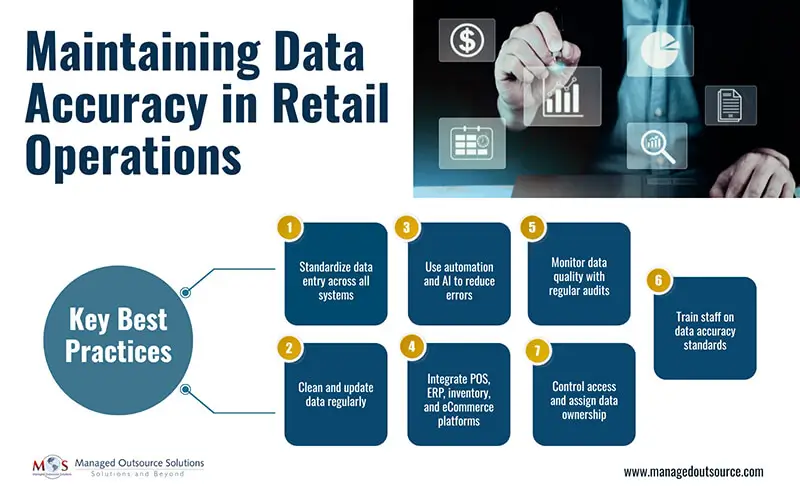
Best Practices for Maintaining Data Accuracy in Retail Operations
- Standardize Data Entry Processes: Use consistent formats, naming conventions, and validation rules across all systems to reduce manual errors and inconsistencies.
- Implement Regular Data Cleansing: Periodically remove duplicates, correct inaccuracies, and update outdated records to maintain clean and reliable retail data.
- Leverage Automation and AI Tools: AI-powered data validation, product data management (PDM), and automated updates help minimize human error and improve accuracy at scale.
- Ensure System Integration Across Channels: Align POS, ERP, inventory, and eCommerce platforms to prevent data mismatches between online and in-store operations.
- Monitor Data Quality with Ongoing Audits: Track key data quality metrics such as completeness, accuracy, and consistency to catch issues early and prevent downstream errors.
- Train Staff: Educate employees on the importance of accurate data entry and provide clear guidelines to ensure accountability.
- Control Access: Limit editing rights and assign data ownership to specific teams to reduce unauthorized changes and confusion.
Data cleansing in retail is not a one-time project—it’s a continuous activity.
Retail data changes constantly: new SKUs, seasonal pricing, supplier updates, promotions, store openings, and customer behavior shifts. Treating data cleansing as a periodic “cleanup” leads to recurring errors. High-performing retailers embed data cleansing into daily and weekly workflows, often through automated validation rules and scheduled audits.
Expert takeaway: Ongoing cleansing prevents small errors from compounding into revenue-impacting issues.
Outsource Data Management to Specialists When Needed
Maintaining accurate retail data requires ongoing effort, advanced tools, and dedicated expertise. When internal teams are stretched or data volumes grow too complex, reaching out to data cleansing companies can be a smart move. Expert service providers use proven data cleansing processes, automation, and quality checks to ensure accuracy, consistency, and compliance, freeing businesses to focus on core operations, customer experience, and growth.
Eliminate errors, duplicates, and inconsistencies
Partner with experts for clean, retail-ready data.
Get a Free Trial