
If you’ve been watching the outsourcing industry closely, you already know it’s entering a new era. What once focused mainly on cost savings has now evolved into a strategic powerhouse. Today, staying updated on BPO market trends is essential for any business that wants to compete in a fast-moving, tech-driven world. Companies increasingly depend on BPO services not just for efficiency, but for expertise, scalability, and advanced tech capabilities – all contributing to the rapidly expanding business process outsourcing (BPO) industry.
With AI revolutionizing everything from customer support to data processing, the BPO market is undergoing one of its biggest shifts ever. As automation and intelligent workflows reshape how outsourcing works, this is the perfect time to dive into the latest insights, growth patterns, and future forecasts defining the modern BPO landscape.
Global BPO Market Trends: Key Statistics
Here are some latest statistics according to a report by Market.us.
- Rapid Market Expansion: The BPO analytics market is projected to grow from $36.61 billion in 2025 to $186.09 billion by 2034, at a strong CAGR of 19.8%, highlighting the surge reflected in many outsourcing market analysis reports.
- Rise of Data-driven Decisions: The growth is largely fueled by the increasing need for data-driven decision-making, as organizations use analytics to streamline operations and stay competitive.
- North America Leads the Market: North America held 38.4% of the BPO market in 2023, generating USD 121 billion, supported by advanced IT infrastructure and mature outsourcing capabilities.
- Role of Emerging Technologies: The report highlights that growing adoption of AI and automation continues to push global BPO services growth across industries.
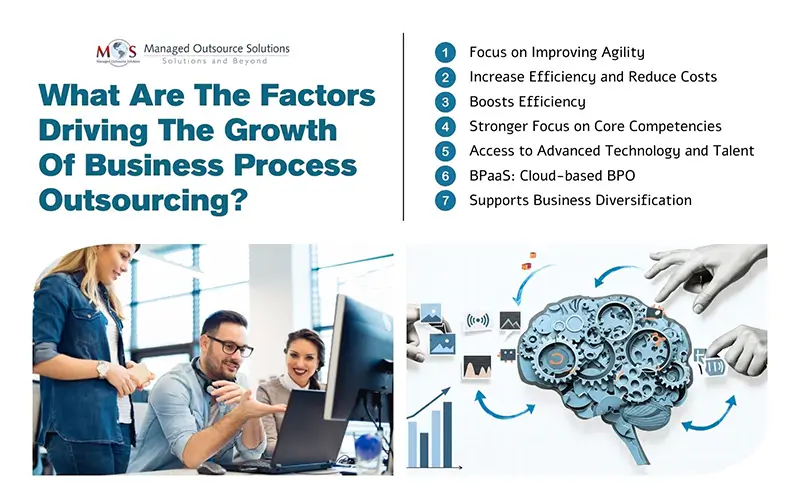
Factors Driving the Growth of Business Process Outsourcing
- Focus on Improving Agility: Businesses today face constant changes, economic shifts, new technologies, and evolving market demands. To stay competitive, they must be agile. Business agility means responding quickly to customer needs, launching new products faster, reducing costs, and tracking market trends in real time.BPO helps companies stay agile by giving them access to specialized services with greater accuracy and speed. This support allows organizations to adapt quickly in a fast-moving digital environment.
- Increase Efficiency and Reduce Costs: According to Business Wire, cutting operational costs is one of the biggest drivers of global BPO growth. Outsourcing reduces logistical and geographical barriers, helping companies save significantly-often 30-40%-by working with offshore providers. BPO companies handle front-office and back-office tasks at lower costs, reducing expenses tied to staff, office space, equipment, and training. This improves efficiency and frees up internal resources.
- Boosts Efficiency: BPO boosts efficiency by helping businesses focus on their core activities instead of getting overwhelmed by routine tasks. It streamlines operations and improves internal processes, making daily workflows smoother and more productive. Outsourcing also uses services like document scanning and data entry to improve information access and speed up decision-making. By delegating non-core tasks, companies free up valuable manpower and resources for high-priority work that drives growth.
- Stronger Focus on Core Competencies: As businesses grow, managing day-to-day operations becomes demanding. Outsourcing non-core functions allows companies to shift their time and resources to what matters most – product development, customer service, and innovation. In healthcare, for example, outsourcing revenue cycle management or claims processing helps organizations stay focused on improving patient care.
- Access to Advanced Technology and Talent: BPO providers invest in the latest technologies and highly trained professionals. This gives them access to skills, tools, and consulting expertise without heavy investment in hiring or training. It also helps them respond faster to customer needs and market changes.
- BPaaS: Cloud-based BPO: Cloud technology has transformed the outsourcing industry. Gartner defines Business Process as a Service (BPaaS) as cloud-delivered BPO designed for multiple users. BPaaS provides scalable platforms, trained teams, and remote access to back-office services anytime, anywhere.
- Supports Business Diversification: BPO also helps companies innovate and expand into new areas by giving them access to specialized expertise they may not have in-house. With advanced skills, modern tools, and industry-specific knowledge from outsourcing partners, businesses can confidently explore new product lines or service offerings. This reduces the financial and operational risks that usually come with diversification. As a result, companies can grow into new markets more smoothly while staying focused on their main strengths.
Technological Advancements Shaping BPO Services
Technology continues to redefine how BPO solutions operate, making them faster, smarter, and more efficient. Automation, artificial intelligence (AI), machine learning (ML), cloud computing, and advanced security tools are now at the core of modern outsourcing. These innovations help companies streamline operations, cut costs, and enhance accuracy, making technology a major driver of the industry’s evolution.
- Automation of Business Processes: Automation has completely transformed the BPO industry. It accelerates workflows, reduces operational costs, and improves accuracy in everyday processes. Robotic Process Automation (RPA) uses software bots to perform repetitive tasks such as data extraction, form filling, validation, file transfers, invoice processing, customer onboarding, and claims processing. By replacing manual work with automated bots, organizations benefit from faster turnaround times and significantly fewer errors—an essential advantage for industries with strict regulatory standards. RPA also works 24/7, allowing BPO companies to maintain continuous operations. This frees up employees to focus on strategic tasks where human judgment is needed and boosts overall productivity across outsourced functions.
- Artificial Intelligence (AI) and Machine Learning (ML): AI and ML are driving a new wave of innovation in BPO by improving speed, decision-making, and service quality. AI enhances RPA by helping bots handle more complex tasks like exceptions and decision-based actions. AI-powered chatbots deliver instant customer support, reducing wait times and improving user experience.ML models analyze real-time customer sentiment, forecast trends, and detect suspicious activities—strengthening security and helping businesses respond more effectively. Together, AI and ML enable BPO companies to automate complex processes, enhance data analytics, improve accuracy, and offer highly personalized services based on customer behavior and insights.
- Cloud Computing: Cloud computing has become a game changer for business process outsourcing. It allows BPO companies to work more efficiently through centralized, secure, and scalable platforms. With cloud technology, organizations can easily store, access, and share large volumes of data without investing in expensive hardware. Cloud platforms support real-time project collaboration, enabling teams across different locations and time zones to work seamlessly. They also make it easier to scale services based on client needs and reduce the costs of data storage and IT maintenance. For companies outsourcing administrative or back-office tasks, cloud integration ensures smooth communication, consistent output, and faster delivery.
- Conversational AI for Customer Service: AI-powered tools are redefining customer support within BPO operations. These technologies deliver faster resolutions and more personalized experiences while lowering operational costs:
- Computer Telephony Integration (CTI): Improves phone-based interactions through automatic dialing, call routing, and instant access to customer information.
- Contact Center as a Service (CCaaS): Manages multiple communication channels – calls, chats, emails – on one unified platform.
- Self-service Portals: Include chatbots, Interactive Voice Response (IVR) systems, and searchable knowledge bases that guide customers without human intervention
These conversational AI tools make customer service more accurate, efficient, and scalable, helping businesses enhance engagement and satisfaction.
- Technology for Data Security: Advanced technology plays a major role in securing outsourced operations. Several tools protect sensitive data and ensure compliance:
- Data Encryption: Protects data in transit and at rest.
- Access Controls: Uses MFA and role-based permissions to secure confidential information.
- Firewalls: Filter unauthorized traffic and prevent attacks.
- Intrusion Detection Systems (IDS): Monitor networks for threats in real time.
- SIEM Solutions: Analyze logs and detect security incidents faster.
- Cloud Security: Offers encryption, access control, and disaster recovery for cloud-based operations.
- Automated Monitoring: Tracks systems continuously for anomalies.
- AI and ML: Identify and respond to emerging threats proactively.
- Blockchain: Ensures data integrity with tamper-proof records.
The Impact of AI on the BPO Industry
AI is projected to drive significant growth in the data management market, which is expected to reach $513.3 billion by 2030 – according to a recent IoT Analytics report. It also plays a central role in Healthcare BPO market size and forecasts, where automation and analytics are transforming patient data handling and administrative workflows. Market reports highlight the impact of AI on business process outsourcing solutions, many of which are centered on data management services.
Artificial intelligence (AI) is transforming the BPO industry by optimizing processes and automating repetitive tasks, leading to greater efficiency, enhanced customer experiences, and cost savings. Technologies such as robotic process automation (RPA) streamline operations like data entry, invoice processing, and customer inquiries, reducing human error and accelerating workflows. Additionally, AI-driven virtual assistants and chatbots provide 24/7 support, ensuring prompt and efficient customer service outsourcing are enhancing customer experiences and supporting digital transformation driving BPO services demand across industries.
Bringing everything together, it’s clear that the BPO industry is no longer just about outsourcing tasks – it’s about embracing smarter, AI-powered transformation. Automation, predictive analytics, and intelligent support tools are becoming central to how providers deliver value. Businesses that adapt to evolving BPO market trends will position themselves ahead of competitors as digital expectations grow. With BPO services now integrating AI into nearly every process, organizations have more opportunities than ever to innovate, scale, and enhance customer experiences. The future of outsourcing is bright – driven by technology, shaped by global talent, and ready for businesses that are prepared to move forward with it.