
Insurance companies manage vast volumes of claims information every day. Each claim requires the collection, verification, and recording of multiple details before insurers approve or settle it. Traditionally, employees handled these activities manually, which made the process slow and prone to human errors. Digital transformation allows insurers to adopt technologies that improve operational efficiency and accuracy. Among these innovations, RPA in insurance claims data entry has become an important solution for streamlining repetitive tasks and improving the overall claims data entry workflow.
Robotic process automation (RPA) uses software bots that mimic human actions within digital systems. These bots capture information, transfer data between applications, and update claim records without human intervention. By automating routine tasks, insurers handle large volumes of information faster while maintaining consistency and accuracy. As insurance companies continue modernizing their operations, these technologies play a crucial role in increasing process efficiency and delivering faster service to policyholders.
Eliminate claims data entry delays!
Deploy RPA platforms that process high volumes accurately and instantly.
Call: (800) 670-2809
Understanding the Role of RPA in Insurance Claims Data Entry
Insurance organizations rely on multiple digital systems to manage claim information, including policy administration platforms, document management systems, and claims processing applications. Employees move information between these systems to maintain accurate claim records, which increases workload and slows operations. RPA enables insurers to manage this process more efficiently. Software bots capture information from claim forms, validate entries, and transfer data across platforms according to predefined rules.
RPA also supports structured workflows within claims departments. Bots can update claim files, notify relevant teams, and initiate verification steps as soon as new information enters the system. These capabilities help insurers maintain organized claim records while ensuring that processes move forward without delays. In practice, these automated workflows follow a series of structured processing steps.
A typical automated workflow includes several steps:
- Capturing incoming claim forms from portals, emails, or scanned documents
- Extracting key fields such as policy numbers, claim amounts, and dates
- Verifying the information against policy databases
- Entering validated data into claims management systems
- Generating alerts and status updates
This workflow reduces manual workload and helps insurers manage claim information more efficiently. When insurers combine automation with technologies such as optical character recognition and intelligent document processing, their systems can interpret information from unstructured documents like invoices or medical reports. As a result, insurers manage claims more efficiently while maintaining consistency across transactions.
Why Insurance Claims Data Entry Needs Automation
Insurance claims operations involve several departments and systems. Data moves between customer portals, policy databases, verification systems, and payment platforms. Manual processes create operational challenges that slow down claims resolution.
Common issues include:
- Large volumes of paperwork and scanned documents
- Time-consuming manual data entry tasks
- Increased risk of data duplication or entry mistakes
- Delays in claim verification and settlement
- Difficulty maintaining compliance with regulatory requirements
Digital technologies help insurers address these challenges by enabling claims data entry automation across their workflows. Automated systems perform routine tasks quickly and consistently, allowing employees to focus on higher-value responsibilities such as fraud analysis, customer communication, and claim evaluation.
Industry studies show that RPA technologies significantly improve operational efficiency by reducing processing delays and minimizing manual workload. As insurance companies face growing claim volumes and customer expectations, automation becomes an essential operational strategy.
Key Benefits of Implementing Automation in Claims Data Operations
Insurance companies that implement RPA tools experience measurable improvements in productivity and accuracy. Organizations that adopt robotic process automation services can transform their claims workflows and handle higher workloads without increasing staffing requirements.
Faster Processing Cycles
Software bots execute repetitive tasks within seconds. Activities that once required several hours now take only minutes, enabling insurers to accelerate claim verification and settlement.
Improved Accuracy
Human operators may occasionally introduce errors when entering large volumes of information. Automation systems follow predefined rules and validation checks, ensuring consistent and accurate data recording.
Reduced Operational Costs
These technologies reduce the time employees spend on repetitive tasks. Organizations can redirect staff toward strategic activities such as policy analysis, fraud detection, and customer engagement.
Stronger Compliance Management
Insurance companies must follow strict regulatory standards and documentation requirements. Automated systems maintain detailed activity logs and ensure that workflows follow predefined compliance rules.
Better Customer Experience
Faster processing directly improves the experience of policyholders. When insurers process claims quickly and accurately, customers receive faster decisions and timely payments.
These advantages explain why insurers increasingly adopt RPA technologies as part of their digital transformation strategies.
How Automation Technologies Work in Claims Data Workflows
Modern RPA platforms combine multiple technologies to streamline claims data entry operations. When insurers integrate these tools effectively, they create efficient systems that handle document backlogs with minimal manual intervention.
A typical automated claims workflow includes several stages:
Document Capture and Classification
Automated systems collect claim forms, invoices, and supporting documents from digital channels such as customer portals, email attachments, and scanned uploads.
Data Extraction and Validation
Automation tools extract relevant information from documents using AI-enabled recognition technologies. These tools then validate the extracted data against policy records and claim databases.
System Integration and Updates
Software bots transfer verified information between internal systems, update claim records, and trigger subsequent workflow steps.
Exception Handling
Automation systems identify unusual cases and automatically route them to human specialists for detailed review.
When these technologies work together, insurers achieve efficient claims processing automation that reduces operational delays and improves transparency. Automation also allows insurers to scale their operations quickly during periods of high claim volumes, such as natural disasters or large-scale incidents.
Integrating AI and Other Technologies with Automation
Insurance companies increasingly combine RPA platforms with artificial intelligence to improve document analysis and decision-making capabilities. These technologies enable systems to process complex information sources that traditional RPA tools cannot handle easily.
For instance, automation platforms rely on intelligent document processing to interpret unstructured documents such as repair estimates, invoices, and medical records. Machine learning algorithms and OCR technologies extract relevant data fields from various document formats with high accuracy.
Additional technologies that strengthen RPA systems include:
- Machine learning models that validate extracted data and detect anomalies
- Natural language processing tools that analyze textual information in documents
- Predictive analytics platforms that identify potential fraud patterns
- Cloud-based infrastructure that supports scalable automation environments
Organizations that adopt AI data entry services further enhance their automation capabilities by integrating AI with robotic workflows. These technologies allow insurers to capture data more accurately and process complex claims documentation efficiently.
Real-world Impact of RPA in Claims Data Entry
RPA and AI-driven technologies have already transformed claims data entry processes across the insurance industry. Many insurers report measurable improvements in productivity and service delivery after implementing automation tools.
Organizations frequently observe several operational improvements:
- Faster claim registration and validation
- Higher data accuracy across digital records
- Increased claims processing capacity
- Improved compliance monitoring and reporting
Automation also helps insurers manage spikes in claim submissions. For example, large-scale natural disasters generate thousands of claims within a short period. Automation systems continue processing information continuously without fatigue, which enables insurers to maintain operational efficiency during peak demand.
Organizations that modernize their operations increasingly invest in automation solutions for high-volume insurance claims processing so they can manage growing workloads more effectively. These solutions integrate multiple automation technologies that streamline the entire claims data entry lifecycle.
Challenges and Considerations in Automation Implementation
Although automation offers substantial benefits, organizations must address several operational considerations before implementing automation strategies.
Process Standardization
Automation delivers the best results when workflows follow clearly defined rules. Organizations should review existing processes and standardize them before introducing automation tools.
Data Quality Management
Automation systems depend on reliable input data. Insurers must maintain strong data governance practices to ensure consistent and accurate information across systems.
Integration with Legacy Systems
Many insurance companies still rely on older technology platforms. IT teams must configure automation tools carefully so they interact smoothly with these systems.
Workforce Adaptation
Automation changes how employees perform daily tasks. Organizations should train staff members to supervise automated workflows, analyze exception cases, and manage automation performance.
Companies implementing intelligent automation solutions for insurance claims documentation combine process redesign with technology adoption to maximize operational benefits.
The Expanding Role of Automation in Insurance Operations
RPA technologies continue to evolve as insurers pursue greater efficiency and resilience in their operations. The combination of robotics, artificial intelligence, and advanced analytics reshapes how insurance companies manage data-intensive processes.
Future RPA initiatives can include:
- Hyperautomation platforms that integrate multiple technologies
- Self-learning systems that improve performance over time
- AI-driven fraud detection tools that identify suspicious claims patterns
- Automated communication systems that provide real-time claim updates
Insurance organizations increasingly adopt robotic process automation services to strengthen digital capabilities and streamline complex operational workflows. As automation technologies mature, insurers will integrate them across underwriting, policy administration, and customer service operations.
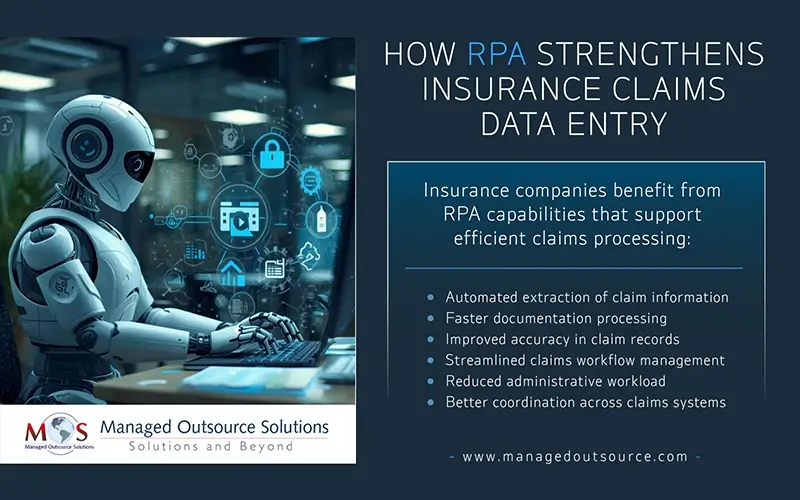
Strengthening Claims Data Entry Operations through Intelligent Automation
Insurance companies operate in an environment where speed, accuracy, and operational efficiency directly influence customer satisfaction. Manual workflows struggle to keep pace with growing claim volumes and rising service expectations. Workflow platforms provide insurers with a practical solution for managing complex claims more efficiently.
By implementing RPA platforms, insurers improve how they capture, verify, and process claims information. These technologies enhance transparency, reduce processing delays, and support consistent compliance with regulatory standards. Automation also enables employees to focus on analytical and customer-oriented tasks instead of data entry tasks.
As the insurance sector continues embracing digital transformation, RPA will remain a key component of modern claims management strategies. Organizations that integrate intelligent technologies into their workflows will strengthen operational efficiency, deliver faster service to policyholders, and adapt more effectively to evolving industry demands.