Organizations frequently evaluate productivity through headcount, technology investments, or revenue performance while overlooking a quieter operational issue: how repetitive work consumes strategic capacity. Administrative coordination, data processing, reporting, scheduling, invoice management, and documentation consume substantial internal bandwidth across industries. Understanding the ROI of delegating routine business tasks has therefore become increasingly important for efficiency, scalability, and workforce productivity.
Many organizations underestimate the cumulative cost of repetitive operational work. Small inefficiencies, when multiplied across teams and departments, gradually reduce productivity and limit organizational agility.
For example, leadership teams spending several hours weekly on reporting reviews, calendar coordination, or manual approvals lose time that could otherwise support business planning, innovation, and customer-facing priorities.
While this operational friction rarely appears on balance sheets directly, its long-term effect influences growth capacity, employee performance, and profitability.
While delegation of routine back office tasks is frequently associated with labor savings, its greatest value usually emerges through improved operational focus, faster decision-making, and better allocation of internal expertise. This becomes particularly relevant as organizations increasingly explore BPO outsourcing to improve operational flexibility and reduce internal administrative strain.
Why Routine Work Quietly Reduces Business Performance
Routine operational work supports business continuity, but excessive administrative burden weakens performance. Organizations rarely struggle because these responsibilities lack importance. Instead, challenges emerge when highly skilled employees spend disproportionate time on low-complexity activities, such as:
- Manual reporting and reconciliation
- Calendar coordination
- Data entry and documentation
- Invoice processing
- Customer follow-up administration
- Scheduling management
The issue becomes more significant as organizations grow. What initially appears manageable gradually evolves into workflow congestion, delayed decision-making, and operational inefficiency.
For example, finance teams repeatedly correcting manual data inconsistencies may struggle to focus on forecasting accuracy. Customer-facing teams managing administrative updates may spend less time strengthening client relationships. Over time, repetitive workloads create organizational drag.
The ROI of Delegating Routine Business Tasks: A Strategic Perspective
The financial value of delegation extends far beyond payroll reduction.
The ROI of delegating routine business tasks becomes visible when organizations evaluate broader operational outcomes. Key areas of measurable impact include:
Leadership Capacity Recovery
Executives and managers frequently spend excessive time supervising repetitive workflows. Delegation improves leadership focus by shifting low-complexity responsibilities to specialized support systems or external teams. This enables leaders to prioritize:
- Strategic planning
- Revenue generation
- Client relationships
- Process innovation
- Risk management
Faster Decision Cycles
Operational bottlenecks slow execution. When repetitive coordination consumes internal bandwidth, approvals, reporting, and communication frequently become delayed. Delegation reduces friction and improves responsiveness.
Workforce Specialization
Organizations create stronger productivity when employees focus on work aligned with expertise.
For example, a financial analyst spending hours formatting spreadsheets contributes less strategic value than one focused on forecasting and scenario planning.
Delegation strengthens role alignment and improves organizational efficiency.
The Hidden Cost of Leadership Attention Fragmentation
Leadership productivity depends heavily on uninterrupted focus. Yet, many organizations underestimate how repetitive operational interruptions reduce executive performance. Frequent context switching between strategic priorities and administrative activities weakens decision quality.
Examples include:
- Constant approval requests
- Administrative coordination
- Manual tracking updates
- Scheduling interruptions
- Documentation reviews
Research increasingly links fragmented work patterns to lower productivity and reduced cognitive efficiency. Even short interruptions create cumulative performance loss.
The operational issue is therefore not simply workload volume. It is attention fragmentation.
Businesses seeking stronger execution increasingly evaluate how internal workflows consume leadership capacity.
Operational Efficiency beyond Labor Savings
Organizations frequently view delegation through cost reduction alone. This perspective limits strategic evaluation. The strongest returns frequently emerge through operational consistency and process reliability.
Delegation can improve:
- Workflow standardization
- Accuracy rates
- Process continuity
- Documentation consistency
- Turnaround time
For example, organizations managing high-volume administrative operations improve service reliability through specialized support functions rather than expanding internal teams indefinitely.
This creates scalability without proportional overhead growth.
According to research from the Deloitte, organizations increasingly adopt external operational support models to improve efficiency and workforce flexibility.
How Delegation Improves Workforce Productivity and Retention
Employee productivity depends heavily on role clarity.
High-performing professionals generally seek meaningful, specialized work rather than repetitive administrative responsibilities.
When repetitive workflows dominate schedules:
- Employee engagement may decline
- Strategic output decreases
- Burnout risk increases
- Retention challenges become more likely
Delegation helps organizations create stronger alignment between employee expertise and operational priorities.
For example:
Sales professionals spending excessive time updating records contribute less revenue-focused activity. Healthcare administrators overloaded with documentation may struggle to prioritize patient coordination.
Organizations that optimize role alignment improve both productivity and employee satisfaction.
The Role of Specialized Partners in Business Scalability
Scalability becomes increasingly difficult when organizations depend exclusively on internal operational expansion.
Many businesses strengthen operational resilience through specialized service providers. This may include:
- Administrative support
- Data processing
- Customer service operations
- Back-office coordination
- Documentation management
Strategic BPO outsourcing supports flexibility by helping organizations scale operations without proportionally increasing fixed workforce costs.
However, successful delegation requires clear governance, workflow definition, and measurable performance standards. Without process clarity, delegation may create inefficiency instead of operational improvement.
How AI Is Transforming Delegation and Process Management
Artificial intelligence increasingly reshapes how organizations manage repetitive work.
AI-Assisted Workflow Automation
AI-assisted systems reduce manual intervention across repetitive processes such as documentation review, scheduling, and classification tasks. This improves speed and consistency.
AI-Enabled Operational Intelligence
AI-enabled systems identify workflow bottlenecks, process delays, and recurring inefficiencies. Organizations use these insights to improve productivity and resource allocation.
AI-Driven Process Optimization
AI-driven systems forecast operational demand and recommend process improvements based on historical performance patterns. The growing influence of AI in business process outsourcing reflects a shift toward hybrid operating models where human expertise works alongside intelligent automation.
Research from the McKinsey & Company indicates that organizations increasingly report measurable productivity gains associated with generative AI adoption.
Common Delegation Mistakes Businesses Make
Delegation becomes ineffective when organizations approach it reactively.
Common mistakes include:
- Delegating without documented workflows
- Failing to define performance expectations
- Treating delegation only as cost reduction
- Overloading internal teams before acting
- Delegating highly strategic responsibilities unnecessarily
Strong operational models distinguish between activities requiring internal expertise and those better managed through specialized support.
Building a Sustainable Delegation Framework
Organizations seeking stronger operational performance should establish clear evaluation criteria.
A practical framework includes:
Task Prioritization
Identify repetitive, low-complexity responsibilities consuming excessive internal time.
Workflow Standardization
Document processes before delegation begins.
Performance Measurement
Evaluate:
- Turnaround time
- Accuracy
- Productivity improvement
- Cost efficiency
Continuous Optimization
Review workflows regularly to identify improvement opportunities. This structured approach improves long-term operational efficiency while reducing organizational friction.
Strategic Takeaway for Long-Term Business Performance
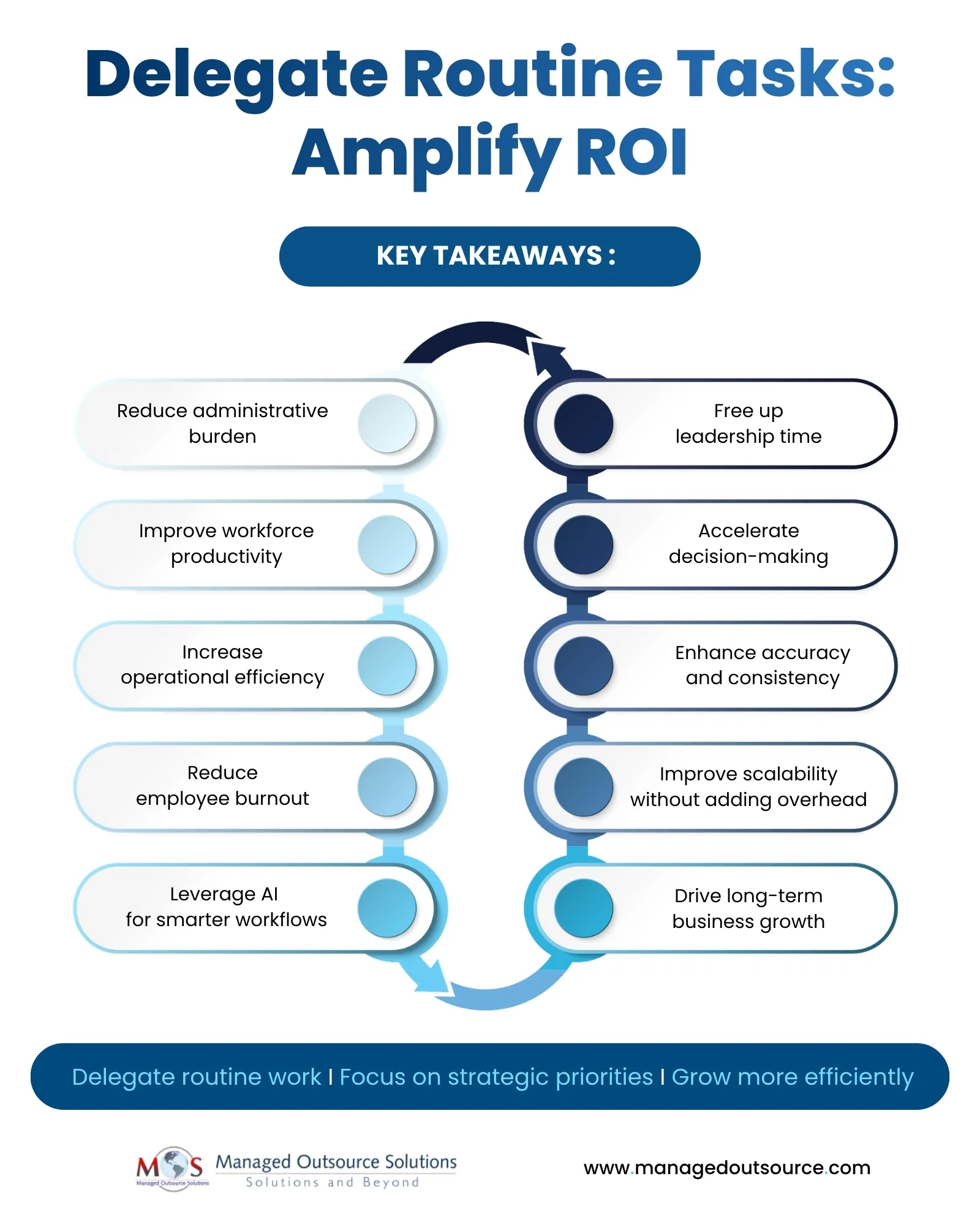
Organizations rarely improve performance through workforce expansion alone. Understanding the ROI of delegating routine business tasks helps businesses identify hidden inefficiencies, strengthen productivity, and improve leadership focus. Companies that balance internal expertise with specialized operational support, AI-driven optimization, and structured delegation frameworks position themselves for stronger scalability, operational resilience, and long-term business growth. The growing role of AI in business process outsourcing further strengthens this transformation by improving operational accuracy, efficiency, and process scalability.
Frequently Asked Questions
What types of routine business tasks should organizations delegate first?
Organizations should begin with repetitive, time-intensive activities that require consistency rather than strategic decision-making. Examples include scheduling, documentation, data processing, reporting support, customer follow-ups, and invoice management. The objective is to recover internal capacity without disrupting high-value work.
How can businesses measure the ROI of delegating routine business tasks?
The ROI of delegating routine business tasks can be measured through improvements in productivity, reduced operational delays, leadership time recovery, lower administrative burden, faster turnaround times, and stronger workforce specialization. Businesses should evaluate both financial and operational outcomes rather than labor savings alone.
Does delegation reduce quality or operational control?
Not necessarily. Quality concerns typically emerge when organizations delegate without documented workflows or clear performance expectations. Structured governance, standardized processes, and measurable KPIs help maintain consistency while improving operational efficiency.
What role does AI play in delegated business operations?
AI-assisted, AI-enabled, and AI-driven systems increasingly support repetitive operational workflows through automation, predictive insights, and workflow optimization. Businesses frequently combine human expertise with intelligent automation to improve speed, accuracy, and scalability.
When should a business consider external operational support?
Organizations should evaluate external support when repetitive operational work begins limiting productivity, slowing decision-making, increasing employee overload, or affecting growth capacity. Businesses experiencing rapid expansion or operational bottlenecks may benefit significantly from specialized support models.