
Traditionally, the real estate industry has been characterized by manual processes, paperwork, and data-intensive tasks. However, as technology continues to evolve, businesses are increasingly turning to innovative solutions to streamline operations, enhance efficiency, and improve customer experiences. Robotic Process Automation (RPA) is one of the most impactful technologies that is driving this change. As real estate firms look to streamline operations and boost accuracy, automation emerges as a strategic priority. Among all available technologies, RPA stands out due to its ability to automate repetitive, rule-based processes with high speed and accuracy. However, successful real estate RPA implementation requires more than simply installing software bots. Real estate companies must overcome challenges related to legacy systems, data quality, integration, change management, and long-term scalability. This post explores these challenges, best practices, and the benefits of adopting real estate automation solutions for modern property operations.
What is RPA in Real Estate?
RPA enables the automation of repetitive, rule-based tasks by mimicking human interactions with computer systems and applications. When it comes to real estate, RPA can be used to automate a wide range of processes, including data entry, document management, lead generation, and customer service, among others.
RPA in real estate utilizes software robots, or “bots,” to interact with various applications and systems used in the industry, such as customer relationship management (CRM) software, property management systems, and marketing platforms. These bots can perform tasks quickly, accurately, and consistently, freeing up human employees to focus on more strategic and value-adding activities. This makes RPA a vital tool for real estate process optimization and a key step toward wider digital transformation.
Streamline operations and reduce costs—talk to our experts now!
How is RPA Relevant to The Real Estate Industry
The real estate industry is characterized by numerous time-consuming and labor-intensive tasks, making it an ideal candidate for RPA implementation. Key factors that make RPA relevant to the real estate industry include –
- Data-intensive processes – Real estate transactions involve a significant amount of data entry, document processing, and data management, which can be streamlined and automated using RPA.
- Repetitive tasks – Many tasks such as property listings, lead generation, and client communication, involve repetitive steps that are well-suited for RPA automation.
- Compliance and regulatory requirements – Subject to numerous regulations and compliance standards, the real estate industry often involve extensive documentation and reporting processes that can be automated with RPA.
- Integration challenges – Real estate businesses frequently use multiple software applications and systems that may not be integrated, leading to manual data transfer and process inefficiencies that RPA can address.
- Customer experience enhancement – By automating routine tasks, professionals can focus more on delivering personalized and high-quality customer experiences, which are crucial in a highly competitive industry.
Key Benefits of Using Robotic Process Automation for Real Estate Operations
Implementing RPA in real estate businesses can yield several significant benefits, including –
- Improved Efficiency and Productivity – Automation enables real estate teams to shift repetitive tasks – such as data entry, document verification, and tenant communications – to bots. RPA bots work 24/7, reducing processing time dramatically and freeing employees to focus on higher-value tasks.
- Cost Reduction and Scalability – By automating labor-intensive workflows, businesses can reduce operational costs while handling higher workloads without increasing staff. Scaling RPA is also simpler, as new automation scripts can be added quickly.
- Enhanced Accuracy and Compliance – Manual processes often result in errors – especially in data handling and documentation. RPA ensures consistent, rule-based execution, reducing risk and improving compliance. This is especially beneficial in areas like lease agreements, property documentation, and financial reporting.
- Better Customer Experience – With backend tasks efficiently handled by bots, agents and property managers can respond to inquiries faster and offer a more streamlined customer journey. This leads to stronger client relationships and improved service quality.

Top RPA Use Cases in the Real Estate and Property Management Industry
To better understand the practical applications of RPA in the real estate industry, we explore some common use cases –
- Automated Property listing Management – RPA can be used to automate the process of creating, updating, and distributing property listings across multiple platforms, such as real estate websites, social media, and listing aggregators. This ensures that listings are consistent, up-to-date, and visible to a wider audience.
- Lead Management and CRM Automation – Bots can capture leads from websites, social media platforms, or CRM systems, update records, qualify leads, and schedule follow-ups automatically – shortening sales cycles. RPA can automate the process of capturing leads from various sources (such as website forms, social media, and events), qualifying them based on predefined criteria, and automatically nurturing them through personalized communication and follow-ups.
- Tenant Onboarding and Lease Management – RPA simplifies tenant screening, application review, document preparation, and lease updates. This reduces administrative burdens and speeds up the onboarding process.
- Property Listing Automation – Updating property listings across multiple websites manually is time-consuming. RPA can be used to automate the process of creating, updating, and distributing property listings across multiple platforms, such as real estate websites, social media, and listing aggregators. It can automatically update property information, pricing, availability, and images, ensuring consistency across platforms. This ensures that listings are consistent, up-to-date, and visible to a wider audience.
- Finance and Accounting Automation – Invoice generation, payment reminders, payment reconciliation, expense tracking, and financial reporting can be automated using RPA, improving accuracy and lowering manual workload.
- Contract and Document Management – RPA can streamline the creation, review, and approval of contracts, lease agreements, and other real estate documents. It can automate tasks such as populating document templates, routing documents for review and signatures, and storing completed documents in centralized repositories.
- Data entry and Migration – RPA can automate data entry tasks, such as entering property details, client information, and transaction data into various systems, ensuring accuracy and consistency.
- Reporting and Data Analytics – RPA can be used to collect and aggregate data from various sources (e.g., CRM systems, property management software, marketing platforms) and generate real-time reports and analytics dashboards. This enables data-driven decision-making and helps identify trends and opportunities.
- Customer Service and Communication – RPA can streamline customer communication processes, such as sending automated responses, scheduling appointments, and handling routine inquiries, improving customer satisfaction.
- Mortgage and Loan processing – RPA can automate various steps in the mortgage and loan processing workflow, including document collection, credit checks, underwriting, and approval processes, reducing processing times and improving customer experiences.
Challenges in Implementing RPA in Real Estate
While the benefits are significant, real estate firms must navigate several obstacles to make automation successful.
- High Initial Investment – Although RPA reduces long-term costs, initial investments can be high due to licensing, integration, setup, training, and development. Small and mid-sized companies may struggle to justify upfront costs without a strong ROI plan.
- Integrating with Legacy Systems – Many real estate businesses use outdated systems that lack APIs or do not interact well with automation tools. Integrating RPA with such systems may require custom solutions or additional software layers.
- Poor Data Quality and Non-Standardized Processes – RPA performs best when data is structured and processes are standardized. Real estate workflows often vary across locations, properties, or teams, creating inconsistencies that complicate automation.
- Security and Compliance Risks – Handling sensitive tenant, property, and financial data requires strict privacy and security controls. Without proper safeguards, automation may introduce vulnerabilities or compliance risks.
- Employee Resistance and Change Management – Employees may fear job displacement or feel overwhelmed by new technologies. A lack of clarity and training can lead to resistance, slowing down adoption.
- Scaling and Maintenance Issues – RPA bots require ongoing updates and maintenance, especially when processes change or systems undergo upgrades. Companies must allocate long-term resources for support and scalability.
- Choosing the Right Vendor or Tools – Not all RPA platforms are built for real estate-specific challenges. Choosing the wrong solution can result in poor automation performance and wasted resources.
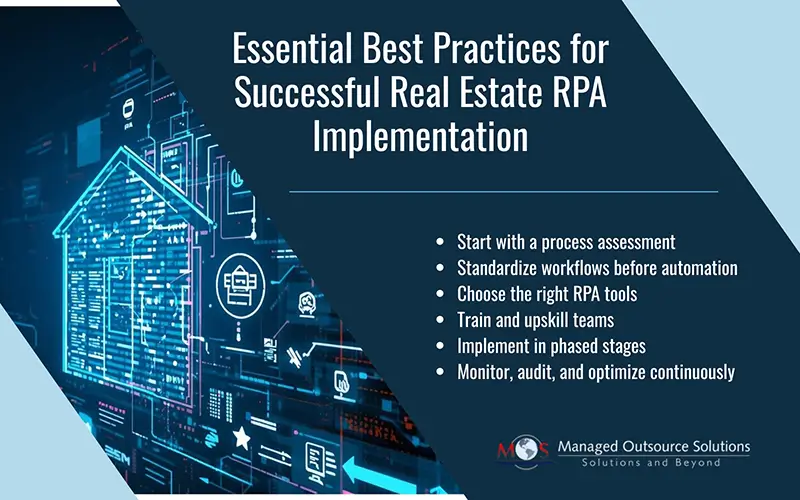
Best Practices for Effective Real Estate RPA Implementation
Implementing RPA in the real estate industry requires careful planning and a structured approach. Here are some key steps businesses can follow –
- Conduct a Comprehensive Process Assessment – Before automating anything, assess all workflows to identify the most repetitive, rule-based, and time-intensive tasks. Prioritize those that promise the highest ROI and operational impact.
- Define Goals and Objectives – Clearly define the goals and objectives you want to achieve through RPA implementation. This could include improving efficiency, reducing costs, enhancing customer experiences, or ensuring compliance.
- Select an RPA solution – Evaluate and select an RPA solution that meets your specific requirements. Consider factors such as scalability, integration capabilities, security features, and vendor support.
- Develop a Proof of Concept – Before full-scale implementation, develop a proof of concept (POC) to test the RPA solution on a specific process or use case. This will help identify potential challenges and refine your approach.
- Train and upskill Employees – Ensure that your employees are trained and upskilled to work with the RPA solution. This may involve providing training on RPA concepts, bot development, and process optimization.
- Implement and Monitor – Once you have a successful POC, proceed with a phased implementation of the RPA solution across the identified processes. Monitor the performance and impact of the RPA bots, and make necessary adjustments as needed.
- Establish Governance and Control – Implement governance and control mechanisms to ensure the proper management, security, and compliance of your RPA implementation. This includes defining roles and responsibilities, establishing audit trails, and implementing change management processes.
- Optimize Continuously – Implementing RPA is not a one-time undertaking, rather it’s an ongoing process. Continuously monitor and optimize your RPA solutions to adapt to changing business requirements, process improvements, and technological advancements.
RPA in real estate is more than just a trending technology – it is a strategic enabler of efficiency, accuracy, and scalability. When implemented correctly, RPA accelerates workflows, reduces costs, enhances customer experiences, and unlocks the full potential of real estate process optimization.
However, successful real estate RPA implementation depends on thorough planning, the right tools, strong governance, clear communication, and continuous improvement. By addressing challenges and adhering to best practices, real estate organizations can leverage real estate automation solutions to transform their operations, eliminate inefficiencies, and build a more data-driven, and competitive future.