
The education sector is changing faster than ever, and institutions are looking for smarter ways to handle daily tasks while improving student experiences. Many universities and schools now rely on RPA services to reduce paperwork, speed up administrative processes, and enhance overall productivity. As institutions deal with rising expectations and tighter budgets, they are turning to digital tools that streamline operations. This is where RPA in education becomes a game changer, helping schools manage data, reduce repetitive work, and support better learning environments while supporting broader digital transformation in education goals.
The shift toward digital transformation is driven by growing student diversity, flat enrolments, and the pressure to provide personalized academic experiences. Automation helps educational institutions cut costs per student, freeing up resources for infrastructure upgrades and improved learning tools. With large volumes of data generated daily, many HEIs now rely on modern solutions and even data processing services to manage and analyze information faster. These advancements represent a major move toward automation in academic administration, allowing institutions to operate more efficiently than before.
This post discusses the multiple benefits of RPA technology for academic and administrative workflows.
How Robotic Process Automation improves Efficiency in Educational Institutions
Robotic Process Automation is a digital technology that performs repetitive, rule-based tasks with high accuracy. In educational institutions, RPA acts like a virtual assistant that handles routine tasks across academic, administrative, HR, and finance departments. RPA applications in schools and universities support consistent and structured workflows in these areas.
Around 60% of tasks in educational settings can be automated with Robotic Process Automation tools. This includes student acquisition, onboarding, document handling, engagement workflows, and more. RPA helps staff save time while reducing errors, allowing them to focus on teaching and student support.
Real world example
At the Georgia Institute of Technology, a chatbot was used as a teaching assistant for a graduate course. The bot, called “Ms. Watson” and developed with IBM Watson, handled nearly 10,000 messages in a single semester with a 97% accuracy rate. Students eventually discovered that the helpful “Ms. Watson” they had been interacting with was not a human TA, but an AI chatbot.
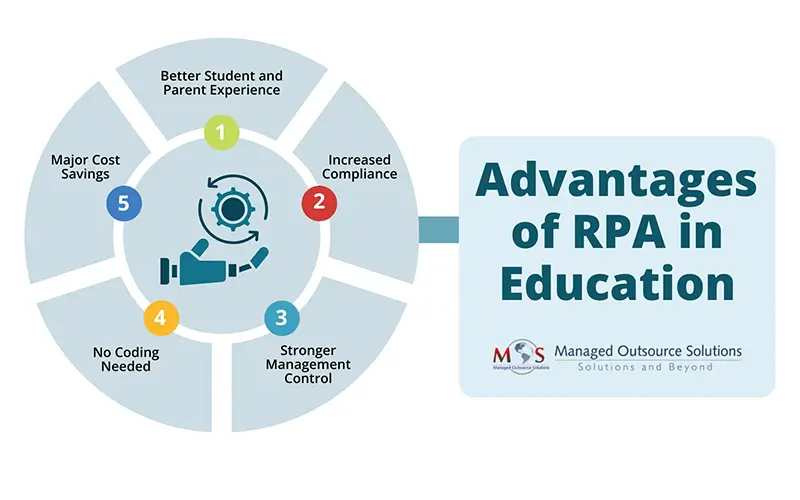
Benefits of RPA in the Education Industry
- Better Student and Parent Experience: By automating back-office work, institutions deliver faster and more accurate services. Students and parents receive information quickly, whether it’s related to classes, events, or documentation, ensuring smoother communication.
- Stronger Management Control: Centralized RPA systems help universities monitor, schedule, and manage software robots. This enhances governance, improves operational control, and ensures tasks are completed on time. Real-time analytics and audit reports help leadership make smarter decisions.
- Increased Compliance: RPA reduces data inconsistencies and logs every action performed by bots. This makes compliance checks easier and internal reviews faster. Staff can identify issues early and maintain regulatory accuracy.
- No Coding Needed: Most RPA tools use simple drag-and-drop interfaces. Staff can automate tasks without technical expertise, making adoption much easier.
- Major Cost Savings: Research shows RPA can reduce costs by 25–60%. Institutions save money on labor-heavy tasks and benefit from higher productivity without needing more staff.
Practical Use Cases of RPA in Education
Educational tasks generally fall into administrative and academic categories. Here’s how RPA supports both:
- Attendance Management
RPA can track attendance for students and staff, generate daily or monthly reports, and notify parents if attendance drops. Staff can also access detailed leave summaries and overtime records automatically.
- Processing Grade Sheets
Instead of teachers manually entering grades, RPA extracts scores from the central database and builds report cards instantly. Automated systems can even send results to parents. With machine learning integration, some tools can evaluate answers or grade assignments.
- Student Servicing
During admissions or exams, institutions receive hundreds of queries. With AI, NLP, chatbots, and SMS bots, RPA can respond to common questions about schedules, internships, hostels, placements, or travel requests—reducing staff workload significantly.
- Student Registration and Enrollment
This is one of the most paperwork-heavy processes. RPA can collect student data, validate documents, check eligibility, process fees, and send confirmation emails—ensuring a seamless and error-free registration workflow.
- Financial Reporting
Handling educational loans and financial documentation is time-consuming. RPA automates fee management, payroll processing, scholarship creation, and other financial tasks. Institutions can easily create fee groups and manage optional fee structures.
- Scheduling Meetings
From parent-teacher meetings to board discussions, scheduling can take hours. RPA automates invites, revisions, reminders, and attachments—ensuring smooth coordination.
- Online Classroom Support
Online learning involves multiple tasks such as attendance tracking, grading, and progress monitoring. RFID cards can automatically mark attendance in physical classrooms, while digital attendance sheets with timestamps can be used for online classes. RPA ensures teachers can focus on teaching instead of admin work.
- Staff Hiring and Payroll
RPA helps shortlist candidates, schedule interviews, and recommend pay ranges based on experience and industry norms. It also automates payroll by evaluating staff attendance and calculating monthly payouts.
Automation doesn’t replace jobs, it removes manual, repetitive tasks so staff can focus on meaningful work. This shift increases accuracy, reduces burnout, and helps institutions serve students more effectively. Educational institutions that adopt a balanced model, automation plus human judgment, gain a competitive edge. They can improve academic delivery, reduce administrative errors, and provide a modern, efficient learning environment. As digital transformation accelerates, universities and schools that embrace automation will be better prepared for future challenges.
Using RPA in business operations involves setting up software bots to handle repetitive, rule-driven manual tasks. The shift toward automation is no longer optional in any sector, including education. With rising workloads, higher student expectations, and fast-paced academic environments, institutions need smarter systems to stay efficient.
Implementing RPA services can transform everyday operations and improve quality across departments. By integrating these solutions, educational institutions gain better control over data, reduce paperwork, increase accuracy, and create more time for student-focused activities. RPA isn’t just beneficial for the education sector, it also streamlines workflows, reduces manual effort, and boosts efficiency across a wide range of businesses and industries.
Educational institutions that adopt automationtoday will deliver better experiences tomorrow, more organized, more efficient, and more student-centric than ever.
Enhance efficiency and cut manual workloads with our RPA services.