The real estate and property management industry is undergoing a major digital shift. As property portfolios grow and workflows become more complex, traditional manual processes are no longer enough to ensure efficient management or sustainable profitability. This is where RPA in property management is emerging as a transformative solution.
By integrating software robots into daily operations, organizations can automate high-volume, rules-based tasks that once consumed countless administrative hours. Right from processing lease agreements to managing rent payments, maintenance requests, financial reconciliations, compliance documentation, and tenant communications, RPA in real estate helps property managers streamline practically every stage of the workflow. Instead of relying on manual data entry, repetitive form-filling, and time-consuming validation checks, RPA bots can execute these tasks with speed, accuracy, and consistency – all while operating 24/7 without interruption.
Top firms are increasingly adopting robotic process automation services to modernize their operations, eliminate human errors, and reduce the burden on staff. As a result, property managers can shift their focus from routine administrative work to high-value activities such as improving tenant experience, optimizing portfolios, and fostering stronger client relationships.
In a rapidly evolving real estate market, the importance of real estate process automation cannot be overstated. RPA not only enhances operational efficiency but also helps real estate companies stay competitive and resilient in an industry where timely, data-driven decision-making is crucial.
Streamline your real estate operations with smart automation
Explore how RPA can transform your property management workflows today.
Call Now!
What Is RPA and Why It Matters in Property Management
At its core, RPA is software technology that uses “bots” to mimic human actions – tasks like entering data, validating information, and transferring records between systems. These bots can follow rules, operate 24/7, and free up staff from mundane, repetitive work. RPA automates repetitive and time-consuming tasks based on software robots to enhance productivity and efficiency. When it comes to property management, many operational activities are data-intensive and repetitive. These activities include lease processing, rent reminders, maintenance scheduling, finance reconciliation, compliance reporting, and more. These are precisely the kinds of workflows where RPA real estate automation provides value.
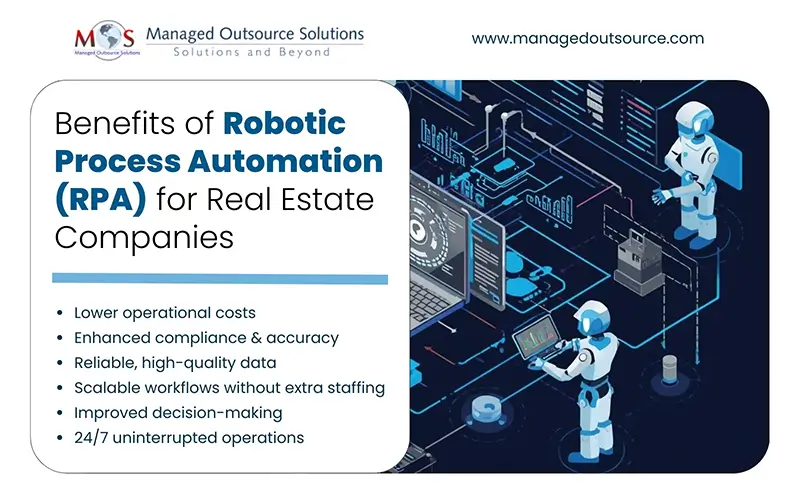
Benefits of Robotic Process Automation for Real Estate Companies
- Reduced Operational Costs – Implementing RPA involves initial investment, but in the long run, the costs saved in manpower and error correction are substantial. Bots reduce repetitive burdens, enabling cost-efficient scaling.
- Enhanced Compliance & Risk Mitigation – By automating regulatory processes (e.g., AML/KYC checks, lease compliance), RPA ensures that every transaction or document change adheres to the required standards. This helps lower regulatory risk as well as errors in compliance reporting.
- Improved Data Quality – With RPA managing data extraction and validation, real estate firms minimize manual data entry errors. Therefore, their dashboards, reports, and financial records are more reliable.
- Scalability without Proportional Cost Rise – As portfolios grow, property firms don’t need to hire proportionally more administrative staff. Software bots can handle increased volume, making scaling more efficient.
- Better Decision Making – RPA not only automates tasks but also aggregates data from multiple systems and generates insights. Property managers can use real-time analytics for better decision making around portfolio management, pricing strategies, and maintenance planning.
- Faster Tenant Onboarding & Enhanced Experience – Automated tenant screening, background checks, document generation, and lease creation mean a smoother onboarding journey. Combined with automated communication (rent reminders and maintenance updates), tenant satisfaction improves.
- Maintenance Efficiency – Automating maintenance workflows – from request logging to assignment, follow-ups, and closure – makes operations faster and more transparent, which is vital for tenant retention.
- Round-the-Clock Operations – With bots working 24/7, critical tasks don’t have to wait for business hours – payments can be reconciled at night, reports built overnight, and reminders sent proactively.
- Higher Employee Satisfaction – By offloading repetitive tasks, your staff can focus on higher-value work – building client relationships, strategizing growth, or solving complex problems. This leads to more fulfilling jobs and potentially lower attrition.
Implementing RPA in Property Management: Key Considerations
To successfully deploy robotic process automation services in property management, companies should think strategically. Here are some key considerations –
- Process Assessment – Map all your existing workflows (tenant onboarding, payments, maintenance, and compliance). Identify rule-based, repetitive, high-frequency tasks that are ripe for automation. In short, understanding which tasks can be automated is the first step.
- Pilot before Scale – Start with a pilot – automate rent reminders or maintenance requests first. Test the automation, measure ROI, and iron out bugs before extending RPA across the business.
- Choose the Right RPA Partner – Work with a trusted RPA implementation partner or firm that understands real estate process automation. Whether in-house or external, make sure they have domain knowledge and technical expertise.
- Integration Capability – RPA bots must integrate with your current property management systems: CRM, ERP, accounting software, maintenance portals, etc. Seamless integration ensures data flows and reduces silos.
- Governance & Compliance – Define ownership, monitoring, and control mechanisms for bots. Establish exception handling protocols and audit logs – especially for compliance and financial tasks.
- Scalability and Maintenance – As your property portfolio grows, bots need to scale. Additionally, there must be ongoing bot maintenance, versioning, and updates to adapt to changing business rules.
- Change Management – Train staff on the new workflows. Communicate clearly how bots will help – not replace – them. Engaging your team early ensures smoother adoption and alignment.
- Measure Success – Define KPIs (cost reduction, time saved, error rate, tenant satisfaction) and monitor them. Use these metrics to justify further investment and expansion of RPA.

Key Use Cases of RPA in Property Management
Here discussed are some key practical use cases where RPA bots make a real difference –
- Lease Agreement Processing – RPA bots can generate lease documents, extract data from applications, validate tenant information, and store contracts in an organized repository. This reduces manual data entry, speeds up onboarding, and cuts errors in lease documentation. RPA streamlines lease agreement processing by automating data entry and verification. Bots can retrieve tenant details from applications, input data into lease templates, and cross-check details for accuracy. Automation reduces processing time, cuts down errors, and guarantees compliance, freeing up the time for property managers so they can focus on higher-value tasks and tenant experience enhancement.
- Rent Collection and Processing – Bots send notifications before due dates, follow up on late payments, and reconcile payments directly with the accounting system. This significantly reduces friction in payment management and improves cash flow. RPA streamlines rent collection and processing by automating routine tasks that previously required manual effort. Automated rent reminders are sent to tenants ahead of due dates, ensuring timely notifications. The system also manages payment processing by connecting with banking platforms and instantly updating tenant records. This approach helps maintain on-time payments, reduces the need for continuous follow-ups, and lowers the risk of financial errors. With RPA, property managers can easily and accurately generate rent collection reports, gain real-time insights, and dedicate more time to handling complex issues and strengthening tenant relationships.
- Maintenance Requests Management – When tenants request maintenance (via email, online form, or portal), RPA bots can automatically log the ticket, assign it to the appropriate technician, schedule work, and provide status updates to tenants. This improves response times, lowers resolution delays, and enhances tenant satisfaction. RPA can manage the entire maintenance request workflow from start to finish. It records incoming requests from different sources like emails or online forms and automatically assigns them to the right technicians based on their skills and availability. Tenants are kept informed through automated status updates, while the system also schedules follow-up notifications to ensure timely resolution.
- Vendor Management – Property management often involves working with multiple vendors (contractors, suppliers). RPA can streamline vendor onboarding, contract management, and payments. Automation ensures that vendor contracts are compliant, payments are accurate, and the vendor database is up-to-date.
- Data Entry and Reporting – RPA bots can gather data across multiple systems (CRM, ERP, property portals), compile reports (occupancy, maintenance, finance), and generate dashboards. This reduces errors, saves hours of manual reporting, and gives property managers real-time insights.
- Compliance and Regulatory Reporting – Compliance is critical in real estate: AML/KYC checks, lease regulation, local property laws, etc. With RPA, compliance checks can be automated, reports generated and submitted on time, and records maintained systematically. With RPA, property management teams can automate tasks like compliance monitoring, report generation, and submission processes. The system continuously checks operations against regulatory requirements, automatically compiles the necessary documents, and submits them on time to the appropriate authorities. This greatly reduces the risk of non-compliance, helping ensure that all activities meet legal standards and protecting the business from potential penalties or legal complications.
- Financial Automation (Accounting) – RPA can automate accounts payable (AP) and accounts receivable (AR) workflows – extracting invoice data, reconciling accounts, updating ledgers, and generating financial reports. Bots can also assist in Net Asset Value (NAV) calculations for property portfolios, helping investors and asset managers. RPA also supports budget forecasting by analyzing past financial records and detecting patterns and trends that guide future planning.
Challenges & Risks to Watch Out For
- Complex Process Variability – Not all property management workflows follow the same rules, making it difficult for bots to handle exceptions. If a process requires human judgment or varies frequently, RPA may fail or require constant reconfiguration.
- Initial Investment – RPA implementation requires spending on software, integration, and skilled professionals. While ROI is strong long term, the upfront cost can be a barrier for small or mid-sized property firms.
- Maintenance Overhead – Bots need ongoing monitoring and updates whenever business rules, templates, or software systems change. Without proper maintenance, automated workflows can break unexpectedly, causing operational disruptions.
- Data Silos – If systems like CRM, accounting, and maintenance portals are not integrated, RPA may automate inefficiencies instead of fixing them. This can limit the true value of automation and prevent property managers from achieving seamless workflows.
- Security & Compliance Risks – RPA bots handle sensitive tenant, financial, and property records, which require strong safeguards. Poorly governed automation can expose companies to data breaches, compliance violations, and audit failures.
- Resistance to Change – Employees may fear automation will replace their jobs or disrupt established routines. Without change management and training, adoption becomes challenging, reducing the effectiveness of RPA.
In the fast-evolving real estate landscape, embracing RPA in property management is no longer an experiment – it’s a competitive necessity. Robotic process automation services bring efficiency, accuracy, scalability, and cost savings. Through real estate automation, firms can streamline their back-office workflows, enhance tenant experience, improve compliance, and free up human capital for more strategic work. By deploying real estate process automation, property management firms gain a transformative tool – one that enables how RPA improves efficiency in property management in measurable ways. The benefits of robotic process automation for real estate companies involve reduced operational cost, better compliance, higher scalability, and more satisfied tenants and staff.