
The healthcare outsourcing landscape is changing faster than ever, and organizations are now rethinking how they manage operations, improve efficiency, and deliver better patient outcomes. As digital transformation accelerates, staying updated on healthcare BPO growth trends has become essential for any provider trying to navigate this evolving space. These trends are not just reshaping workflows—they’re redefining what healthcare organizations expect from a business process outsourcing company.
From AI-powered automation to data-driven decision-making and remote patient support, the healthcare BPO sector is entering a new era where technology and human expertise come together to provide smarter, more scalable solutions. Whether you’re a healthcare leader or a technology-driven organization, understanding these changes will give you a competitive edge in a rapidly expanding market.
Healthcare BPO Growth Trends: Why the Industry Is Growing So Fast
The conversation around outsourcing in healthcare has exploded in recent years. That’s because today’s healthcare environment is more complex than ever. Digital transformation, regulatory demands, cost pressures, staffing shortages, and patient expectations all contribute to the rising relevance of BPO.
Smaller practices especially are turning to outsourced healthcare services to lighten their administrative load. Meanwhile, tools like Electronic Health Records (EHRs), cloud platforms, and telehealth services make it easier to partner with BPO providers and integrate outsourced services seamlessly.
What used to be a cost-saving option is now a strategic move to improve performance, efficiency, and patient satisfaction.
Key Healthcare BPO Services in Demand
Healthcare organizations now outsource a wide range of processes to streamline operations:
- Medical billing and coding
- Claims processing
- Appointment scheduling
- Telehealth support
- Insurance verification
- Data entry and patient record management
Providers of outsourcing services not only help reduce administrative burden but also increase accuracy, improve turnaround times, and enhance patient experience. Many BPO providers also use automation, analytics, and AI-powered tools to deliver faster and error-free results. They help organizations achieve healthcare operational efficiency, reduce turnaround times, and enhance accuracy.
With advanced analytics, healthcare providers can gain insights into performance, patient behavior, financial patterns, and workflow efficiencies—all without needing a full internal analytics team.
Healthcare BPO Market Statistics and Growth Forecasts
So, how fast is the healthcare BPO industry growing? Here are some statistics:
- According to Precedence Research, the global healthcare BPO market is expected to expand from USD 466.6 billion in 2025 to more than USD 1 trillion by 2034.
- Similarly, Zion Market Research projects the market to grow from USD 392.4 billion in 2024 to nearly USD 985 billion by 2034.
- North America leads the market with almost 49% share in 2024.
- The U.S. and Canada rely heavily on outsourcing for billing, RCM, customer support, and claims operations.
This growth highlights how essential BPO services have become, not only for large hospitals but also for smaller clinics and independent practitioners aiming for healthcare process optimization.
4 Key Strategies to Enhance Patient Experience Using Healthcare BPO
Modern patients expect fast, convenient, and personalized care at every stage of their healthcare journey. To meet these rising expectations, Healthcare BPO providers are using automation, advanced technologies, and scalable workflows. Here are the four strategies shaping patient experience and how BPO improves efficiency in healthcare operations.
- AI and Automation Transforming Healthcare BPO
AI and automation are at the forefront of emerging technologies shaping the healthcare BPO market. They help healthcare providers in the following ways.
- Routine tasks like billing, claims processing, and data entry are automated, reducing manual effort while speeding up turnaround times.
- Rule-based automation minimizes errors, improving accuracy in critical workflows.
- Chatbots provide round-the-clock support, giving patients immediate assistance.
- Predictive analytics help identify risks and operational bottlenecks.
Rather than replacing staff, AI frees healthcare workers to focus on complex decisions and meaningful patient interactions.
- AI and Automation Transforming Healthcare BPO
Growing Healthcare Demand Requiring Scalable Support
Aging populations, chronic diseases, and expanded insurance access continue to increase patient volumes.
- BPO teams manage claims, billing, patient onboarding, and referrals to ensure smooth service delivery.
- Support with chronic care coordination helps maintain continuity of care as patient needs become more complex.
Outsourcing enables healthcare organizations to scale quickly, reduce delays, and maintain high service quality—even during staffing shortages or peak seasons.
- Cybersecurity Becoming a Top Priority
With rising digital adoption, safeguarding patient data is more critical than ever.
- BPO providers use advanced encryption, MFA, intrusion detection, and secure cloud systems to protect sensitive information.
- AI-driven threat monitoring enables rapid response to cyber risks.
- Strict compliance frameworks and regular audits help prevent violations and maintain patient trust.
Strong cybersecurity capabilities are becoming a key factor when choosing BPO partners.
- Telehealth Expansion Creating New Outsourcing Needs
Telehealth has become a permanent part of modern care delivery.
- BPO teams manage virtual scheduling, patient onboarding, remote monitoring, and technical support.
- They also maintain documentation and ensure compliance across digital encounters.
As remote care grows with AI diagnostics and wearable devices, BPO support will be essential for scaling virtual healthcare efficiently.
Key Drivers Behind the Growth of Healthcare BPO
The rise of healthcare BPO is fuelled by several factors that are reshaping how providers manage operations. These drivers are not only influencing current outsourcing trends but also supporting the development of a more efficient, scalable, and patient-centered healthcare system..
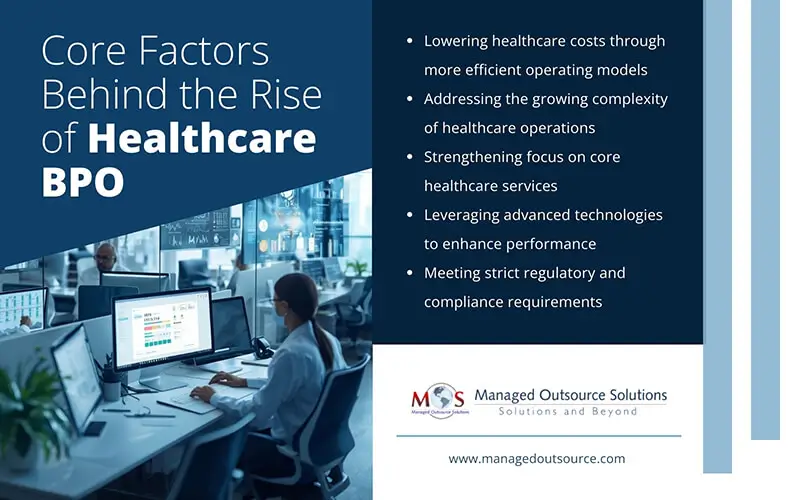
- Lowering Healthcare Costs through Efficient Operating Models
With healthcare expenses increasing, providers are under pressure to operate more cost-effectively. Outsourcing administrative tasks helps reduce staffing and overhead costs significantly. This allows organizations to allocate more resources to clinical care and essential patient services.
- Addressing the Complexity of Healthcare Operations
Healthcare involves intricate administrative, regulatory, and clinical processes that can overwhelm internal teams. BPO providers bring specialized expertise to manage these complexities efficiently. This results in smoother workflows, quicker turnaround times, and improved patient satisfaction.
- Strengthening Focus on Core Healthcare Services
Outsourcing non-clinical tasks like claims, billing, and coding enables providers to concentrate on delivering quality patient care. With fewer administrative burdens, medical professionals can dedicate more time to diagnosis, treatment, and patient communication. This enhanced focus ultimately improves healthcare outcomes.
- Leveraging Advanced Technologies for Better Performance
Technologies like AI, machine learning, and RPA are reshaping healthcare operations. BPO partners help organizations adopt these tools to automate tasks, reduce errors, and accelerate processing. This leads to more accurate workflows and better decision-making through data-driven insights.
- Meeting Strict Regulatory and Compliance Requirements
Healthcare organizations must comply with rigorous data security and privacy regulations. Outsourcing to experienced BPO providers ensures strong compliance frameworks, regular audits, and secure data handling. This minimizes risks related to violations, legal penalties, and reputational damage.
Emerging Global Healthcare Industry Trends
The role of BPO in healthcare is rapidly evolving, helping providers modernize operations with advanced technologies that improve patient services, streamline workflows, and create safer, data-driven systems. Several global trends are driving this transformation:
- AI innovations accelerating automation and productivity:
Next-generation AI tools, such as automated dosage monitoring systems and intelligent virtual assistants are helping healthcare teams complete administrative work with greater accuracy and speed. Newer advancements like agentic AI, capable of independent planning and execution with limited human involvement, are minimizing manual workloads and giving clinicians more time for meaningful patient interaction.
- Human–AI collaboration shaping a smarter workforce:
Healthcare organizations are increasingly adopting a blended workforce model where AI handles repetitive, data-heavy tasks while professionals focus on strategic, patient-centric responsibilities. This partnership showcases how human judgment and machine precision complement each other and provides a glimpse into the future structure of healthcare work.
- Rising adoption of Robotic Process Automation (RPA):
RPA tools are simplifying tasks such as scheduling appointments, processing claims, and entering patient data. By reducing manual errors and operational strain, RPA enables providers to shift their attention back to direct patient care.
- Growth of personalized healthcare services:
BPO companies are supporting the use of personalization technologies such as patient portals and tailored health records that improve patient engagement. These tools empower individuals to manage appointments, access test results, and communicate with their care teams more effectively, strengthening the provider–patient connection.
Improving Patient Experience While Cutting Costs
One of the biggest challenges in healthcare today is delivering an exceptional patient experience without raising operational costs. Patients now expect faster communication, transparent billing, personalized service, and seamless digital interactions. However, administrative overload often makes it difficult for providers to maintain these standards consistently.
This is where Healthcare BPO creates significant value. Outsourcing helps organizations:
- Reduce turnaround times for billing, claims, and patient inquiries.
- Improve accuracy and documentation quality, reducing costly errors.
- Provide 24/7 multilingual patient support, improving accessibility for diverse populations.
- Strengthen engagement through CRM-backed communication tools and timely follow-ups.
With rising healthcare costs and increasing administrative pressure, outsourcing has become an essential strategy for hospitals, clinics, and health systems aiming to optimize resources without compromising patient care quality.
As technology continues to advance and patient expectations rise, one thing is clear: the healthcare outsourcing industry is only going to grow stronger. The organizations that truly thrive will be the ones that adapt early, understand the nuances of Healthcare BPO Growth Trends, and partner with the right experts to support this evolution.
Working with a trusted business process outsourcing company can give healthcare organizations the agility, scalability, and technological innovation they need to stay competitive. The future of healthcare BPO isn’t just about outsourcing tasks—it’s about building smarter, more connected systems that improve care, reduce costs, and drive long-term success.
Streamline your healthcare operations and improve patient care with our services.