
Automation has become a critical driver of efficiency, scalability, and competitiveness for modern organizations. Understanding business automation readiness is essential before investing in new technologies, as it helps companies evaluate their processes, infrastructure, and workforce preparedness. From streamlining repetitive tasks to improving accuracy and turnaround times, workflow automation plays a vital role in transforming how businesses operate. However, not every organization is equally prepared to adopt automation, making it important to assess readiness, identify gaps, and align automation initiatives with long-term business goals.
Key Factors that Indicate Business Automation Readiness
Recognizing when automation shifts from being optional to essential is a critical step toward sustainable growth. Businesses that clearly understand their readiness can uncover inefficiencies, improve performance, and future-proof operations. Below are five key indicators that signal your organization is ready to embrace automation in a meaningful way.
- Repetitive Tasks Are Draining Employee Productivity
When teams spend a large portion of their day handling repetitive, manual activities, productivity and morale often suffer. Across industries such as finance, HR, IT, healthcare, manufacturing, and logistics, tasks like data entry, approvals, onboarding, invoicing, and inventory tracking consume valuable time. These processes typically involve manual handoffs and multiple checkpoints, creating bottlenecks and increasing the risk of errors. Automation can eliminate redundancy, ensure consistency, and allow employees to focus on higher-value work that drives innovation and growth. - Business Growth Is Limited by Operational Scalability
As customer demand increases, manual processes struggle to keep up. If your organization finds that expanding operations requires continuously adding staff or results in declining service quality, scalability has become a challenge. Automation enables businesses to handle higher volumes of work without proportionally increasing costs. By standardizing workflows and accelerating execution, companies can scale operations smoothly while maintaining accuracy and service standards. - Disconnected Systems Are Slowing Down Workflows
When critical systems do not communicate with one another, teams are often forced to manually transfer data between platforms. This approach not only wastes time but also introduces errors that can disrupt customer communication and decision-making. Lack of integration makes real-time insights difficult and complicates reporting. Automating system integrations allows data to flow seamlessly across applications, improving visibility, accuracy, and overall workflow efficiency. - Compliance and Security Risks Are Becoming Harder to Manage
Manual processes make it difficult to enforce consistent controls, track access, and maintain audit trails—especially in regulated industries. As data volumes grow, so do the risks related to compliance and security. Automation helps standardize controls, monitor activity, and reduce human error. With secure, automated workflows in place, organizations can strengthen compliance management while protecting sensitive information more effectively. - Competitors Are Advancing Faster with Automation
When competitors adopt automation to improve response times, streamline operations, and enhance customer experiences, the gap becomes noticeable. Falling behind industry standards can impact efficiency, reputation, and customer loyalty. Evaluating performance against competitors often reveals the need for a clear automation strategy for businesses—one that prioritizes high-impact areas and aligns technology investments with measurable outcomes.
By identifying these signals early, organizations can confidently move toward automation initiatives that deliver lasting value, improve resilience, and support long-term business success.
Steps to Prepare Your Business for Automation
Before investing in automation, it is essential to evaluate whether your organization is truly prepared. Skipping this step can lead to inefficiencies, rework, and project delays. In one real-world scenario, a company moved forward without fully understanding or documenting their existing workflows. As implementation progressed, overlooked processes and new requirements kept surfacing, disrupting timelines and complicating delivery. This experience clearly demonstrates why a readiness assessment is foundational for digital transformation in business.
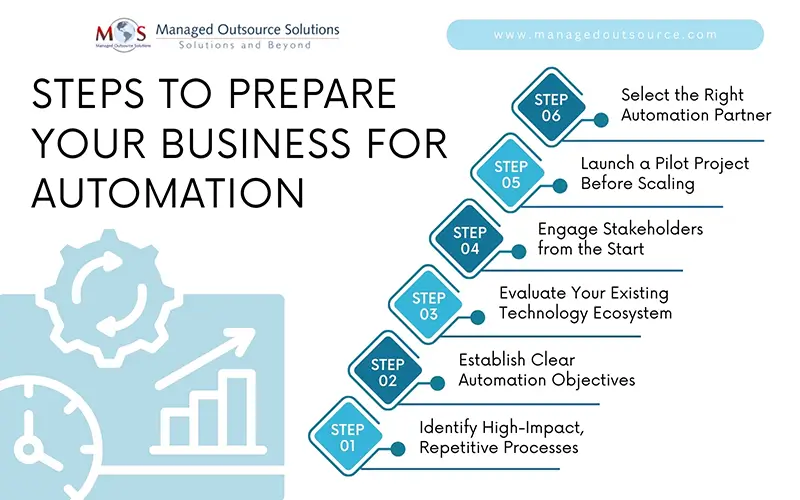
Below is a structured, practical approach to assessing automation readiness and setting your organization up for success.
- Step 1: Identify High-Impact, Repetitive Processes
Begin by uncovering operational bottlenecks that consume time and resources. Many organizations struggle with repetitive tasks that quietly reduce productivity and create delays. Common problem areas include manual data entry, unclear or undocumented workflows, inconsistent compliance tracking, approval delays caused by excessive handoffs, workforce shortages, and operational capacity constraints. Pinpointing these inefficiencies helps you identify where business process automation can deliver the greatest immediate value. - Step 2: Establish Clear Automation Objectives
Automation efforts are most effective when guided by well-defined goals. Rather than taking a vague approach, clarify what success looks like for your organization. This could include streamlining workflows, reducing turnaround times, minimizing errors, lowering operational costs, improving customer experiences, strengthening compliance, or boosting employee satisfaction. Clear objectives ensure your automation initiatives remain focused and measurable. - Step 3: Evaluate Your Existing Technology Ecosystem
A thorough review of your current technology stack is critical. Assess the software and platforms already in use, such as CRM systems, project management tools, and enterprise applications. Examine their integration capabilities, available APIs, and compatibility with automation technologies. Additionally, consider technical requirements, licensing costs, scalability, and potential vendor dependencies. This evaluation reveals gaps, integration challenges, and opportunities for modernization. - Step 4: Engage Stakeholders from the Start
Early involvement of leadership, IT teams, and operational managers significantly increases the likelihood of success. Gathering input and addressing concerns at the planning stage fosters alignment and trust. When stakeholders understand the goals and expected outcomes, they are more likely to support adoption and contribute valuable insights that shape an effective automation strategy. - Step 5: Launch a Pilot Project Before Scaling
Attempting to automate all processes at once can introduce unnecessary risk. Instead, start with a pilot project focused on a single, well-defined workflow. This approach allows you to test assumptions, identify challenges, measure impact, and refine your approach before scaling. Small, controlled implementations provide valuable learning opportunities with minimal disruption. - Step 6: Select the Right Automation Partner
Implementing a successful automation strategy for businesses requires the right partner. Look for a provider who understands your industry, aligns with your goals, and can design solutions tailored to your operational needs. Whether you opt for off-the-shelf tools or custom-built solutions, the right partner will support phased implementation and long-term scalability while aligning with your overall.
Assessing your organization’s preparedness before implementing automation is not just a best practice—it is a necessity for long-term success. By carefully evaluating processes, technology, stakeholders, and scalability, businesses can avoid costly missteps and ensure smoother adoption. Having a well-defined business automation readiness checklist serves as a practical guide to identify gaps, prioritize opportunities, and align automation initiatives with strategic goals. When combined with advanced solutions such as AI document processing, organizations can unlock higher efficiency, improved accuracy, and sustainable growth, positioning themselves to thrive in an increasingly automated business landscape.
Find out if your business is automation-ready—start your assessment today.