
In today’s fast-moving business landscape, back office outsourcing is no longer just a cost-saving tactic—it’s a strategic enabler for efficiency, growth, and competitive advantage. Whether you’re a startup scaling operations or an established enterprise navigating digital transformation, smart outsourcing can free up your team to focus on core goals while optimizing internal processes. By delegating administrative, operational, and support tasks to experienced service providers, your company can benefit from skilled talent, modern technology, and flexible resources that scale as your business grows.
This guide explores the full spectrum of back office outsourcing services, the tangible business benefits they offer, the role of technologies like RPA and AI in driving efficiency, and how next-generation outsourcing models are transforming back office operations into strategic business enablers.
What Is Back Office Outsourcing?
Back office outsourcing is a subset of business process outsourcing (BPO)–the broader practice of hiring a third party to handle both customer-facing (front office) and internal (back office) tasks, to save costs and improve efficiency.
“Back office” refers to internal administrative and operational tasks that support front-end activities but don’t interact directly with customers — functions like data entry, payroll, HR, record-keeping, and IT support. Outsourcing these functions involves partnering with external experts who handle them efficiently. Powered by automation and intelligent workflows, modern outsourced solutions are designed to deliver measurable operational value.
Today, outsourced back office services play a critical role in supporting business agility, improving performance, and enabling sustainable growth in a competitive landscape. According to Credence Research, the global back office outsourcing market was valued at approximately USD 264.75 billion in 2024 and is projected to reach USD 487 billion by 2032, expanding at a CAGR of about 7.3%. This growth reflects increasing demand for cost savings, operational scalability, and specialized expertise across industries.
Why Companies Are Outsourcing Back Office Operations
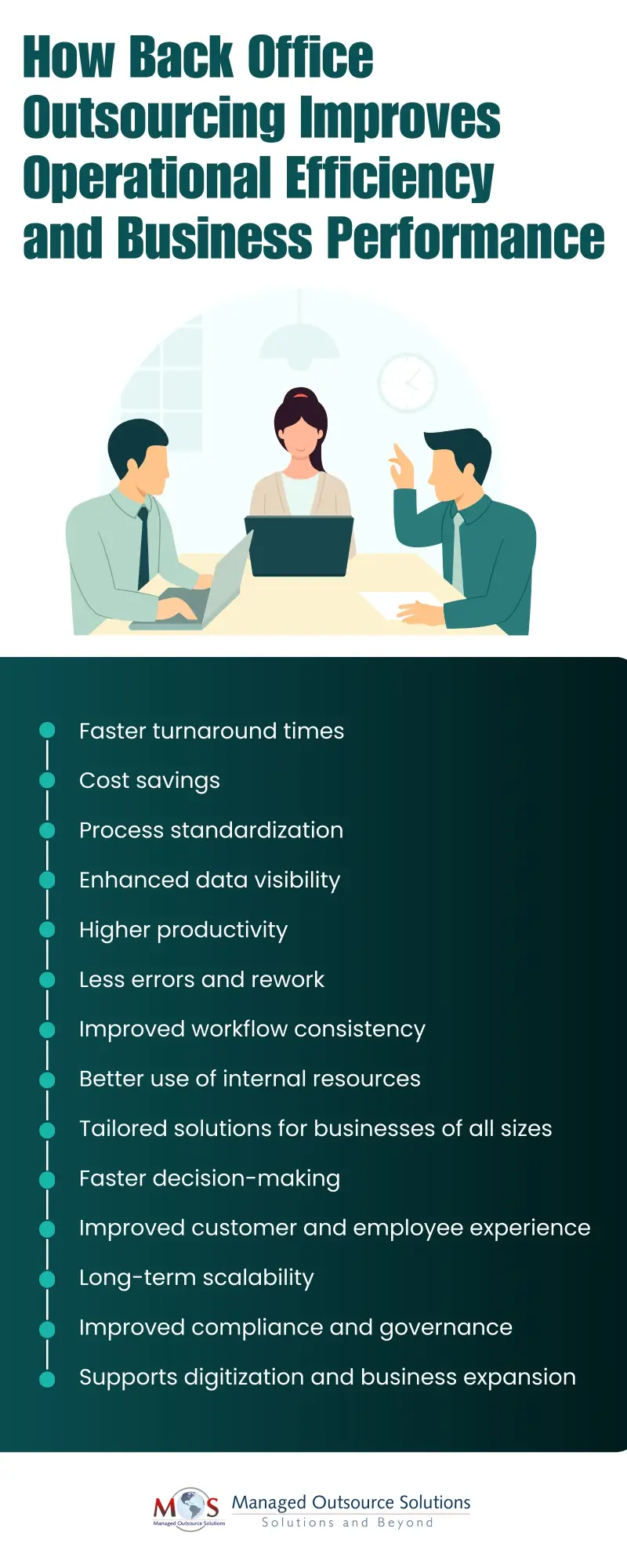
As businesses deal with growing operational complexity, tighter regulations, and ever-increasing volumes of data, managing everything in-house can quickly become overwhelming. Outsourcing non-customer-facing functions offers a practical way to simplify workflows, reduce errors, and boost overall efficiency. Here are the key benefits of back office outsourcing vs in-house operations:
- Drives Operational Efficiency
- Reduces Operational Costs
- Provides Access to Specialized Talent and Technology
Outsourcing allows businesses to eliminate repetitive, time-consuming tasks that distract from revenue-generating work. When external teams handle tasks like data entry or document processing, internal staff can focus on strategic initiatives, boosting overall productivity.
For instance, a healthcare practice may spend valuable staff hours on tasks like data entry, claims processing, and medical documentation. By outsourcing these routine back office activities, clinical and administrative teams can focus more on patient care and revenue cycle performance instead of paperwork.
One of the most compelling benefits is cost savings — outsourcing eliminates expenses related to hiring, training, infrastructure, and technology investments. Organizations save on payroll, benefits, office space, and software licenses, while still getting skilled support.
Outsourcing partners bring expertise and dedicated resources that many in-house teams may lack. They often enable back office automation using advanced systems, automation platforms, and industry best practices, boosting performance and accuracy in their offerings. Automated workflows improve accuracy, speed up turnaround times, and provide better visibility into operations.
For instance, when done manually, tasks such as data extraction, validation, and report generation are time-consuming and error prone. When you partner with an outsourcing provider that leverages AI and automation, routine tasks are completed faster, with greater accuracy and consistency.
Key Back Office Support Services Businesses Should Consider
Here are the most common outsourced services that transform back office operations:
Payroll Support
Payroll involves constant calculations, tax updates, compliance requirements, and strict deadlines. Even small errors can lead to penalties, employee dissatisfaction, and time-consuming corrections.
Professional payroll outsourcing ensures accurate salary processing, tax calculations, compliance, and reporting—handled by specialists using secure systems—saving time, reducing errors, and ensuring employees are paid correctly and on time.
HR Outsourcing
Managing HR internally can overwhelm teams with benefits administration, compliance with changing labor laws, employee records, and performance tracking—especially as the workforce grows.
Outsourced HR teams handle routine and compliance-heavy tasks efficiently, streamline employee data management, and support benefits and performance processes, improving operational efficiency and employee satisfaction.
Data Entry & Processing
Accurate data is vital for reporting, compliance, and informed decision-making, but manual data entry is time-consuming, error-prone, and difficult to scale,.
When companies outsource data entry, processing, and cleansing, they benefit from high accuracy, faster turnaround times, and consistent data quality—while freeing internal teams to focus on analysis and strategic work.
Document Scanning and Digitization
Paper records take up physical space, slow down access to information, and increase the risk of loss, damage, or compliance issues.
With outsourced document scanning solutions and digitization services, organizations can convert physical documents into secure, searchable digital files, improving accessibility, supporting compliance, and reducing storage and retrieval costs.
Virtual Staffing
Hiring full-time staff for fluctuating workloads increases costs related to recruitment, training, benefits, and infrastructure—often without optimal utilization.
Virtual staffing provides access to skilled remote professionals who can support administrative and customer-facing tasks on demand, offering flexibility, scalability, and cost efficiency without long-term commitments.
Transcription Services
In-house transcription can create backlogs, inconsistencies, and delays—especially when dealing with large volumes of audio or industry-specific terminology.
Outsourced transcription services deliver accurate, timely, and standardized documentation using trained specialists and quality checks, ensuring reliable records for legal, medical, or business use.
Legal Coding & Specialized Functions
Legal coding and other specialized back office tasks require deep domain knowledge, precision, and familiarity with evolving standards—making them difficult and costly to manage internally.
Professional outsourcing partners provide experienced specialists who handle complex coding and technical tasks accurately, improve turnaround times, and ensure compliance with industry requirements.
Many back office service providers also tailor these services to meet the specific needs of different industries—ranging from healthcare and life sciences to telecom, retail, and e-commerce. Outsourcing partners that provide Industry-focused solutions understand the unique workflows, compliance requirements, and data sensitivities within each sector, and deliver more accurate, efficient, and compliant back office support. This ensures that businesses gain customized solutions designed to support their operational goals and long-term growth.
How Back Office Outsourcing Improves Operational Efficiency and Business Performance
The Role of Technology in Modern Back Office Outsourcing
Technology plays a central role in modern back office outsourcing, transforming manual, time-consuming processes into faster, more efficient workflows. By combining skilled teams with automation and intelligent tools, outsourcing providers help businesses improve accuracy, reduce turnaround times, and manage growing data volumes with greater consistency.
Robotic Process Automation (RPA)
Robotic Process Automation (RPA) automates repetitive, rule-based tasks such as data entry, invoice processing, reporting, and system updates. These software bots execute tasks quickly and consistently, reducing errors and freeing internal teams to focus on higher-value activities rather than routine processing. Global Growth Insights reports that the RPA technology market which was valued at ~$11.5 billion in 2024 is expected to reach ~$37 billion by 2034.
AI and Intelligent Automation
AI-driven automation extends beyond basic task execution by enabling data extraction, validation, and analytics across structured and unstructured sources. In modern outsourcing models, AI works alongside human teams, increasing speed and scale while people manage exceptions, insights, and decision-making.
Up to 73% of companies are adopting AI to boost process efficiency, with outsourcing providers leading implementation — applying AI chatbots, RPA, and automated workflows for operational tasks, according to Prision. The result is smarter, more reliable workflows.
Automation as a Competitive Advantage
As demand grows, automation-assisted outsourcing solutions deliver clear business advantages. They help control operational costs, scale processes efficiently, and improve accuracy and compliance through standardized workflows. By leveraging automation and RPA services, businesses can build agile, future-ready operations that support long-term growth.
From Conventional to Next-Gen Back Office Outsourcing
Back office outsourcing has undergone a significant transformation in recent years. What was once viewed primarily as a way to reduce costs and manage workload has evolved into a strategic, technology-driven model focused on efficiency, scalability, and business outcomes.
Traditional outsourcing models were largely task-based and labor-intensive. Service providers focused on handling high-volume, repetitive activities at lower costs, often with limited flexibility or integration into broader business goals. While effective for basic support, these models offered minimal visibility, scalability, or process optimization.
Today, there is a clear shift toward technology-driven outsourcing. Modern providers combine skilled teams with automation, AI, and standardized workflows to streamline processes, improve accuracy, and deliver faster turnaround times.
How to Choose the Right Outsourcing Partner
For a successful partnership, look for the following:
Customized service offerings aligned with business needs
Transparent pricing and clear SLAs
Strong data security and quality control
Access to advanced technology and workflow automation
Domain expertise in your industry
Selecting the right outsourcing partner is critical to unlocking the full benefits of back office services, from cost savings and efficiency to access to advanced technology and industry expertise.
Business process outsourcing companies have evolved from mere providers of cost-effective support services to strategic accelerators for business performance. Embracing intelligent outsourcing solutions is essential for staying competitive in a changing world. With the right services and technologies, organizations can reduce costs, optimize processes, and grow more efficiently.
Learn how our technology-driven back office services can boost growth.