
The insurance industry is experiencing a rapid digital transformation, driven by the growing need for speed, operational efficiency, and accuracy. One of the most impactful advancements fuelling this shift is AI insurance claims processing automation. By leveraging artificial intelligence, insurers and healthcare organizations can streamline the traditionally complex claims lifecycle while reducing manual workload and administrative costs. From document intake to adjudication, AI data entry is revolutionizing how claims are captured, processed, validated, and reimbursed. This post explores the role of AI in claims processing, the operational advantages it delivers, and the future trends in AI and claims processing shaping the next era of insurance operations.
The Traditional Claims Processing Landscape
Insurance claims processing has historically been labor-intensive and time-consuming. Claims handlers must review forms, extract data, verify coverage, detect errors, and approve reimbursements—often across multiple disconnected systems. Manual workflows create several operational challenges such as high administrative burden, frequent data entry errors, processing delays, increased claim denials and rising operational costs. Repetitive documentation reviews and data extraction tasks consume a significant share of adjusters’ time, slowing settlements and impacting customer satisfaction.
What Is AI Insurance Claims Processing Automation?
AI insurance claims processing automation refers to the application of artificial intelligence technologies—such as machine learning (ML), natural language processing (NLP), computer vision, and robotic process automation (RPA)—to digitize and automate the entire claims lifecycle. These systems can:
- Capture and extract claim data automatically
- Interpret structured and unstructured documents
- Validate policy and eligibility details
- Detect anomalies
- Adjudicate claims using rule engines
Automation transforms claims handling from a manual workflow into an intelligent, data-driven ecosystem capable of processing claims in minutes rather than weeks.
Benefits of AI Data Entry in Insurance Claims Management
The benefits of AI data entry in insurance claims management extend across operational, financial, and customer experience domains.
- Increased Accuracy: AI data entry eliminates common human errors such as typos, missing fields, and incorrect coding. Using machine learning and validation algorithms, AI cross-checks claim details against policy rules and medical documentation. This ensures higher data precision from the start. Improved accuracy leads to cleaner claims and fewer disputes. Over time, this strengthens payer-provider trust and compliance outcomes.
- Faster Claims Processing: AI significantly reduces the time required to capture, extract, and input claim information. What once took hours of manual entry can now be completed in minutes. Automated workflows enable instant routing, review, and validation of claims. Faster processing accelerates adjudication and reimbursement cycles. This speed improves cash flow for providers and service satisfaction for policyholders.
- Reduced Operational Costs: Manual data entry requires large administrative teams, increasing labor expenses. AI automation reduces dependency on repetitive human tasks, lowering staffing and overtime costs. It also minimizes rework caused by data entry errors or claim rejections. Over time, organizations get to experience substantial savings in back-office operations. These cost efficiencies allow insurers to reinvest in innovation and customer service.
- Lower Claim Denial Rates: Incomplete or inaccurate data is a leading cause of claim denials. AI validates entries in real time, ensuring all required documentation and codes are present before submission. Automated checks flag discrepancies early for correction. This proactive approach improves first-pass acceptance rates. Fewer denials mean faster payments and less administrative rework.
- Enhanced Fraud Detection: AI systems analyze large datasets to identify unusual billing patterns or suspicious claims. Machine learning models compare claims against historical trends and known fraud indicators. This enables early detection of duplicate billing, inflated charges, or falsified documentation. Automated alerts allow investigators to intervene quickly. Stronger fraud detection protects insurers from financial losses.
- Improved Staff Productivity: By automating repetitive data entry, AI frees employees to focus on higher-value tasks. Claims professionals can spend more time on complex case reviews and customer interactions. This improves decision quality and operational efficiency. Reduced manual workload also lowers employee burnout. Overall productivity and job satisfaction increase significantly.
- Better Compliance and Audit Readiness: AI ensures claims data is captured in standardized, regulation-compliant formats. Automated documentation trails make it easier to track edits and approvals. This transparency supports internal audits and regulatory reviews. Organizations can quickly retrieve claim histories and validation logs. Strong compliance reduces legal risk and financial penalties.
- Scalability and High-volume Handling: Insurance claim volumes can surge during disasters or peak seasons. AI systems scale instantly to process large workloads without compromising speed or accuracy. Unlike manual teams, automation does not require additional hiring or training. This flexibility ensures consistent service levels. Scalable processing is critical for business continuity and growth.
Implementation of AI in Claims Processing
Integrating AI into existing healthcare claims processing systems requires careful planning and execution. Here are the key steps and considerations for a successful AI integration:
- Assess Current Processes: Start by evaluating the current claims processing workflow to identify specific areas where AI can add value. Understanding the existing process helps in selecting the right AI tools and technologies.
- Choose the Right AI Solution: Select an AI solution that aligns with your organization’s needs and goals. Consider factors such as ease of integration, scalability, and compatibility with existing systems. Partnering with reputable vendors that specialize in AI for healthcare can provide valuable insights and support.
- Ensure Data Quality: AI systems rely on high-quality data for accurate processing and analysis. Ensure that your data is well-organized, and free from inconsistencies. Implementing data governance practices can help maintain data integrity and reliability.
- Train and Educate Staff: Provide comprehensive training sessions to educate employees about the new AI tools, their functionalities, and how they can be integrated into daily operations. Encourage a culture of continuous learning and improvement.
- Monitor and Optimize: Regularly review performance metrics, identify areas for improvement, and make necessary adjustments. Keeping the system updated with the latest AI advancements can also enhance its efficiency and effectiveness.
- Focus on Change Management: Effective change management strategies can facilitate a smooth transition to AI-driven claims processing. Engage stakeholders early in the process, address any concerns or resistance, and communicate the benefits of AI adoption.
Challenges in AI Insurance Claims Processing
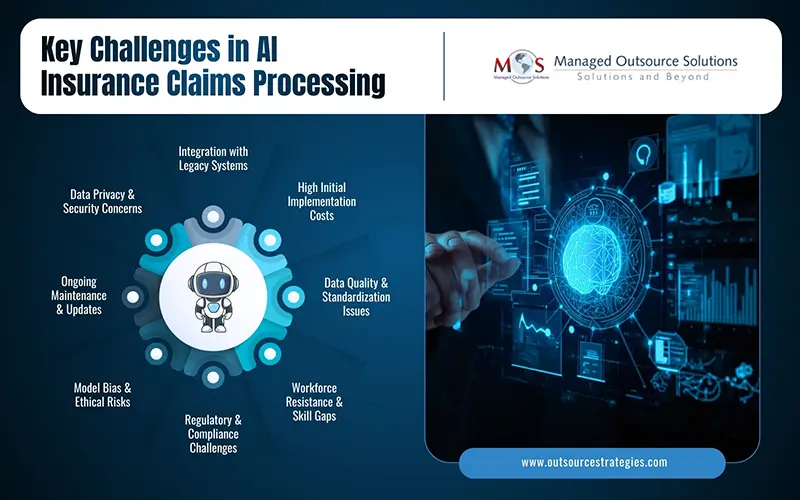
While the benefits of AI in insurance claims processing are significant, organizations may encounter challenges during implementation. Here are common challenges and strategies to overcome them:
- Data Privacy and Security Concerns: Insurance claims contain sensitive personal, medical, and financial information. Implementing AI requires handling large datasets, and this could increase the risk of breaches or cyber-attacks. Organizations must comply with strict data protection regulations like HIPAA and GDPR. Robust encryption and access controls are essential to maintain trust and compliance.
- Integration with Legacy Systems: Many insurers still operate on outdated core systems not designed for AI compatibility. Integrating modern AI tools with legacy infrastructure is challenging. It may require middleware, APIs, or full system upgrades. Poor integration can limit automation efficiency and data flow.
- High Initial Implementation Costs: Deploying AI solutions involves upfront investments in technology, infrastructure, and training. Costs include software licensing, customization, and data migration. Smaller insurers may find these expenses challenging. However, long-term ROI often offsets the initial spending through efficiency gains.
- Data Quality and Standardization Issues: AI systems rely on clean, structured, and well-labeled data for accurate outputs. Inconsistent formats, missing fields, or duplicate records can affect performance. Poor data quality leads to incorrect predictions and processing errors. Data cleansing and standardization are critical before AI deployment.
- Workforce Resistance and Skill Gaps: Employees may fear job displacement due to automation. This resistance may slow AI adoption and transformation initiatives. Additionally, staff may lack the technical skills needed to work alongside AI tools. Training, reskilling, and change management programs are necessary for smooth implementation.
- Regulatory and Compliance Challenges: Insurance is a highly regulated industry with evolving legal frameworks. AI systems must align with compliance requirements and audit standards. Lack of transparency in AI decision-making (black-box models) can raise regulatory concerns. Explainable AI is becoming essential to address this challenge.
- Model Bias and Ethical Risks: AI models trained on biased datasets may produce unfair or inaccurate claim decisions. This can impact claim approvals, fraud detection, or risk scoring. Ethical concerns arise if automation disadvantages certain groups. Continuous monitoring and unbiased training data are required to mitigate risks.
- Ongoing Maintenance and System Updates: AI systems require continuous monitoring, retraining, and performance tuning. Changes in payer rules, coding updates, or policy structures must be reflected in the AI models. Ongoing maintenance adds to operational responsibility.
Future Trends in AI and Claims Processing
The future trends in AI and claims processing looks promising, with several emerging trends expected to shape the industry:
- Advanced Machine Learning Models: As AI technology advances, more sophisticated machine learning models will be developed, offering greater accuracy and efficiency in claims processing.
- Integration with Blockchain: Combining AI with blockchain technology can enhance transparency and security in claims processing. Blockchain’s decentralized ledger can provide a tamper-proof record of transactions, reducing fraud and errors.
- Real-time Claims Processing: Future AI systems may enable real-time claims processing, significantly reduce turnaround times and improve cash flow for healthcare providers.
- Predictive Analytics: AI-powered predictive analytics can forecast claim outcomes, identify potential issues before they arise, and provide actionable insights for proactive decision-making.
- Increased Adoption of AI-powered RPA: Robotic Process Automation (RPA) integrated with AI will become more prevalent, automating repetitive tasks and further streamlining the claims processing workflow.
The evolution of AI insurance claims processing automation marks a transformative shift in how insurers and healthcare organizations manage claims. Through automated claims data entry and intelligent workflow orchestration, AI eliminates inefficiencies that once slowed reimbursements and increased operational costs.
The benefits of AI data entry in insurance claims management—including improved accuracy, reduced denials, faster settlements, and cost savings—make automation a strategic necessity. As innovation accelerates, emerging future trends in AI and claims processing—from predictive analytics to blockchain integration—will further redefine claims ecosystems. Organizations that embrace AI-driven automation today will lead the insurance industry into a faster, smarter, and more customer-centric future.
Boost accuracy and speed with AI insurance claims processing automation.