
Healthcare has long operated under a structural paradox: highly skilled professionals spend a disproportionate share of their working hours on administrative tasks rather than patient care. Scheduling, prior authorization, claims processing, documentation, and compliance reporting consume a considerable amount of valuable time and resources. Agentic AI is transforming healthcare operations by addressing this paradox directly. Unlike earlier AI tools that required human initiation at each step, agentic systems execute multi-step tasks autonomously, make contextual decisions, and adapt to changing inputs without constant oversight. For health systems, AI in business process outsourcing delivers agentic capability through specialist partnerships, giving them access to intelligent operational infrastructure without the burden of independent deployment.
According to Deloitte’s 2026 US Health Care Outlook Survey, over 80% of healthcare executives expect agentic AI and generative AI to deliver moderate-to-significant value across clinical, business, and back-office functions in 2026. This is no longer a technology on the horizon. It is an operational priority reshaping how health systems allocate resources and structure workflows.
What Distinguishes Agentic AI from Earlier Automation
To understand why agentic systems can deliver different results, it helps to see how they differ from earlier forms of healthcare automation.
Traditional automation tools, including robotic process automation (RPA), follow a fixed set of rules and instructions. They are effective at handling repetitive tasks, but their capabilities are limited to the scenarios they were programmed to manage. When something changes, such as a payer updating a prior authorization form or modifying submission requirements, the workflow can fail until the rules are manually revised and the system is updated.
Agentic systems take a more dynamic approach. Rather than simply following predefined rules, they can interpret information, assess the task at hand, choose the most appropriate actions, and use available tools to achieve the desired outcome. They also monitor results, learn from feedback, and adjust their approach when circumstances change or outcomes differ from expectations. This capability changes the economics of healthcare administration. Tasks that previously required human coordination across multiple steps and systems become continuous, autonomous workflows that operate at scale.
Agentic AI is Transforming Healthcare Operations: Key Application Areas
Agentic systems deliver the greatest value in areas with the highest administrative burden and the most significant costs associated with inefficiency.
Prior Authorization and Claims Management
Prior authorization is among the most time-consuming administrative functions in healthcare. Physicians and their staff spend hours each week gathering clinical documentation, navigating payer portals, and responding to denials. Agentic systems handle this end-to-end: retrieving clinical records, matching documentation to payer criteria, submitting requests, tracking status, and escalating denials for physician review only when genuine clinical judgment is required.
According to Mordor Intelligence’s analysis of the healthcare agentic AI market, RPA-style agents extracting prior-authorization details and populating claim forms have reduced denied-claim rates by up to 18%. For health systems processing thousands of authorizations monthly, this reduction translates directly into recovered revenue and reduced administrative overhead.
Patient Scheduling and Capacity Management
Appointment scheduling in complex health systems involves matching patient needs, provider availability, equipment requirements, and facility capacity simultaneously. Agentic systems manage this process dynamically, adjusting schedules in real time as cancellations, referrals, and urgent cases arise. They send automated reminders, process rescheduling requests, and update downstream systems without staff intervention.
Beyond scheduling efficiency, advanced automation supports better capacity utilization reduces wait times, improves throughput, and directly impacts patient satisfaction scores that influence reimbursement under value-based care models.
Clinical Documentation Support
Documentation burden is a primary driver of physician burnout. Clinicians spend significant time after patient encounters completing electronic health record entries that take time away from direct care. AI-assisted documentation tools capture and structure clinical notes from recorded patient interactions, presenting draft documentation for physician review and approval. Physicians edit rather than author from scratch, reducing documentation time without compromising accuracy or compliance.
Revenue Cycle Management
Revenue cycle processes, from charge capture through payment posting, involve multiple handoffs between clinical, administrative, and financial teams. Errors at any stage create claim denials, delayed reimbursement, and write-offs that affect organizational finances directly. AI-enabled revenue cycle tools monitor transactions continuously, identify coding inconsistencies before submission, flag underpayments against contracted rates, and prioritize denial appeals by recovery value. Health systems utilizing these tools report measurable improvements in clean claim rates and days in accounts receivable.
AI-driven Transformation Across Clinical and Operational Functions
Beyond administrative workflows, agentic systems are producing measurable impact across broader operational and clinical functions.
AI-assisted Diagnostic Support
AI-assisted diagnostic tools analyze imaging studies, laboratory results, and patient histories to surface findings that warrant clinical attention. These tools do not replace physician judgment. They process data at a scale and consistency that human review cannot sustain across high patient volumes, reducing the risk that time-sensitive findings are missed during busy periods.
AI-enabled Supply Chain and Inventory Management
Healthcare supply chain disruptions carry direct patient care consequences. AI-enabled inventory management systems monitor stock levels, predict consumption patterns based on scheduled procedures and historical usage, and generate procurement recommendations before shortages develop. This shifts supply management from reactive to anticipatory, reducing both stockouts and excess inventory carrying costs.
AI-powered Workforce Scheduling
Staff scheduling in healthcare balances clinical skill requirements, regulatory staffing ratios, shift preferences, and patient census fluctuations simultaneously. AI-powered scheduling tools optimize these variables continuously, producing schedules that reduce overtime costs, maintain compliance with staffing requirements, and adapt to census changes in real time. For large health systems managing hundreds of units across multiple facilities, the labor cost impact of optimized scheduling is substantial.
Regulatory Compliance Monitoring
The healthcare industry operates under complex and frequently updated regulatory requirements covering billing practices, patient privacy, clinical documentation, and quality reporting. AI-driven compliance monitoring tools track organizational activities against current regulatory parameters, flag deviations as they occur, and generate audit-ready documentation continuously. This proactive approach catches issues before they become violations.
Practical Example: Agentic AI in a Hospital Revenue Cycle
Consider a mid-size regional hospital processing approximately 8,000 claims monthly. The revenue cycle team spent the first week of each month resolving prior authorization gaps, coding inconsistencies, and payer-specific formatting errors that caused first-pass denials. Resolving denied claims was a labor-intensive process, occupying three full-time employees with tasks such as claim research, documentation review, and resubmission.
By deploying an agentic revenue cycle system, the hospital automated prior authorization retrieval, coding validation against payer rules, and denial triage by recovery value. First-pass claim acceptance improved by 14% within the first quarter. The three staff members who had previously managed denial backlogs, could now focus on complex clinical appeals and payer contract negotiations, work that required human judgment and produced higher recovery value.
Managing Risk in Agentic Healthcare Deployments
Autonomous systems operating in healthcare environments require governance frameworks that match their capability. The stakes of errors, whether in clinical documentation, billing, or patient scheduling, demand that health system leaders establish clear parameters for agentic system oversight.
Effective governance covers:
- Defined scope boundaries specifying which decisions require human approval
- Continuous monitoring of system outputs against quality benchmarks
- Audit trails that document every autonomous action for compliance purposes
- Escalation protocols that route exceptions to qualified human reviewers
- Regular performance reviews that identify drift from expected outcomes
Health systems that build governance frameworks before scaling agentic deployments protect both patient safety and organizational compliance while capturing operational efficiency gains.
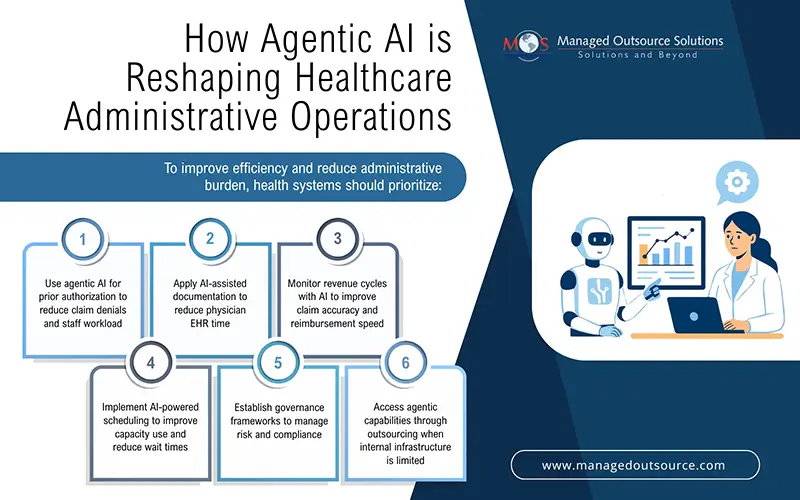
How AI in Business Process Outsourcing supports the Healthcare System
Building internal agentic AI infrastructure requires technology investment, specialized talent, and change management capacity that many health systems cannot prioritize alongside their core clinical and operational demands. By integrating agentic capabilities, AI in business process outsourcing is reshaping how health systems access operational support.
AI-enabled outsourcing partnerships now combine specialist human oversight with agentic execution for high-volume administrative functions. Claims processing, prior authorization management, patient scheduling support, and revenue cycle monitoring operate through agentic systems supervised by expert teams who manage exceptions, monitor quality, and handle escalations. This human-in-the-loop approach drives better accuracy while preventing costly errors.
This model is particularly valuable for organizations that lack the internal technology infrastructure to deploy and maintain agentic systems independently. Access to AI-enabled operational capability through an outsourcing partnership removes the implementation burden while delivering the performance benefits.
Agentic AI is transforming healthcare operations from a reactive, labor-intensive function into a proactive, continuously optimizing system that frees clinical and administrative professionals to focus where their expertise delivers the most value. For health systems committed to improving both operational efficiency and patient outcomes, outsourced services built on agentic AI infrastructure provide a practical and scalable path to that transformation, without requiring health systems to build and manage the underlying capability independently.
Want to reduce claims denials, cut documentation burden, and improve revenue cycle performance?
Discover how agentic AI solutions can reshape your operational model.