Business process outsourcing (BPO) is entering a decisive phase where artificial intelligence is no longer an enhancement. It is the foundation of scalable operations. Any modern guide to business process outsourcing must begin with how AI is reshaping workflows, enabling organizations to manage rising transaction volumes, stricter compliance demands, and increasingly complex data environments.
Across industries, operational pressure is intensifying. Enterprises now process millions of digital interactions daily, from invoices and claims to contracts and customer records. These growing workloads introduce persistent challenges such as high volume, data complexity, regulatory compliance, and time-sensitive execution. Traditional outsourcing models built around manual workflows are struggling to meet these demands efficiently.
This shift has accelerated the adoption of AI in business process outsourcing, where intelligent technologies automate repetitive tasks and enhance decision-making. Platforms such as DeepKnit AI enable organizations to move beyond simple task outsourcing toward intelligence-driven execution. Rather than just digitizing information, modern workflows interpret, validate, and route data automatically using machine learning and natural language processing.
The demand for advanced business process outsourcing services now includes specialized AI data entry services and intelligent document conversion services capable of delivering structured, searchable, and compliance-ready data. These capabilities are essential for enterprise-wide digital workforce transformation, where AI-enabled systems collaborate with skilled professionals to maintain operational continuity.
This post examines AI’s transformation of outsourcing through challenges, workflows, human expertise, benefits, services, use cases, and partner selection strategies that build scalable enterprise operations.
Guide to Business Process Outsourcing in the AI Era
Business process outsourcing has evolved beyond cost-saving initiatives into intelligence-driven service models. This transformation supports the shift toward enterprise-level digital workforce modernization.
Traditional outsourcing relied on sequential task execution performed manually. While effective for predictable workloads, these systems struggled when volumes increased or document formats diversified.
Modern business process outsourcing services powered by AI operate through integrated pipelines that automate document intake, classification, extraction, validation, and routing simultaneously.
Platforms such as DeepKnit AI support:
- Automated multi-channel document intake
- AI-driven classification of transaction types
- Contextual extraction of key fields
- Automated validation against business rules
- Dynamic workflow routing
Such functionality redefines operational efficiency.
For example, AI data entry services now interpret context rather than simply capturing text. AI models recognize layout variations, detect anomalies, and validate outputs before submission. Similarly, modern document conversion services transform legacy files into structured datasets enriched with searchable metadata.
This supports enterprise-level digital workforce transformation, where automation handles repetitive workflows while specialists oversee compliance and quality.
Key Challenges Enterprises Face in Modern BPO Operations
Modern outsourcing operations must address growing operational complexity. These challenges explain why AI-driven transformation is becoming essential.
High Transaction Volumes
Enterprises generate enormous quantities of transactional data across departments. Manual workflows cannot scale efficiently, leading to delays and backlogs. This challenge is particularly evident in data entry, where repetitive manual input increases error risk.
AI-driven ingestion pipelines resolve this by processing thousands of records simultaneously, reducing turnaround times and eliminating manual bottlenecks.
Compliance and Regulatory Pressure
Regulatory requirements demand accurate, traceable records across every workflow stage. Manual validation introduces risk and slows processing.
AI-enabled validation mechanisms automatically verify extracted data against predefined rules, improving compliance readiness and audit visibility.
Time-sensitive Processing Demands
Modern enterprises operate in real-time environments where delays directly impact service delivery. Manual routing systems introduce latency.
AI-driven routing engines distribute tasks dynamically based on priority, ensuring consistent performance even during peak demand.
How AI-driven Systems Transform Business Process Outsourcing
The transformation in business process outsourcing occurs through integrated workflow stages that automate data movement and decision-making.
AI-driven Classification
Classification engines identify document types based on structure and keywords. This ensures workflows begin accurately and reduces manual intervention.
These capabilities strengthen AI data entry services, enabling faster initiation of data processing workflows.
Contextual Data Extraction
AI-enabled extraction tools analyze content and capture relevant data fields such as names, dates, and financial values. Unlike fixed templates, contextual models adapt to different layouts automatically.
This structured output supports enterprise integration and improves data usability.
Predictive Validation
Validation mechanisms compare extracted data against rules and historical records. This reduces errors before data enters enterprise systems and strengthens intelligent process automation frameworks.
Intelligent Workflow Routing
AI routing engines assign tasks dynamically based on urgency and complexity. High-priority transactions are escalated automatically, improving turnaround times.
Continuous Learning
DeepKnit AI for instance, incorporates feedback loops that refine model accuracy over time. As workflows evolve, systems adapt, supporting long-term operational improvement.
The Role of Human Expertise in AI-enabled BPO
AI systems enhance workflows, but human expertise remains essential for oversight, compliance, and decision-making.
Human-in-the-Loop Validation
AI processes routine transactions while specialists review flagged exceptions. This ensures high accuracy without increasing manual workload.
Exception Handling
Complex cases require contextual judgment. Human specialists resolve unusual scenarios and refine automation logic.
Compliance Oversight
Regulatory professionals define validation rules and monitor audit readiness, ensuring workflows remain compliant with industry standards.
Domain Expertise Integration
Industry-specific knowledge improves AI model training accuracy. Specialists provide context necessary for interpreting complex documentation.
This collaborative approach supports sustainable digital workforce transformation, where employees transition into strategic roles focused on analysis and governance.
Strategic Business Benefits of AI-driven BPO
Organizations adopting AI-enabled outsourcing gain measurable operational advantages, as shown below:
| Benefit | Description |
|---|---|
| Increased Productivity | Automates repetitive workflows for faster high-volume task processing. |
| Improved Accuracy | Embedded validation cuts manual errors across datasets. |
| Cost Optimization | Efficiency reduces overhead while upholding quality. |
| Scalable Operations | Handles workload spikes without workforce growth. |
| Enhanced Visibility | Dashboards deliver real-time metrics for transparency. |
| Risk Reduction | Validation and audit trails boost compliance. |
Key AI-enabled Business Process Outsourcing Services
Understanding the scope of AI-enabled services helps organizations identify opportunities to modernize their outsourcing strategies.
AI Data Entry and Data Processing Services
Among the most widely adopted solutions are AI data entry services, which automate the capture, interpretation, and validation of high-volume transactional data. Unlike traditional manual entry, AI-driven systems extract data contextually, recognizing patterns across varied document formats.
These services support:
- Invoice and purchase order processing
- Customer onboarding records
- Transactional database updates
- Regulatory data submissions
- Vendor and supplier documentation
By embedding validation rules into workflows, AI-driven data entry systems ensure that captured information meets accuracy and compliance requirements. This reduces dependency on manual verification and supports faster turnaround times.
Intelligent Document Conversion Services
Large organizations maintain extensive archives of paper-based and legacy digital records. Modern document conversion services transform these records into structured digital assets using AI-assisted recognition and classification tools.
AI-enabled conversion workflows support:
- Digitization of historical records
- Optical character recognition (OCR) and layout detection
- Metadata tagging and indexing
- Multi-format file transformation
- Searchable digital repository creation
Such systems reinforce enterprise intelligent process automation by ensuring seamless data integration into analytics and operations.
Finance and Accounting Process Automation
Financial workflows demand accuracy, consistency, and compliance. AI-enabled finance outsourcing services automate routine processes while ensuring validation against accounting standards.
Typical services include:
- Accounts payable and receivable processing
- Invoice reconciliation
- Expense validation
- Financial record maintenance
- Audit-ready documentation preparation
DeepKnit AI enhances these workflows by detecting discrepancies early and flagging exceptions for review, reducing the risk of financial inaccuracies.
Healthcare and Insurance Data Processing
Healthcare and insurance organizations rely heavily on accurate data management. AI-enabled outsourcing solutions streamline claims processing, policy management, and patient documentation workflows.
These services include:
- Medical claims data extraction
- Insurance policy processing
- Eligibility verification workflows
- Healthcare record digitization
AI-driven classification ensures that forms and records are processed consistently, improving both speed and reliability.
Customer and Master Data Management
Customer data is central to modern enterprise operations. AI-enabled outsourcing solutions support centralized data management across multiple systems.
These services involve:
- Customer data consolidation
- Record standardization
- Duplicate detection
- Profile validation
Such services contribute directly to enterprise-wide digital workforce transformation, ensuring that teams operate with consistent and reliable datasets.
Real-world AI Use Cases across Industries
AI-driven outsourcing delivers measurable value across sectors.
Finance and Accounts Payable
AI automates invoice processing by extracting and validating payment details. Faster reconciliation improves vendor relationships and financial accuracy.
Healthcare Claims Processing
AI identifies claim forms, extracts patient information, and verifies treatment codes. These tools enable accurate processing and efficient patient service delivery.
Logistics Documentation
AI-enabled classification processes shipping records and customs documents, improving shipment visibility and reducing delays.
Insurance Policy Administration
AI extracts policy details, validates coverage terms, and routes applications automatically. This improves accuracy and speeds up approval cycles.
Large-scale document conversion services also support enterprise modernization by transforming legacy records into searchable digital repositories.
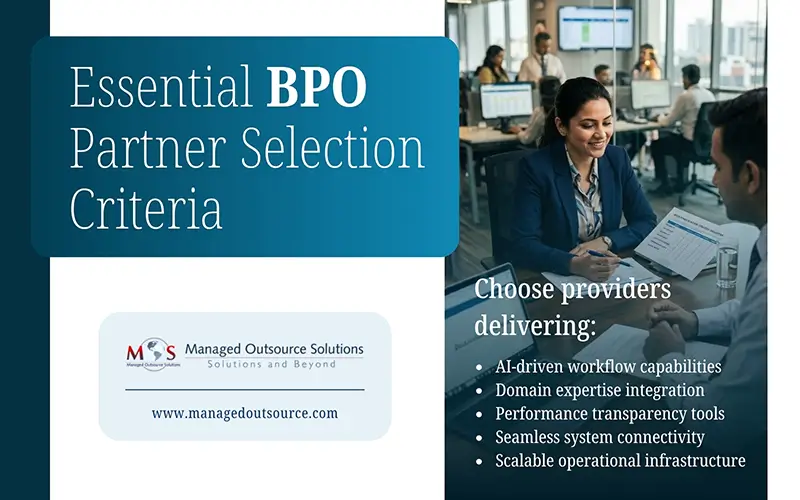
How to Choose the Right AI-enabled BPO Partner
Selecting the right outsourcing partner is one of the most strategic decisions organizations make. As AI in business process outsourcing becomes more advanced, the criteria for evaluating providers must expand beyond cost considerations to include technology capability, scalability, and operational expertise.
Organizations that evaluate partners using structured criteria are more likely to achieve sustainable performance improvements.
Evaluate AI Technology Capabilities
A modern outsourcing partner should offer robust AI-driven infrastructure capable of supporting end-to-end workflow automation. Platforms such as DeepKnit AI demonstrate the value of integrated technologies that combine document processing, validation, and routing into unified pipelines.
When evaluating providers, organizations should assess:
- AI-driven workflow automation capabilities
- Document recognition accuracy levels
- Ability to process diverse formats
- Continuous learning and optimization features
Technology maturity directly influences operational reliability and long-term scalability.
Assess Scalability and Performance Readiness
Outsourcing environments must adapt quickly to workload fluctuations. A capable partner should demonstrate the ability to manage both routine operations and peak demand periods without compromising service quality.
Key evaluation factors include:
- Capacity to process high transaction volumes
- Availability of scalable infrastructure
- Ability to maintain consistent turnaround times
- Performance monitoring frameworks
Scalability ensures that outsourcing operations remain stable as business requirements evolve.
Verify Compliance and Data Governance Expertise
Regulatory compliance remains a critical factor in outsourcing partnerships. Organizations must ensure that providers maintain strict governance standards for handling sensitive data.
Important considerations include:
- Implementation of secure data handling protocols
- Availability of audit-ready reporting
- Compliance with industry-specific regulations
- Transparent documentation processes
AI-enabled validation tools play an important role in maintaining regulatory alignment across workflows.
Evaluate Integration and Technology Compatibility
Integration capability determines how effectively outsourcing workflows align with enterprise systems. A strong partner should provide seamless connectivity between legacy infrastructure and modern applications.
Organizations should examine:
- Compatibility with existing enterprise systems
- Availability of integration frameworks
- Support for cloud-based environments
- Real-time workflow synchronization capabilities
DeepKnit AI functions as an orchestration layer that connects fragmented systems into cohesive workflows, improving overall operational visibility.
Review Human Expertise and Domain Knowledge
While AI technologies drive automation, human expertise ensures operational accuracy. A reliable outsourcing partner should provide skilled professionals capable of handling exceptions and regulatory complexities.
Evaluation criteria include:
- Availability of domain specialists
- Structured exception management workflows
- Continuous workforce training programs
- Experience across multiple industries
This combination of automation and human insight strengthens service reliability.
Ensure Transparency and Performance Visibility
Operational transparency is essential for maintaining accountability. Organizations should select partners that provide measurable performance insights through real-time reporting.
Look for:
- Dashboard-based workflow visibility
- Performance tracking metrics
- SLA monitoring tools
- Exception reporting mechanisms
Transparent performance tracking enables organizations to maintain confidence in outsourcing outcomes.
Build Long-term Strategic Partnerships
Outsourcing relationships should evolve beyond transactional service delivery into strategic collaboration models. Organizations that align with technology-driven partners gain long-term advantages in scalability and innovation.
Selecting a partner capable of supporting intelligent process automation initiatives ensures that outsourcing investments continue delivering value as business environments evolve.
Why AI Outsourcing Succeeds
Business process outsourcing is undergoing a fundamental transformation driven by artificial intelligence. Organizations that adopt AI-enabled workflows are moving beyond traditional execution models toward scalable, intelligent ecosystems.
AI-driven technologies are improving workflow speed, accuracy, and operational resilience in business process outsourcing. From advanced AI data entry services to modern document conversion services, intelligent systems are enabling organizations to transform unstructured information into actionable insights. Human expertise remains central to this transformation, ensuring compliance, governance, and contextual decision-making.
As enterprise workloads continue to grow, organizations that embrace AI-powered outsourcing strategies will achieve stronger operational performance and long-term scalability. The future of outsourcing belongs to businesses capable of combining human expertise with intelligent automation to create adaptive, resilient workflows.
Take the Next Step in AI-Driven Outsourcing!
Align technology, human expertise, and operational workflows to achieve scalable results.
Contact Us Today