
Businesses are generating unprecedented amounts of data every day. Leveraging this data effectively is a key driver of growth and competitiveness. Data mining helps organizations uncover hidden patterns, trends, and correlations within large datasets, and transform raw information into actionable insights. By utilizing advanced data mining services, companies can optimize operations, refine marketing strategies, improve supply chain management, and detect anomalies before they escalate. In this post, we discuss how data mining for business outcomes works.
Importance of Data Mining for Business Outcomes
According to Fortune Business Insights, the global data mining tools market was valued at USD 1.01 billion in 2023 and is projected to grow to USD 2.99 billion by 2032, reflecting a CAGR of 12.9%, with North America leading the market with a 42.57% share. This rapid adoption underscores the critical role of data mining in enhancing business decision-making and operational efficiency.
As industries continue to embrace digitization, the demand for sophisticated data mining solutions is set to rise across sectors. These tools not only streamline data analysis but also empower organizations to predict future trends, optimize resource allocation, and make data-driven decisions with confidence. By uncovering hidden patterns, trends, and relationships within datasets, companies can make informed decisions that help improve efficiency, reduce costs, and drive growth. From predicting customer behavior to identifying operational bottlenecks, the insights provided by data mining enable organizations to stay ahead of the competition.
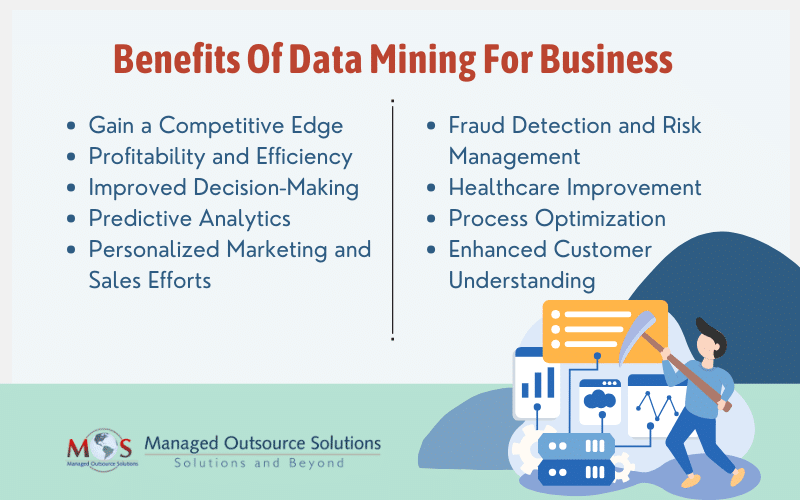
Benefits of Data Mining for Business Decision Making
- Gain a Competitive Edge
Businesses can access their vast datasets more easily with the aid of effective data mining, which uncovers hidden patterns and insightful information about customer preferences, changing consumer behavior, and emerging market trends. Businesses can stay ahead of competitors, innovate, and modify their strategies to suit changing market demands thanks to this competitive advantage, which eventually leads to business success. - Profitability and Efficiency
Data mining guarantees that an organization is gathering and examining trustworthy data. It is frequently a more rigorous, structured procedure that formally defines an issue, collects relevant data, and works to develop a solution. As a result, data mining enhances a company’s operational strength, efficiency, and profitability. - Improved Decision-making
Businesses can learn a great deal about consumer behavior, market trends, product performance, and operational efficiency by examining vast amounts of historical and current data. Based on the knowledge gained from the data, they can make wise decisions that will produce better results. Data-driven decision making produce better results, whether it is used to optimize marketing campaigns, improve customer experiences, or refine product offerings. - Predictive Analytics
Predictive analytics, which helps businesses foresee future trends and outcomes, is made possible by data mining. Among other things, demand forecasting, inventory control, and risk assessment can all benefit from this. To improve its operations and customer experience, for instance, the massive e-commerce and technology company Amazon relies heavily on data mining and predictive analytics in business. Amazon is able to provide product recommendations by looking at the browsing and purchase history of users. They can also anticipate product demand and optimize inventory levels thanks to data mining, which lowers storage costs and guarantees that goods will be available when customers need them. - Personalized Marketing and Sales Efforts
Businesses can identify and target specific customer segments with individualized marketing and sales efforts. They can develop focused marketing campaigns, suggest pertinent goods or services, and enhance their pricing and promotional tactics by evaluating consumer data. Increased sales, better business performance, and higher conversion rates are the results of this focused approach to marketing and sales. - Fraud Detection and Risk Management
Data mining plays a vital role in fraud detection and aids in risk assessment and mitigation across a range of industries, including finance and insurance. Businesses can quickly identify potential risks and suspicious activity by analyzing transaction data to find anomalies. After that, they can take action to lessen these problems and reduce monetary losses. Successful risk management and fraud detection help to preserve a safe working environment, safeguard assets, and guarantee company success. - Healthcare Improvement
Patient data mining and review can help forecast the chance of a disease developing or progressing. For instance, risk factors and early symptoms of diseases like diabetes, cancer, or heart disease may be found by examining data from patient histories and electronic health records (EHRs). Healthcare practitioners can intervene at an early stage and provide more effective treatment and better patient outcomes by identifying these patterns. Additionally, by examining clinical histories and genetic data, a customized treatment plan can be made for each patient, increasing the likelihood of positive results. - Process Optimization
Business process bottlenecks and inefficiencies can be identified through data mining. Businesses can lower expenses, increase productivity, and improve customer satisfaction by streamlining these processes. For instance, a retail business should gather information about all aspects of its supply chain operations, such as order fulfillment, delivery, inventory management, and procurement, in order to increase the efficiency of its supply chain. Through data mining, they can pinpoint inefficiencies and bottlenecks and implement targeted measures to optimize their supply chain procedures. - Innovative Product Development
Data mining can help with the development of creative goods and services. In order to develop innovative and profitable products and services, businesses need to be able to recognize opportunities, comprehend client needs, optimize processes, and reduce risks. Businesses can develop creative solutions that satisfy consumer needs and market demands by examining customer feedback and market trends. - Enhanced Customer Understanding
Through the analysis of consumer behavior, preferences, and demographics, data mining enables businesses to comprehend their clientele more thoroughly. With the help of this knowledge, companies can better customize their marketing campaigns, offerings, and products to the needs of their target market, boosting client happiness and loyalty.
Real-world Applications of Data Mining in Business
Telecommunications
The telecommunications industry has experienced rapid growth, especially with the rise of the Internet. Companies are increasingly adopting data mining services to improve service quality and gain a competitive advantage.
Analyzing patterns in spatiotemporal databases is essential for sectors like mobile telecommunications, mobile computing, and web services. For instance, techniques like outlier analysis can help identify fraudulent users. Tools such as OLAP (Online Analytical Processing) and data visualization enable comparisons across various metrics, including user group behavior, revenue, data traffic, and system performance. This allows telecom companies to make data-driven decisions that optimize operations and enhance customer experiences.
Retail
Retailers generate massive volumes of data from sales, purchasing history, deliveries, consumption patterns, and customer service interactions. The rise of e-commerce has expanded these datasets even further. By leveraging data warehouses and multidimensional analysis, modern retailers can extract actionable insights from this wealth of information.
These insights allow retailers to analyze customer behavior across different segments, products, regions, and time periods. Business data mining techniques help track buying patterns, improve customer satisfaction, personalize product recommendations, and evaluate the effectiveness of marketing campaigns.
Financial Analysis
The banking and finance sectors rely heavily on accurate and reliable data. Financial and customer data can be leveraged to predict loan repayments, assess creditworthiness, and optimize financial decision-making. Data mining simplifies these processes and enhances their accuracy.
Classification techniques identify the key factors influencing customer banking behavior, while multidimensional clustering helps group customers with similar loan repayment patterns. Additionally, data mining can detect financial crimes such as money laundering, enabling banks to maintain compliance and secure operations.
Intrusion Detection
As global connectivity increases, network administrators face growing security challenges, with potential threats jeopardizing the confidentiality and integrity of network resources.
Intrusion detection has become a critical application of data mining. Techniques like association and correlation analysis, aggregation, visualization, and querying tools help identify abnormal activities or deviations from standard behavior. This proactive approach ensures that organizations can safeguard their networks against cyber threats and maintain system reliability.
Leveraging insights from large datasets has become essential for staying competitive. From improving operational efficiency and enhancing customer experiences to detecting fraud and predicting future trends, data mining services empower organizations to make informed, strategic decisions. By adopting these services, businesses across industries can unlock hidden patterns, optimize processes, and drive sustainable growth, ensuring they remain agile and responsive in an increasingly complex market.